
What Boards Should Be Asking For in the AI Era: Mentorship and Sponsorship

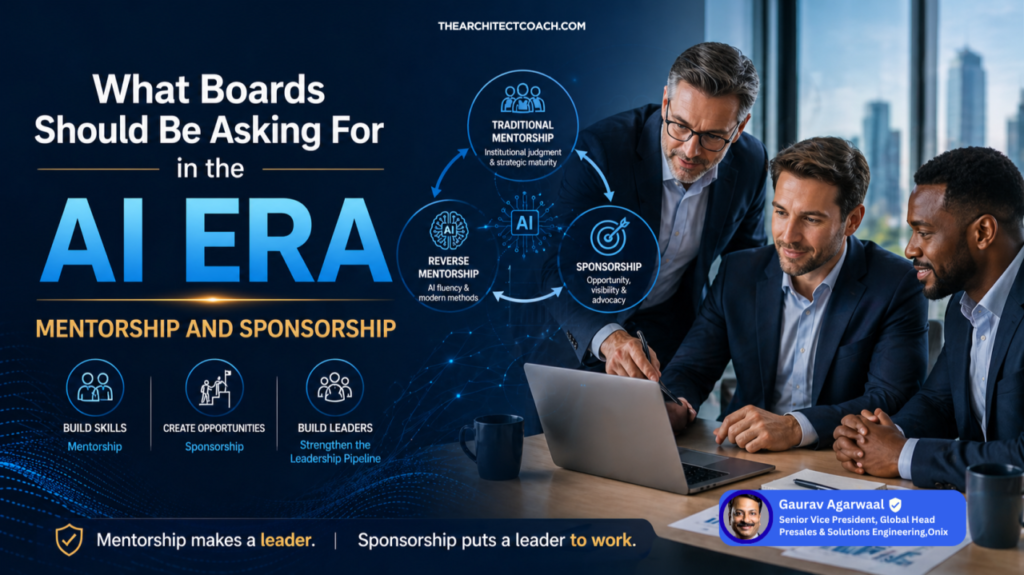
 AI is shortening the “experience advantage” faster than most businesses want to admit. New models, workflows, and speed expectations can now disrupt what used to be a decade-long process of gaining expertise. That doesn’t mean that experienced leaders are no longer needed. It makes leadership systems that don’t change useless.
Mentorship needs to change in this setting, not because “the next generation is different,” but because the way things work is different. And just being a mentor isn’t enough anymore. Companies that want to keep their leadership strong through 2025–2028 will see mentorship (building skills) and sponsorship (creating opportunities) as two parts of the same leadership contract.
Boards don’t need another program for people. They need a way to make leaders.
Why This Time Is Different
Three changes have come together in the last 24 to 36 months:
1) Skills now fade away faster than the memory of an organization can bring them back.
The time that functional expertise lasts is getting shorter. “Tenure” still matters, but it doesn’t mean anything anymore. In many jobs, newer employees can use AI-powered methods that work better than old ones. They also often don’t have the judgment or organizational context to use those methods safely and strategically.
2) Career anxiety is now the same on both sides.
People who are just starting out in their careers are afraid of being seen as inexperienced and missing out on important work. Leaders with a lot of experience, especially those in the middle to senior levels, are afraid that AI-native teams will outpace them and make them passengers in their own domains. This makes the whole company more defensive: people are less open, take fewer risks, and trust each other less across generations.
3) Hybrid work cut down on the “unplanned development moments.”
Being close to someone in person used to do a lot of work that wasn’t obvious, like coaching, giving feedback in the hallways, and advocating for them. Development becomes more transactional in distributed settings unless it is planned with purpose. When relationships are based on calendars, mentorship happens less often, and sponsorship happens even less often.
Companies should be working to improve leadership paths right now. A lot of people do the opposite: they run mentorship as a way to make people feel good and leave sponsorship to informal networks.
That gap is now a risk to the strategy.
What Boards Should Make Sure Leaders Know About Mentorship and Sponsorship
Most companies mix the two up. In practice, they are very different systems:
Mentorship is a skill.
It helps you make better decisions, be more resilient, and deal with uncertainty. Mentorship helps someone get ready.
Sponsorship means moving around.
It opens up opportunities for important work, important discussions, and visible roles. Sponsorship helps someone look ready, and then it gives them a chance to show it.
Mentorship without sponsorship creates competent individuals who remain stagnant.
Sponsorship without mentorship leads to quick promotions and weak performance.
You need both in the age of AI because roles are changing quickly and time-to-readiness is becoming a competitive factor.
The New Model: Loops of Mentorship and Sponsorship (Not Ladders)
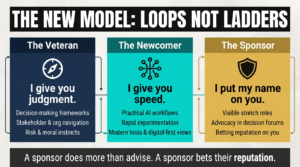
Traditional mentoring assumed that knowledge was stable and only went one way, from senior to junior. That assumption is no longer true because of AI. The best way to help leaders grow now looks like a loop with three moves:
1) Traditional Mentorship: institutional judgment and strategic maturity
This is where experienced leaders become force multipliers. They give:
- decision-making frameworks in situations where you don’t know what’s going to happen;
- managing stakeholders and navigating an organization;
- risk judgment and moral instincts;
- long-term thinking and discipline in making trade-offs;
In a world full of AI, these skills are even more important because automation makes decisions faster and makes mistakes more expensive.
2) Reverse Mentorship: Knowing how to use AI and modern methods
Younger workers can really help:
- practical AI workflows and prompt/agent patterns,
- discipline in experimentation and quick iteration,
- knowledge of modern tools and data, and
- new customer expectations shaped by experiences that put digital first
Reverse mentoring is not just for show. It’s the thing that keeps the layers of leadership from becoming the company’s bottleneck.
3) Sponsorship: A chance to be responsible
Sponsorship is the most rare and important part. It isn’t “support.” It is advocacy that comes with personal credibility:
- putting someone up for a visible initiative;
- giving them a stretch role with real results;
- giving them a chance to be seen in decision-making forums;
- defending a candidate when the results are unclear;
- supporting them in talent reviews and succession debates
A sponsor does more than give advice. A sponsor puts their reputation on the line.
Mentorship makes a leader, but sponsorship puts a leader to work.
What Businesses Often Get Wrong (And Why It Doesn’t Work)
Anti-pattern 1: Using mentorship as motivation
This looks good for internal communications: fireside chats, “mentor of the month,” and coffee talks that people can choose to have. It makes stories, but it doesn’t often change capability or succession depth. Mentorship becomes episodic motivation instead of leader development without structure and outcomes.
Anti-pattern 2: Reverse mentoring as a show
A junior teaches a senior “AI basics,” and everyone feels like they’re making progress, but nothing changes in how decisions are made. Reverse mentoring only works when it is linked to how work is done, such as planning, delivery, customer engagement, risk reviews, and governance.
Anti-pattern 3: Using sponsorship as a personal benefit
When sponsorship takes place behind closed doors, it becomes biased and based on proximity, even if it is not meant to be. This makes people less likely to trust each other, more likely to leave, and creates “hidden hierarchies.” Sponsorship needs to be structured enough to be fair, but not so much that it becomes bureaucratic.
What Leaders Should Do to Make Mentorship and Sponsorship Work (Board-Ready Actions)
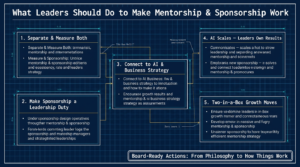
This is where the talk goes from philosophy to how things work.
1) Treat sponsorship and mentorship as two different things, and then measure both.
You won’t get better at either if you don’t separate them.
- Mentorship measures include capability milestones, decision maturity, delivery confidence, and stakeholder breadth.
- Sponsorship measures include stretch assignments, forum visibility, cross-functional moves, and how quickly identified talent can get promoted.
The organization should be able to say who is being developed and who is being promoted.
2) Make sponsorship a duty of leadership, not a favor.
Sponsors should be clearly responsible. What does it mean?
- what “advocacy” means in your business;
- the minimum number of sponsorship actions that must happen each quarter;
- and the places where sponsorship must be present (talent reviews, succession planning, transformation programs).
When personality decides who gets sponsorship, it isn’t fair. When it becomes a duty of leadership, it can grow.
3) Connect both to the AI operating model and the plan for making money
Development needs to follow where AI is changing value:
- product and digital growth,
- customer service and operations,
- risk, compliance, and trust,
- finance and forecasting,
- engineering and delivery speed,
- sales productivity and solutioning
If mentorship and sponsorship are not part of the business strategy, they are just HR theater. If they are tied to where value is changing, they give you an edge over your competitors.
4) Use AI to make things bigger, but hold people responsible for the results.
AI can help with:
- putting mentors and mentees together
- nudging cadence and structure,
- personalized learning pathways, and
- tracking progress signals
But AI can’t take the place of:
- making decisions when things aren’t clear;
- emotional context and trust;
- moral trade-offs;
- sponsorship as a way to build a reputation;
Put another way, AI can make the workflow more efficient, but leaders are responsible for the results.
5) Make “two-in-a-box” growth moves that are connected to real work
When a high-potential leader is paired with a sponsor on an important project, the most progress is made:
- common goals
- clear results,
- visible delivery, and
- planned debriefs
This is how you show that you’re ready: in the field, under pressure, not in training rooms.
The Big but Possible Change: “Proof-of-Work Careers”
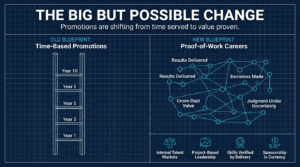
Over the next three to five years, there may be a small but important change: promotions may be based less on how long someone has been in their role and more on “proof-of-work”—the results they deliver, the decisions they make, and the value they create across departments.
Things to look for early on:
- internal talent markets that look like portfolios
- leadership roles based on projects
- Skills verification linked to actual delivery and
- a greater focus on showing good judgment when things are uncertain.
This will make sponsorship even more important, since getting high-value jobs will be the most important thing for careers.
One thing that could slow progress is fear in the middle and defensive leadership.
Technology isn’t the biggest problem. It’s psychology, especially in the middle and upper-middle layers.
When leaders are afraid of being replaced, they keep decisions to themselves and don’t let others make them. They don’t want to do reverse mentoring when they feel threatened by AI-native talent. They don’t advocate for sponsorship because they think it “creates competition.” This defensive stance slows down change and makes succession depth weaker.
The answer is clear: younger talent or AI are not taking over for leaders. Leaders who refuse to change are taking their place.
Final Thoughts: What Boards Should Tell Management to Do Right Now
The business needs to stop treating mentorship as optional and sponsorship as an accident if it wants to be strong and grow during the AI transition.
In the next year, leadership teams should agree on three things that can’t be changed:
- Rebuild mentorship so that it teaches people how to make decisions instead of just sharing their experiences.
- Make sponsorship a part of the system so that opportunities are created on purpose and fairly.
- Make loops between generations so that AI fluency goes up and strategic maturity goes down quickly.
This isn’t a project for culture. It’s a way for leaders to keep track of their supply.
Enterprise CTA:
You don’t have a leadership pipeline if you can’t name your next generation of leaders and the sponsors who are actively putting them in important roles. There is hope for you.
Leave a Reply