
Why BigQuery Is Showing The Next Operating Model: The Data Warehouse Is Becoming An Enterprise Reasoning Platform

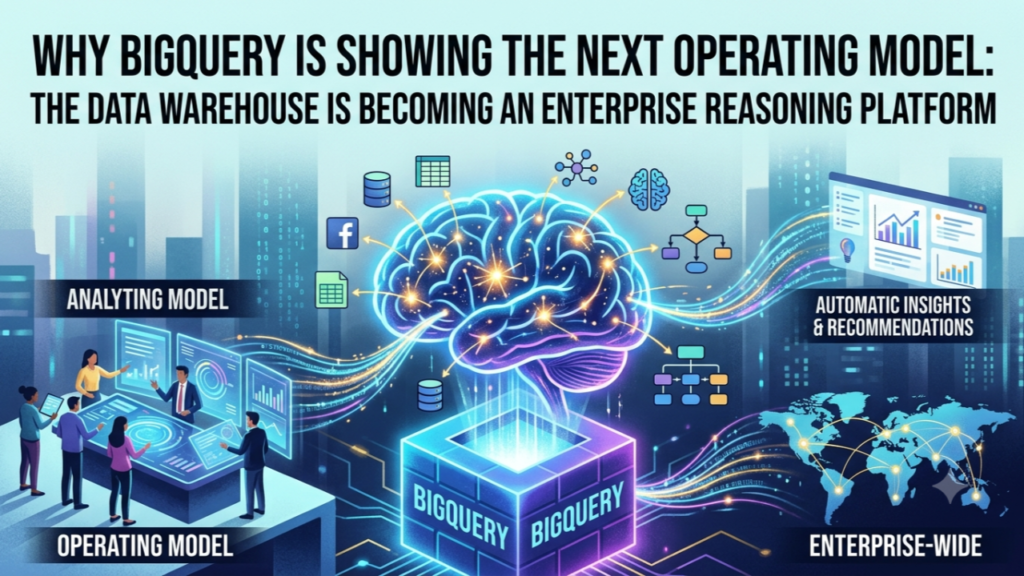
For almost three decades, enterprise data platforms have been optimized for one thing: storing information and answering analytical questions. Data warehouses became the foundation for business intelligence, reporting, dashboards, and self-service analytics. It was a measure of how quickly they could find trusted data and feed it to human decision-makers.
That’s the business model that’s beginning to develop.
Google’s latest iteration of BigQuery suggests that the future data platform is no longer just about answering queries. It is being re-engineered to understand business intent, retrieve organizational context, orchestrate analytical workflows and more and more participate in enterprise decision making.
The significance goes well beyond one product announcement.
This suggests the emergence of a new enterprise architecture where data platforms move from Systems of Analysis to Systems of Reasoning.
The board question is no longer whether AI is able to query enterprise data.
It is as if enterprise data platforms are emerging as the reasoning infrastructure for autonomous business operations.
1) Change the conversation – The warehouse is not the destination anymore
Old-school warehouses answered questions.
Reasoning is done by future platforms.
That’s a game changer.
Modern data platforms are increasingly focused on translating business intent into governed reasoning workflows (as opposed to translating business questions into SQL). Business context, semantic definitions, enterprise policies, proven analytical patterns and orchestration are first class architectural components, not documentation.
Boards must therefore cease to measure data platform maturity by storage, performance or dashboard adoption.
A practical readiness baseline would consist of:
- Percentage of enterprise metrics under control of semantic definitions
- Share of AI questions employing validated analytical patterns
- Percentage of recommendations supported by certified business context
- % of enterprise data products that are available for agentic workflows
- Average decision cycle time using AI reasoning
Board position: The data platforms are becoming reasoning infrastructure not reporting infrastructure.
2) Distinguish Data from Context and Reasoning
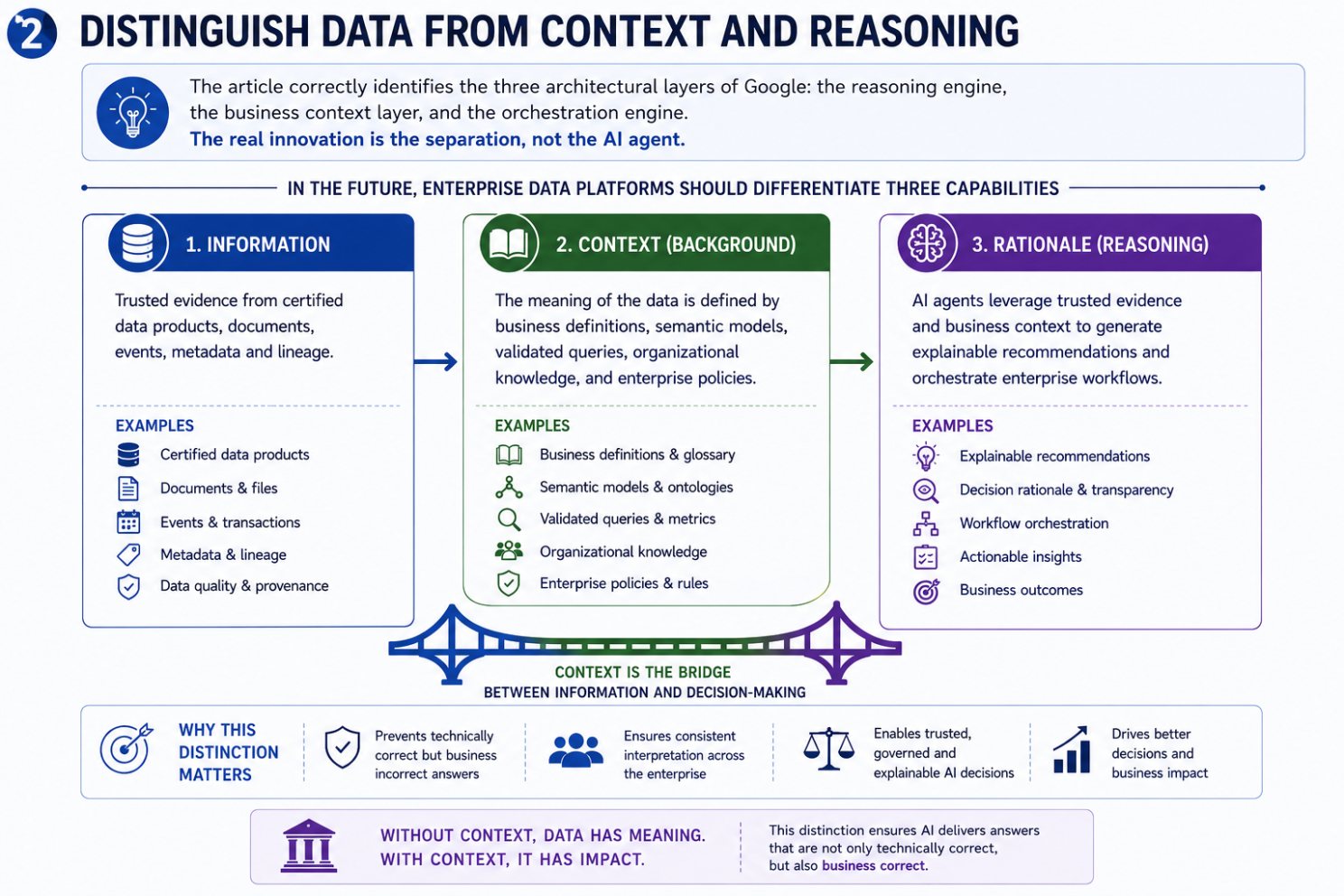
The article correctly identifies the three architectural layers of Google: the reasoning engine, the business context layer, and the orchestration engine. The real innovation is the separation, not the AI agent.
In the future, enterprise data platforms should be able to differentiate three capabilities.
Information
Trusted evidence from certified data products, documents, events, metadata and lineage.
Background
The meaning of the data is defined by business definitions, semantic models, validated queries, organizational knowledge, and enterprise policies.
Rationale
AI agents leverage trusted evidence and business context to generate explainable recommendations and orchestrate enterprise workflows.
This distinction makes sure that AI will not provide answers that are technically correct but business incorrect.
Context is the bridge between information and decision-making.
3) List the ways the enterprise can fail
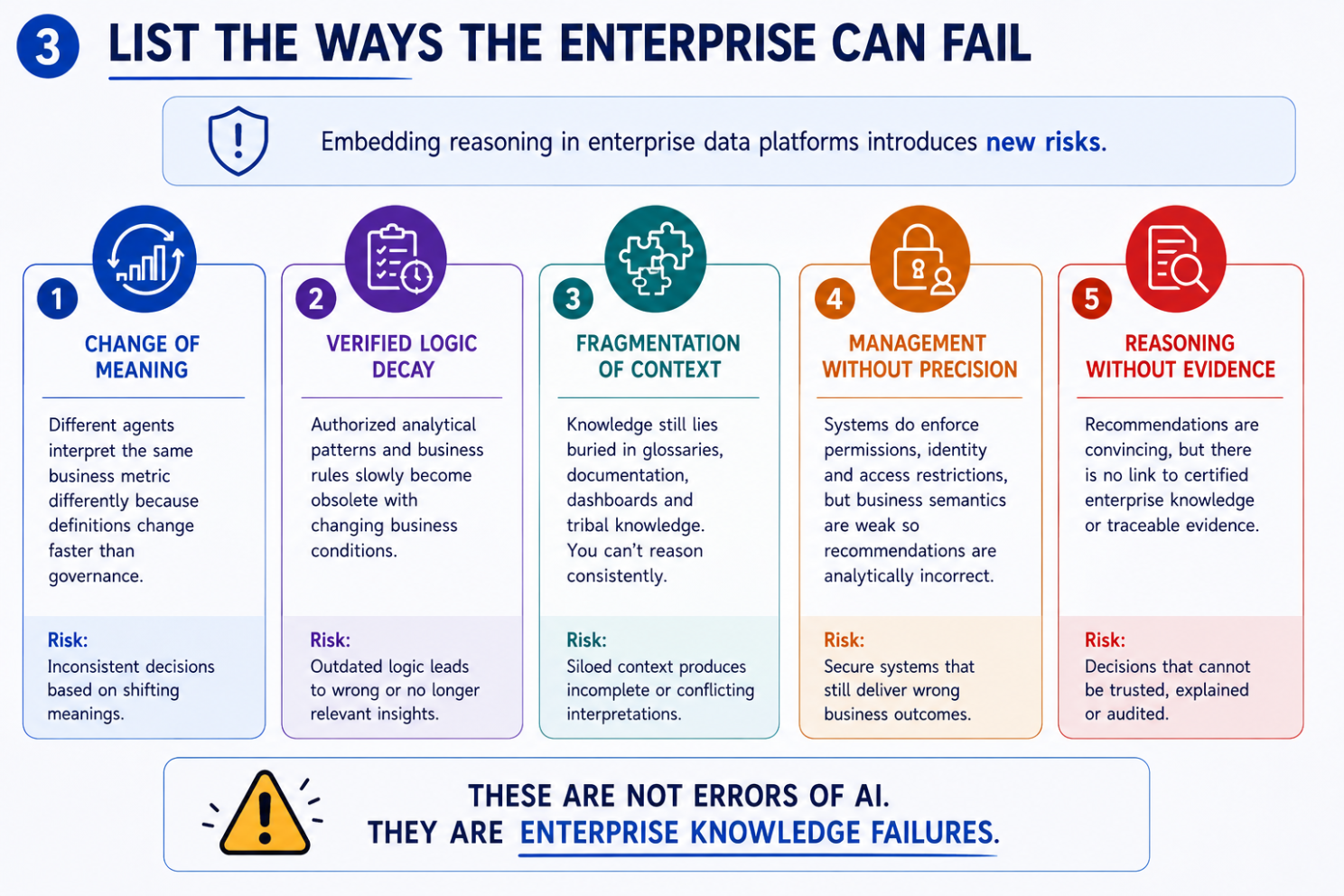
Embedding reasoning in enterprise data platforms introduces new risks.
Change of Meaning
Different agents interpret the same business metric differently because definitions change faster than governance.
Verified Logic Decay
And authorized analytical patterns slowly become obsolete with the changing business rules.
Fragmentation of Context
Knowledge still lies buried in glossaries, documentation, dashboards and tribal knowledge. You can’t reason consistently.
Management Without Precision
Systems do enforce permissions, identity and access restrictions, but business semantics are weak so recommendations are analytically incorrect.
Reasoning Without Evidence
The recommendations are convincing, but there is no link to certified enterprise knowledge.
These are not errors of AI .
They are enterprise knowledge failures.”
4) Constructing an Enterprise Reasoning Platform
The article is implicitly describing components of a future reasoning platform.
Any modern data platform will need a minimum of (from an enterprise architecture perspective):
Data Products Certification
Operational success evidence.
Enterprise Semantic Layer
Shared meaning of business across domains
Context Layer
Business rules, glossaries, validated analytical patterns, lineage and organizational memory
Engine Logic
AI that understands intent, selects evidence and manages analytic workflows.
Layer of Orchestration
Running analytical and operational processes within governance.
Evaluation Layer
Continuous measurement of reasoning quality, recommendation accuracy and business outcomes.
Board translation: Competitive advantage goes from owning more data to governing better reasoning.
5) Evaluate reasoning quality, not query performance
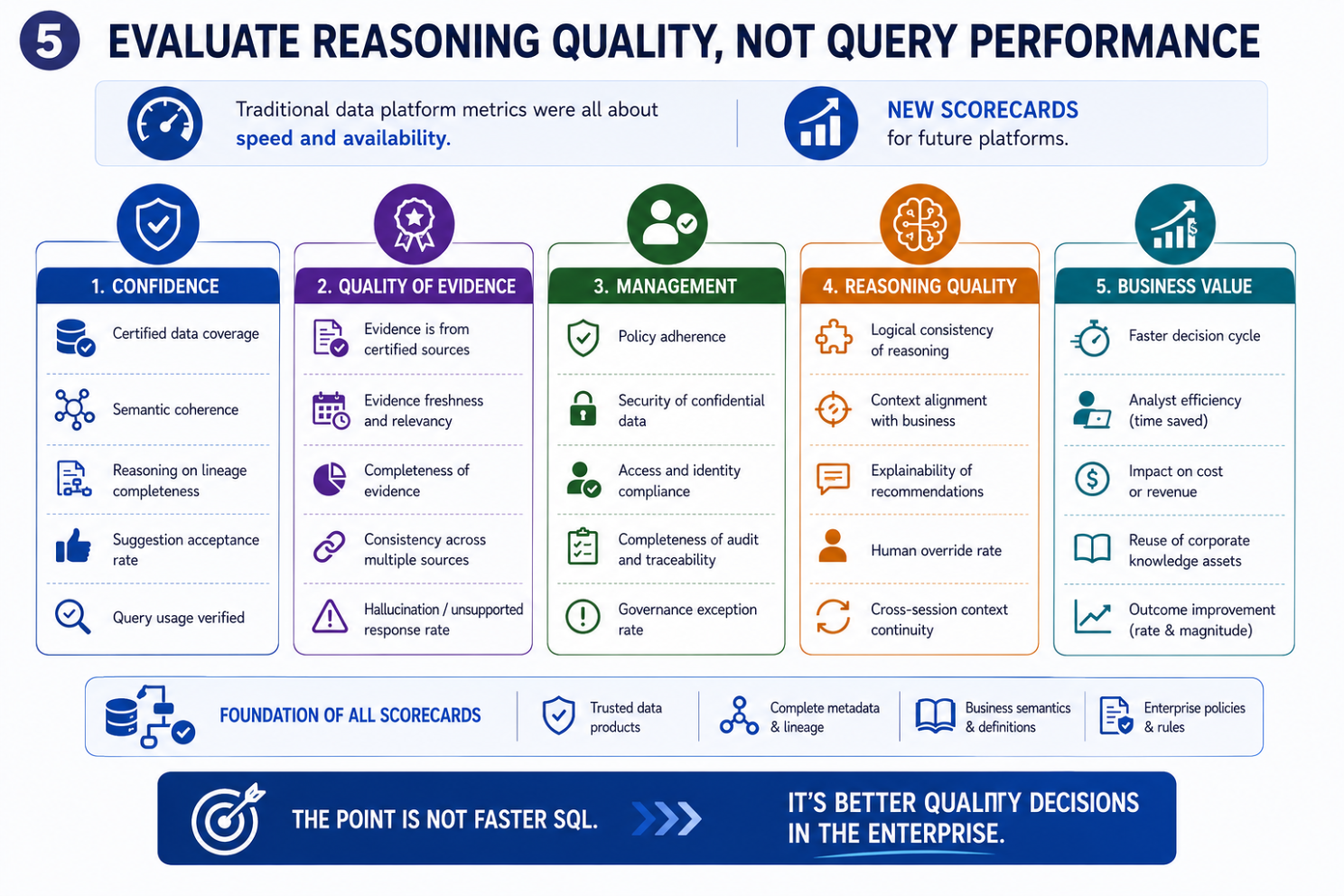
Traditional data platform metrics were all about speed and availability.
New scorecards for future platforms.
Confidence
- Certified data coverage
- Semantic Coherence
- Reasoning on lineage completeness
- Suggestion acceptance rate
- Query usage verified
- Quality of evidence
- How often do humans trump
Management
- Policy adherence
- Security of confidential data
- Completeness of audit
Business Value
- Faster decision cycle
- Analyst efficiency
- Effect on cost or revenue
- Reusing corporate knowledge assets.
The point is not faster SQL.
It’s better quality decisions in the enterprise.
6) Enterprise SLOs on Reasoning Platforms
Commitments should be made at the reasoning level by organizations.
Examples are:
- All recommendations are based on proven enterprise knowledge.
- All business metrics are defined with approved semantics.
- All analytics workflows are fully auditable.
- AI-backed insights are always supported by explainable evidence.
- Every validated analytical pattern is periodically revalidated.
These provide AI with trusted reasoning over inconsistent analysis at scale.
7) The operating model is universal. The technology isn’t.
Google’s implementation is one example of a more general architectural pattern.
Future enterprise platforms will converge on, regardless of vendor:
universal abilities
- Semantic business models
- Context-aware Search
- Proven analysis patterns
- Governance AI orchestration
- Evaluation under way
Accelerators of platforms
- Data Agents for BigQuery
- Databricks AI/Unity Catalog
- Snowflake Cortex
- SAP Joule
- Oracle AI Data Platform
- Microsoft Fabric Copilot
Board implication: Standardize the reasoning architecture before choosing platform features.
8) The operating model alters the role of enterprise data teams
The warehouse is not the end game for enterprise data.
It becomes the foundation of enterprise reasoning.
The data teams increasingly focus on:
- certifying analytical patterns
- curating business semantics
- managing organizational knowledge
- evaluating ai reasoning in enterprise context
- improving decision quality
Their role changes from producing reports to enabling trusted business reasoning at scale.
Conclusion
Each generation of enterprise technology redefines the purpose of data.
Enterprise data was stored in data warehouses.
Business intelligence gave us visibility.
Cloud made infrastructure democratic.
Agentic AI is turning the data platform into an enterprise reasoning system.
The BigQuery announcement from Google, therefore, is less of a product launch and more of an architectural signal.
The organizations that will develop sustainable advantage are not going to just deploy AI agents against their warehouses. They’ll re-architect their data platforms to make enterprise knowledge, business context, governance and reasoning one single governed operating capability.
Question Wall
As AI becomes a more core part of enterprise decisions, are we still investing in platforms that are about querying data, or are we creating enterprise reasoning platforms that can generate explainable, governed, and continuously improving business decisions?
Leave a Reply