
9 AI Agent Architecture Patterns Every Developer Should Understand

Building an AI agent has become surprisingly easy. With modern language models, tool calling, retrieval systems, and agent frameworks, a developer can create something impressive in a relatively short time. The harder question begins after the prototype works: how should the agent actually be structured?
A chatbot that answers simple questions does not need the same architecture as a coding agent that edits files, tests its own output, and changes its approach when something fails. Similarly, a research system coordinating several specialist agents has very different requirements from a predictable document-processing pipeline.

This is why agent architecture matters. There is no single “best” design. Different patterns solve different problems, and using a more complicated architecture does not automatically make a system more intelligent. In many cases, it only makes the system slower, more expensive, and harder to debug.
The nine patterns below offer a practical way to think about how modern AI systems can be organized.
First, Understand the Difference Between a Workflow and an Agent
Before choosing an architecture, it helps to separate two ideas that are often mixed together: workflows and agents.
A workflow follows a path that has already been defined. Imagine a document-processing system where a file is uploaded, its text is extracted, the content is summarized, the summary is classified, and a final report is generated. AI may be involved at several stages, but the sequence itself is fixed. The application already knows what should happen next.
An agent has more freedom. It can decide its next action based on what it has observed so far. A research assistant, for example, may search for information, inspect the results, decide that the evidence is incomplete, modify its search query, retrieve another source, and only then prepare an answer. The developer defines the goal and boundaries, but not necessarily every step.
Neither approach is inherently better. Workflows are easier to predict, test, and control. Agents become valuable when the correct sequence of actions genuinely cannot be known beforehand. The important decision is therefore not “How can I make this more agentic?” but rather “How much autonomy does this problem actually require?”
1. ReAct: Reason, Act, Observe, Repeat
ReAct is one of the most useful starting points for building an agent. Instead of expecting the model to produce a final answer immediately, the system allows it to reason about the task, perform an action, observe what happened, and then decide what to do next.
Consider an AI assistant asked to find a recent research paper and explain its contribution. It may first decide to search for relevant work, inspect the results, open a promising source, review the information, and then prepare its response. If the first search is poor, it can change its approach rather than blindly continuing.

This back-and-forth between reasoning and action makes ReAct particularly useful for search assistants, research tools, troubleshooting systems, and agents that interact with APIs or external tools. Its strength is simplicity: one agent can already accomplish a great deal.
The weakness appears when the loop becomes too long. Too many reasoning steps and tool calls can increase cost, latency, and the chance of the agent drifting from the original objective. For many single-agent applications, however, ReAct remains the simplest sensible starting point.
2. Reflexion: Let the Agent Learn From Its Own Attempts
ReAct allows an agent to respond to new observations, but that does not necessarily stop it from repeating the same mistake. Reflexion adds a self-review stage.
Instead of simply trying again after a failure, the agent first asks what went wrong. A coding agent might generate a program, run it, encounter an error, and then examine why the solution failed. That critique is carried into the next attempt, making the new response more informed than a simple retry.
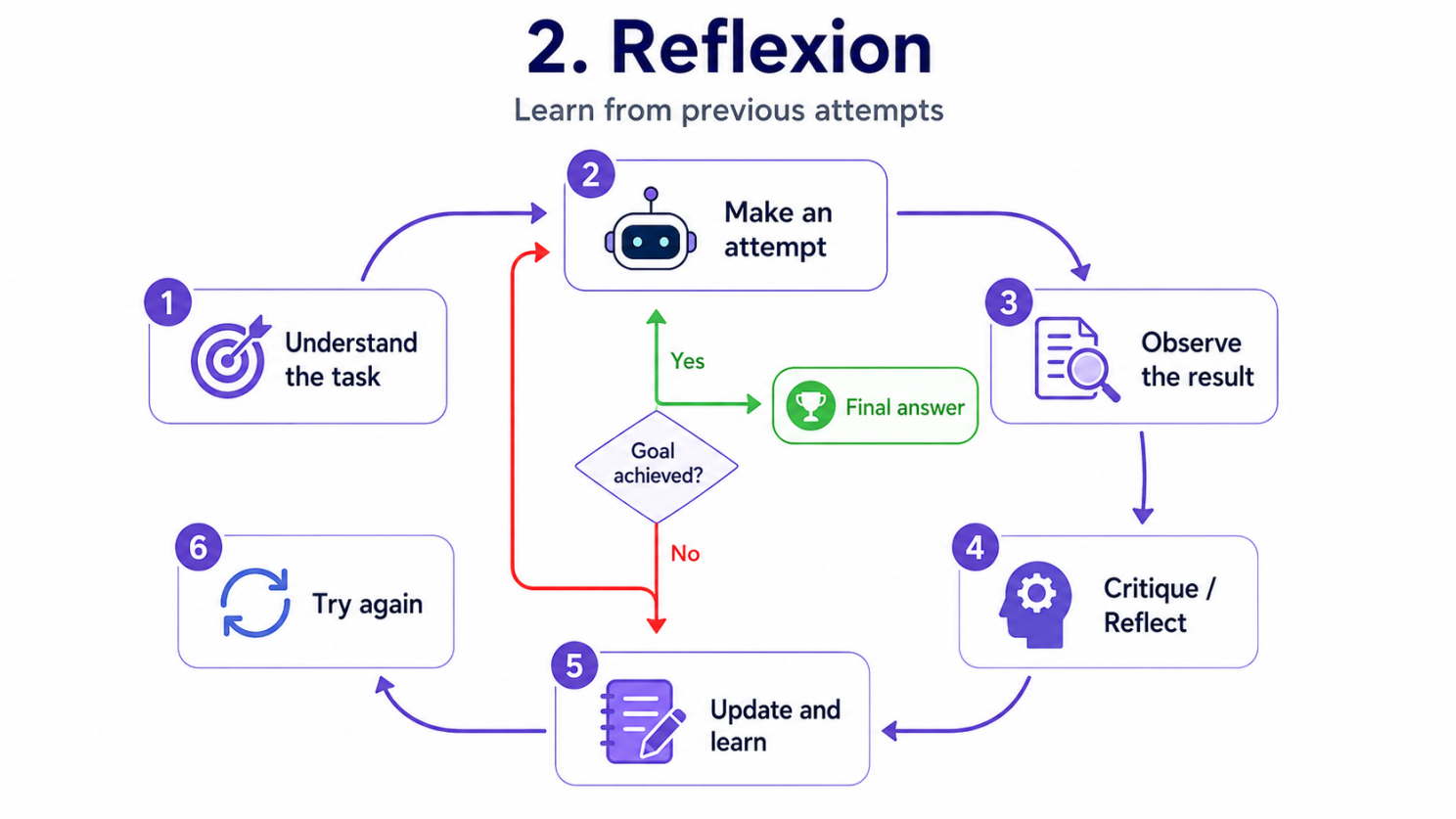
This approach is useful for coding, mathematical reasoning, planning, and other tasks where repeated attempts are normal. It resembles the way people improve by reviewing previous mistakes rather than restarting from scratch every time.
The trade-off is additional computation. Reflection usually means another model call, which increases both cost and response time. It is most valuable when the cost of repeating the same mistake is greater than the cost of evaluating it.
3. Prompt Chaining: Break a Large Task Into Predictable Steps
Not every sophisticated AI system needs autonomous decision-making. Sometimes the better approach is to divide a large problem into a series of smaller, clearly defined stages.
A content-generation system, for example, might first create an outline, then review the structure, write the draft, verify important claims, and finally edit the language. Each stage receives the result of the previous one and performs a specific job.

Prompt chaining is powerful because it gives developers control. When something goes wrong, it is easier to identify which stage caused the problem. Checkpoints can also be placed between steps so that weak information is caught before it travels further through the workflow.
This pattern works best when the sequence is predictable. If the system already knows the steps required to complete a task, prompt chaining is often more reliable than giving an agent unnecessary freedom.
4. Routing: Send Every Request Down the Right Path
Many AI applications handle several very different types of requests. Instead of forcing one model or prompt to solve everything, a router can first identify what kind of request has arrived and send it to the most appropriate destination.
An enterprise assistant might route HR questions to an HR workflow, technical issues to a support agent, financial queries to a specialized model, and general questions to a lightweight assistant. The routing decision can also be based on difficulty: simple requests may go to a faster, cheaper model while complex ones are escalated to a more capable model.

Routing works best when incoming requests can be separated into reasonably clear categories. If those categories heavily overlap, the routing decision itself can become a source of errors.
5. Parallelization: Do Independent Work at the Same Time
Some tasks do not need to wait for one another. If several parts of a problem are independent, they can be processed simultaneously.
For example, a large report might be divided into sections and each section analyzed at the same time. The resulting summaries can then be combined. Another approach is to send the same problem to several agents independently and compare their answers before selecting or synthesizing the final result.

Parallelization can therefore improve both speed and confidence. It is useful in document analysis, research, content evaluation, ensemble-style reasoning, and any situation where work can safely be divided.
The difficult part comes later: combining the outputs. Different agents may disagree, overlap, or produce conclusions at different levels of quality. A good parallel system therefore needs a clear aggregation or evaluation step.
6. Orchestrator–Workers: Let One Agent Coordinate the Others
Prompt chains work when the required steps are known in advance. But some problems cannot be decomposed until the system actually sees them.
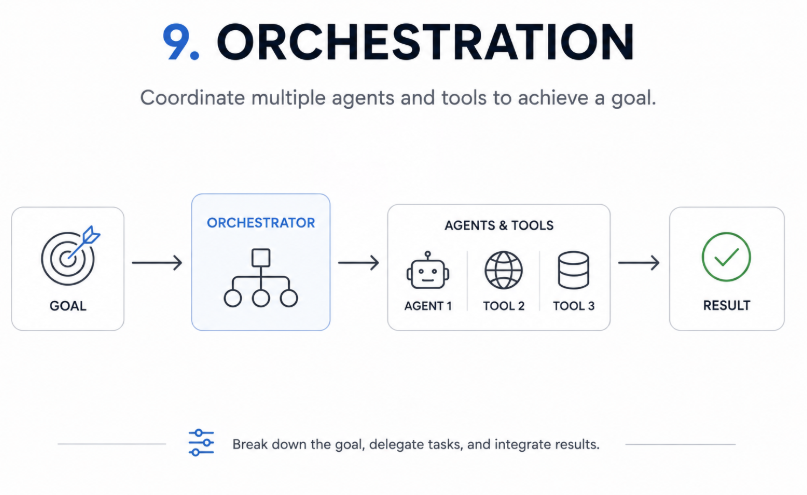
In an orchestrator–worker architecture, one agent acts like a project manager. It studies the task, decides what smaller jobs need to be completed, assigns them to specialist workers, and then combines their results.

Imagine asking an AI system to produce a strategic analysis of a company. Depending on the request, the orchestrator may create separate tasks for competitor research, market trends, financial analysis, technology assessment, and report writing. Another request might require a completely different set of workers.
This flexibility makes the pattern valuable for coding agents, deep research, complex business analysis, and other open-ended tasks. The downside is coordination overhead. The orchestrator must create sensible subtasks, workers need clear instructions, and their results must eventually be merged into one coherent response.
7. Evaluator–Optimizer: Generate, Review, Improve
Sometimes the first answer is not the final answer. If quality matters, the system can separate generation from evaluation.
One component produces a draft, while another checks it against specific criteria. If the result does not meet the required standard, the evaluator provides feedback and the generator revises the output. The loop continues until the response passes the evaluation or reaches a stopping limit.

This architecture works especially well when quality can be described clearly. Code review, compliance checking, technical writing, structured document generation, and policy-sensitive tasks are good examples.
The pattern adds extra model calls, but that additional cost may be justified when inaccurate or poorly structured outputs would create larger problems later.
8. Graph Orchestration: Turn Complex Agent Behavior Into a Controlled Network
As AI systems grow, a straight sequence of steps may become too restrictive. A request might need to branch depending on intermediate results, return to an earlier stage, skip unnecessary steps, or repeat part of the process.
Graph orchestration represents this behavior as connected nodes. Each node can represent an agent, tool, decision, or processing stage, while the edges define how the system can move between them.
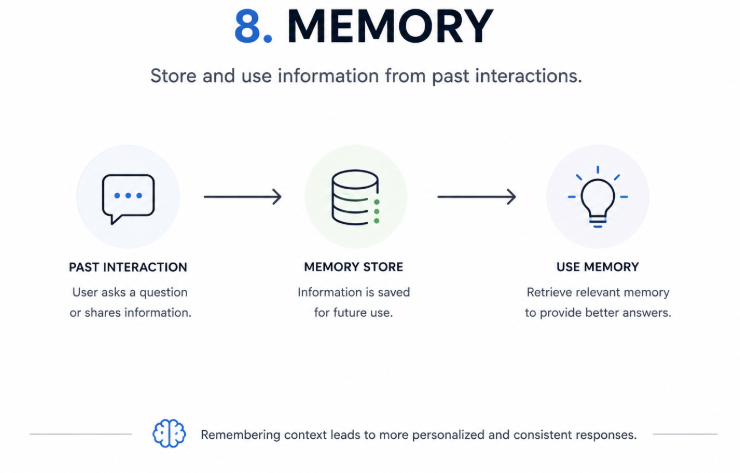
This structure is particularly useful in production systems because developers can inspect which path a request followed. Frameworks such as LangGraph have helped popularize this way of organizing stateful and conditional agent workflows.
Graph-based systems introduce more design work than simple chains, but they provide much better visibility when applications contain branching logic, retries, approvals, or several interacting components.
9. Swarm Architecture: Multiple Agents Without a Permanent Manager
The swarm pattern takes multi-agent collaboration one step further by reducing the role of a central supervisor. Instead of one orchestrator continuously assigning work, several agents operate more like peers.
They may share a common workspace, inspect what others have contributed, add their own findings, challenge conclusions, or pursue new directions. This makes swarm-style systems attractive for brainstorming, exploratory research, and problems where nobody knows the ideal decomposition beforehand.
The freedom is also what makes them risky. Agents can duplicate work, drift away from the original objective, or spend too much time interacting without producing useful progress. Strong stopping rules, shared-state design, and resource limits become essential.
Swarm architectures are therefore powerful for the right exploratory problem, but they are rarely the architecture a team should build first.
Real Systems Usually Combine Several Patterns
These nine architectures are not isolated choices. Production systems often combine two or three of them.
A document-compliance platform might use routing to identify the document type, parallelization to analyze different sections, and an evaluator–optimizer loop to review flagged content. A coding agent might use ReAct for tool interaction and Reflexion after failed tests. A complex research platform might use graph orchestration at the system level while an orchestrator dynamically assigns work to specialist agents.
The strongest architecture is often not one sophisticated pattern. It is a small collection of simple patterns, each solving a specific problem well.
Start Simple and Add Complexity Only When It Solves a Real Problem
One of the easiest mistakes in agent development is starting with too much architecture. A simple requirement quickly becomes a network of planner agents, researchers, critics, supervisors, memory systems, graphs, and several layers of model calls.
Sometimes all of that is necessary. Often it is not.
Every new agent adds communication overhead. Every model call adds latency and cost. Every decision point creates another place where the system can fail.
A better approach is to begin with the simplest version that can reasonably solve the task. If direct prompting is insufficient, add a workflow. If the workflow needs dynamic tool use, introduce an agent. If the agent repeats mistakes, add reflection. If independent work is slowing the system down, introduce parallelization. If the required subtasks cannot be known beforehand, then consider orchestration.
The real skill in agent development is not knowing how to use every architecture. It is recognizing when the architecture you already have has reached its limit—and adding only the pattern that solves that particular limitation.
As AI systems move from impressive demonstrations into real products, that judgment will matter just as much as the choice of model behind the agent.
Leave a Reply