
Rebuilding the Ontology Stack for Boards
A Measurable Program to Ground AI in Meaning, Decisions and Enforcement
Enterprise AI does not usually fail because the model is incapable of producing an impressive answer.
It fails because the organization has not defined what the answer is allowed to mean.
Large language models are designed to generate plausible responses. They are not inherently designed to understand the specific operating definitions, policy boundaries and decision rights of an enterprise.
Consider a simple term: customer.
For the sales team, a customer may be an active account. For finance, it may be a billing entity. For product, it may be an end user. For risk and compliance, it may be a legally verified counterparty.
Each definition may be correct in its own context.
The problem begins when an AI model blends these definitions into one confident answer and applies it to the wrong workflow.
That is why the enterprise-AI conversation needs to move beyond model selection. The strategic question is no longer whether an organization has access to the latest LLM. It is whether the organization has created the meaning-and-decision infrastructure required to use AI reliably.
This is where the ontology stack becomes important.
An ontology stack is not simply a technical architecture. It is an operating model for stabilizing meaning, connecting evidence, recording decisions and enforcing boundaries as AI moves from experimentation into production.
1. Not Every AI Use Case Needs an Ontology
The first mistake organizations make is treating ontology as an enterprise-wide transformation program.
That creates unnecessary complexity.
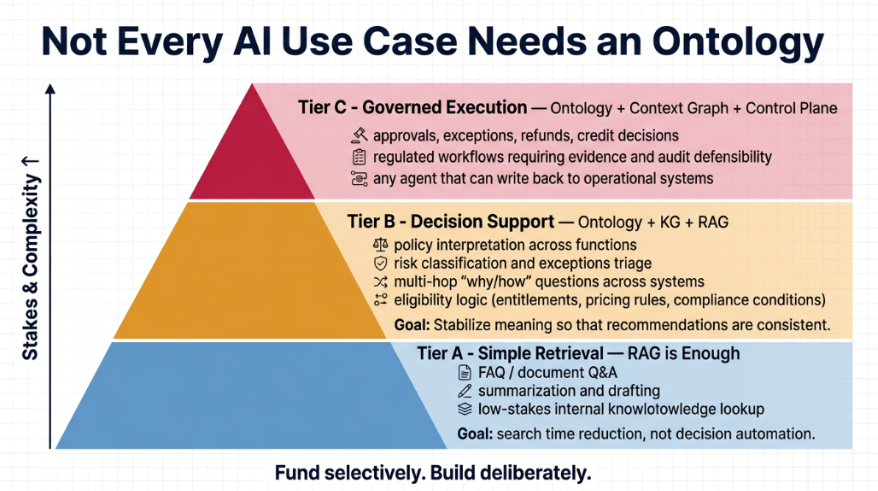
A board should not approve a large semantic architecture merely because the term sounds sophisticated. The right investment depends on the risk of ambiguity and the consequence of a wrong decision.
A practical way to evaluate use cases is to separate them into three tiers.
Tier A: Retrieval and Drafting
These are low-risk applications where the AI primarily helps employees find, summarize or draft information.
Typical examples include:
- internal FAQ assistants
- document search
- meeting summaries
- content drafting
- low-stakes knowledge lookup
For these workflows, a well-designed retrieval-augmented generation system may be enough. The business objective is simple: reduce search time and improve productivity.
The AI is assisting the employee. It is not interpreting critical policy or executing operational decisions.
Tier B: Decision Support in Ambiguous Domains
This is where ontology begins to matter.
Consider a system helping employees interpret eligibility rules, classify risk or assess whether an exception should be escalated. The AI is no longer retrieving a document. It is applying meaning across multiple sources.
Typical examples include:
- policy interpretation across functions
- entitlement and eligibility checks
- exception triage
- pricing-rule interpretation
- risk classification
- multi-hop questions spanning systems
In these workflows, retrieval alone is not always enough. The system needs a governed semantic layer that defines what key business terms mean, how they relate to one another and which constraints apply.
The objective is not necessarily full automation.
It is consistency.
Tier C: Governed Execution
The highest-risk category includes AI systems that can perform actions, write back to operational systems or influence regulated outcomes.
Examples include:
- refunds
- claims processing
- credit decisions
- procurement approvals
- account changes
- compliance-sensitive workflows
- automated exceptions and overrides
At this stage, meaning alone is insufficient.
The organization also needs runtime controls, approval logic, audit trails and clear decision rights.
The board rule is straightforward:
Do not build a semantic empire. Fund the stack where ambiguity, risk and auditability create a measurable business problem.
2. The Ontology Stack: From Meaning to Action
A reliable enterprise-AI system needs multiple layers. Each layer solves a different problem.
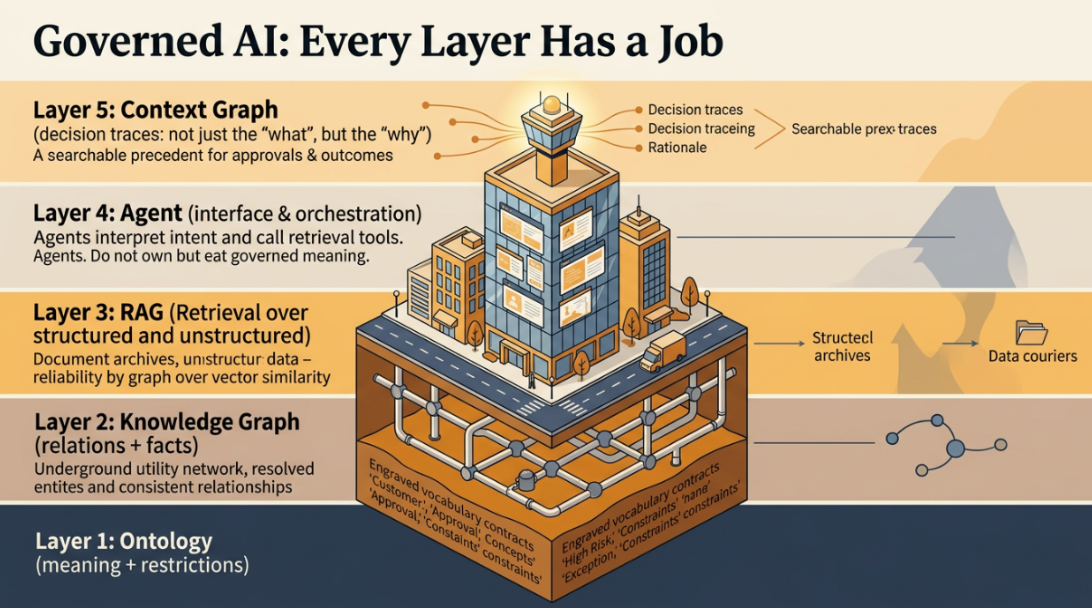
The mistake is to treat the stack as one large platform project. The better approach is to build only the capabilities required for the selected workflow.
Layer 1: Ontology — The Semantic Contract
An ontology defines the enterprise meaning of important concepts.
It answers questions such as:
- What does “customer” mean in this workflow?
- Is an exception different from an override?
- Which terms are synonyms?
- Which relationships are valid?
- Which constraints must always hold?
- Which guidelines allow human judgement?
This is more than a glossary.
A glossary documents words. An ontology connects those words to relationships, rules and operating context.
For the first use case, the ontology should remain small and measurable. A minimum viable version may contain:
- 10–20 core entities
- 20–40 important relationships
- a limited set of constraints
- clear ownership for every critical definition
The purpose is not to model the entire enterprise.
The purpose is to prove that stabilizing meaning improves one important workflow.
Layer 2: Knowledge Graph — The Connected Operating Picture
Once meaning is defined, the system needs to connect it to real enterprise entities.
A knowledge graph represents relationships between objects such as:
- customers
- contracts
- claims
- orders
- suppliers
- policies
- tickets
- approvals
- exceptions
This matters because most business questions do not live inside one document.
A refund decision may depend on an order, a customer segment, a policy version, an earlier complaint and an approval threshold. A standard vector search may retrieve relevant text. A graph can help the system understand how the evidence is connected.
But a knowledge graph is only as reliable as its entity resolution.
If the same customer appears as three separate records across CRM, finance and support systems, the graph may create a sophisticated but incomplete picture.
The board should ask:
Are our enterprise entities resolved consistently enough to trust the relationships we are modelling?
Layer 3: RAG — Evidence Beyond the Model
Retrieval-augmented generation gives the AI access to information beyond its training data.
It allows the model to retrieve policies, records, guidelines and documents before generating an answer.
This is essential, but it should not be overstated.
RAG improves access to evidence. It does not automatically resolve conflicting definitions, decide which business meaning applies or enforce authorization rules.
That is why retrieval design should match the use case.
- Simple document lookup may need standard retrieval.
- Cross-functional policy interpretation may need semantic filtering.
- Multi-hop questions may benefit from graph-based retrieval.
- High-risk workflows require provenance, freshness and source visibility.
For Tier B and Tier C workflows, every material recommendation should answer:
- Which sources were used?
- Which policy version was applied?
- How recent is the information?
- Which assumptions were made?
- Are there unresolved conflicts?
The goal is not merely to generate a good answer.
It is to produce an answer that can be examined.
Layer 4: Agent — The Interface and Orchestrator
The agent is the visible layer.
It receives the request, interprets intent, retrieves information, invokes tools and produces an output.
But the agent should not become the owner of enterprise meaning.
A model is probabilistic. A policy is not.
The model may explain a rule, recommend an action or prepare the evidence. It should not independently redefine what “high risk,” “approved” or “eligible” means.
The board principle is simple:
Agents do not own meaning. They consume governed meaning.
Layer 5: Decision-Context Graph — The Memory of Why
A knowledge graph helps answer:
What is connected to what?
A decision-context graph answers:
Why was this decision made at that moment?
This layer records the rationale surrounding a recommendation or action.
It may capture:
- the entities involved
- the evidence retrieved
- the policy version applied
- the constraints evaluated
- the recommendation generated
- the human approver
- the final action
- the eventual outcome
Over time, this becomes a searchable record of enterprise judgement.
It helps the organization understand recurring exceptions, compare similar cases and identify whether automation is actually improving decision quality.
As AI becomes more autonomous, this decision lineage becomes strategically important.
It is the foundation of an enterprise decision system of record.
3. Grounding Is Not Enforcement
This is the most important distinction for boards.
An ontology defines meaning.
It does not automatically stop an AI system from performing an unsafe or unauthorized action.
A Tier C workflow therefore needs an execution control plane: a mechanism that sits between the AI agent and the operational system.
The model may recommend an action.
A separate control must authorize it.
A minimum enforcement model includes four steps.
Step 1: Resolve Meaning
The incoming request should be mapped to canonical ontology terms and the relevant policy version.
For example, a “refund” may refer to:
- a discretionary customer-service gesture
- a contractual entitlement
- a regulated remediation payment
- an exception requiring senior approval
The system should understand which meaning applies before proposing an action.
Step 2: Classify Decision Rights
Every proposed action should be classified as:
- advisory only
- automatically executable
- approval required
- prohibited
The classification should reflect factors such as financial value, reversibility, regulatory impact and data sensitivity.
Step 3: Route Actions Through a Controlled Gateway
All tool calls and write-back actions should pass through one governed action gateway.
The gateway should verify:
- user and agent permissions
- approval thresholds
- separation-of-duties rules
- permitted parameters
- evidence requirements
- rate limits
- rollback capability
- kill-switch conditions
This prevents the AI system from becoming an uncontrolled execution layer.
Step 4: Generate an Audit Artifact
Every governed action should create a traceable record containing:
- the ontology and policy versions used
- the evidence retrieved
- the constraints applied
- the recommendation
- the approver and timestamp
- the final action
- the outcome
- any later override or correction
This is how enterprise AI moves from grounded answers to governed execution.
4. Governance: Who Owns Meaning?
The hardest problem is not technology.
It is ownership.
Words such as “eligible,” “high risk,” “material,” “approved” and “exception” are not neutral labels. They shape business outcomes.
A change in definition can affect customers, compliance exposure, financial decisions and audit results.
That means ontology cannot be treated as a data-team exercise.
A practical RACI structure looks like this:
Business Teams
Responsible for: core terms, operating definitions and expected outcomes.
Risk and Compliance
Accountable for: approval thresholds, separation of duties, prohibited actions and audit requirements.
Data and Architecture
Responsible for: ontology modelling, knowledge graphs, entity resolution, metadata and provenance.
Platform Engineering
Responsible for: access control, action gateways, monitoring, observability and rollback mechanisms.
Internal Audit
Consulted on: retention policies, traceability, audit-pack design and defensibility.
The central principle is:
A change in meaning is a production change.
Ontology definitions, constraints and decision policies must therefore be versioned, reviewed and tested like other production artifacts.
5. What Should the Board Measure?
The business case should not be framed around the sophistication of the architecture.
It should be framed around measurable improvement.
For Tier B decision-support workflows, boards should track:
- reduction in inconsistent interpretations
- reduction in SME escalations
- faster time-to-decision
- lower rework and correction rates
- percentage of recommendations supported by complete evidence
- override rates
For Tier C governed-execution workflows, boards should track:
- unauthorized actions prevented
- audit exceptions reduced
- approval-cycle time
- evidence-complete decision rate
- rollback frequency
- incident recovery time
- exception-handling cost
- cost per compliant completion
The most useful KPI is not token usage.
Token usage is a platform metric.
The board KPI is:
Cost per successful, compliant completion.
That metric connects AI investment to business value, operational discipline and risk control.
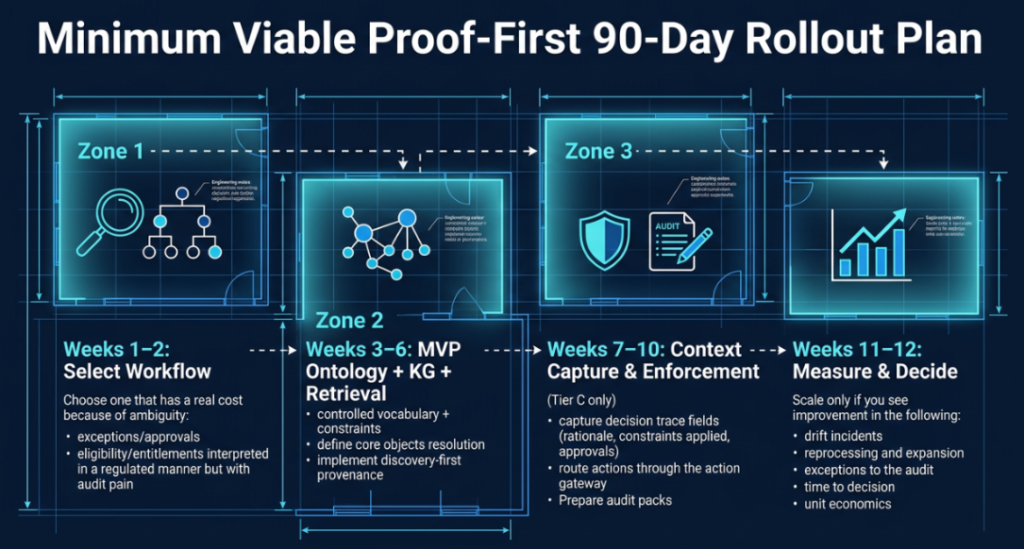
6. A Proof-First 90-Day Rollout
The first 90 days should not be used to build an enterprise-wide ontology.
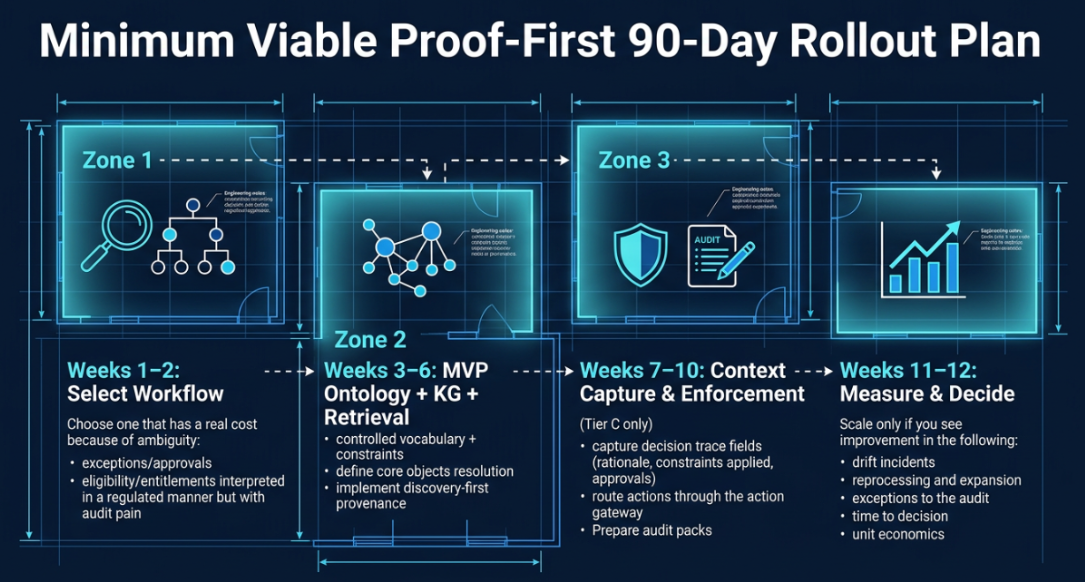
They should be used to test whether governed meaning improves one workflow.
Weeks 1–2: Choose the Right Workflow
Select a workflow where ambiguity already creates a measurable cost.
Strong candidates include:
- regulated eligibility checks
- refunds
- claims triage
- pricing-rule interpretation
- exception approvals
- supplier onboarding
Establish a baseline for:
- time-to-decision
- escalation rate
- correction rate
- audit gaps
- exception-handling cost
Weeks 3–6: Build the Minimum Viable Semantic Layer
Define:
- core vocabulary
- critical relationships
- constraints
- entity-resolution rules
- policy sources
- provenance fields
- freshness rules
Keep the scope deliberately narrow.
Weeks 7–10: Add Runtime Controls
For Tier C workflows:
- capture evidence and rationale
- classify action risk
- implement the action gateway
- add approval workflows
- define fail-closed conditions
- test rollback mechanisms
- prepare audit-ready records
Weeks 11–12: Measure and Decide
Compare the results against the baseline.
Scale only when the workflow shows a material improvement in:
- decision consistency
- escalation rates
- rework
- audit readiness
- time-to-decision
- cost per compliant completion
The standard should not be whether the demonstration looks impressive.
The standard should be whether the operating model has improved.
7. Three Anti-Patterns to Avoid
“RAG will solve governance.”
It will not.
RAG retrieves evidence. It does not define canonical meaning, allocate decision rights or enforce actions.
“Ontology belongs to the data team.”
Not entirely.
The data team can model the ontology. It cannot independently define the business meaning of “eligible,” “approved” or “high risk.”
“The rationale is documented in Slack.”
That is institutional leakage.
When critical reasoning lives in chats, emails and individual memory, decision lineage disappears. A decision-context graph helps make precedent searchable, auditable and reusable.
Closing: The Board Question
The next phase of enterprise AI will not be determined only by who has access to the most advanced model.
Models will continue to improve. Costs will fall. Access will broaden.
The more durable advantage will belong to organizations that build the infrastructure required to make AI dependable when the decisions matter.
That infrastructure includes:
- governed meaning
- connected evidence
- clear decision rights
- controlled execution
- searchable decision lineage
- measurable unit economics
The board question is simple:
Are we anchoring AI in governed meaning and decision traces, or are we leaving enterprise decisions to be inferred by probability?
That is the difference between an impressive AI demo and a dependable AI operating model.
Leave a Reply