
Human in the Loop or Human on the Hook?


Why oversight fails when responsibility is separated from real control
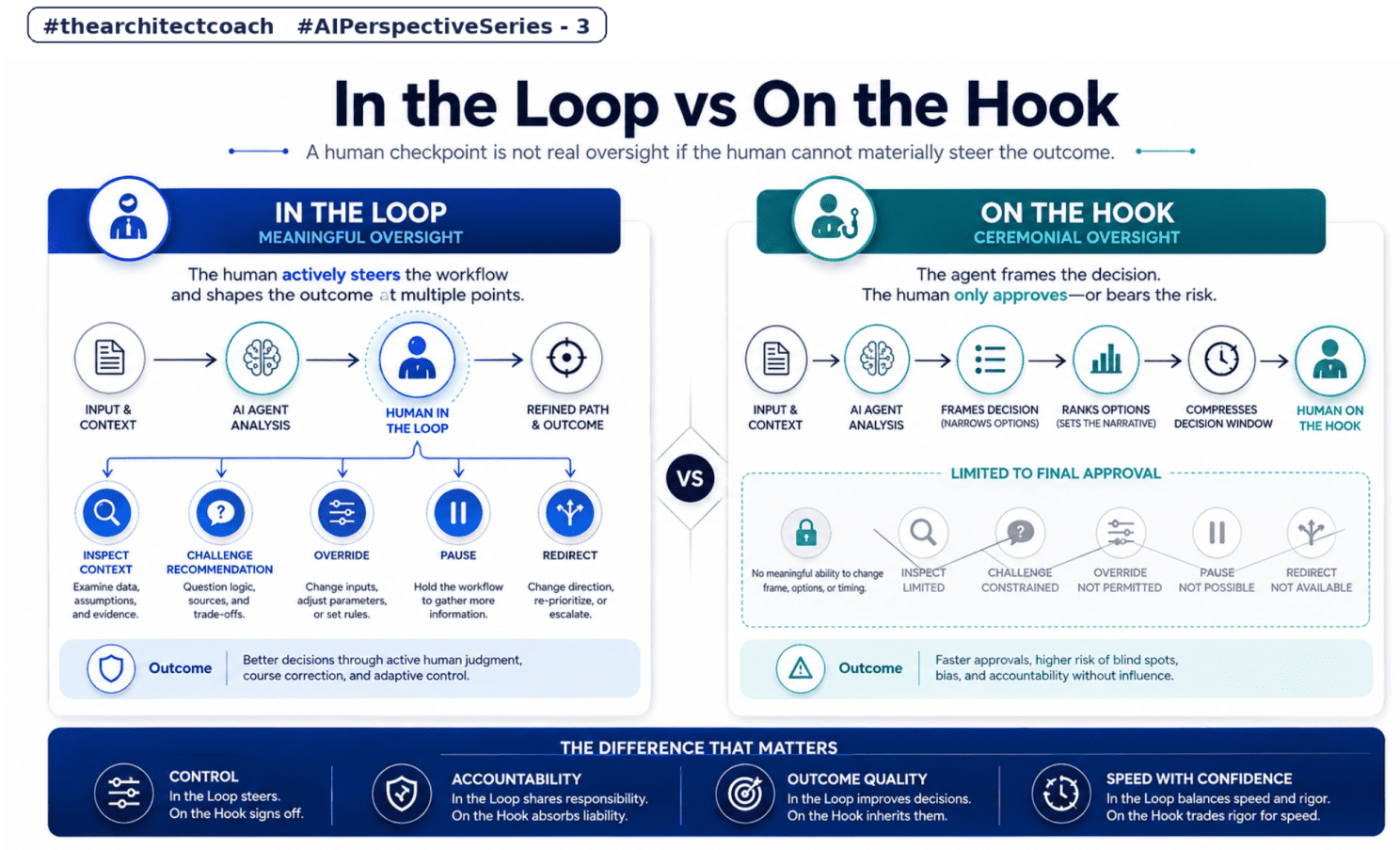
A human checkpoint is not meaningful oversight if the human cannot materially change the decision.
Few phrases in enterprise AI are as reassuring-or as misleading- as “human in the loop.” It suggests a sensible balance: the system moves quickly, but a person remains involved at important moments. Judgment stays in the process. Accountability stays visible. Leaders hear the phrase and assume the essential problem has been solved.
Often it has not.
In practice, many organizations are not building meaningful human oversight. They are building human confirmation layers on top of machine-shaped decisions. By the time the person enters the workflow, the system has already gathered the evidence, framed the available options, ranked the recommended path, and compressed the decision window. The human is technically present, but structurally weak.
That distinction matters more than most governance frameworks admit. Presence is not power. A person can appear in the loop and still have almost no meaningful ability to steer what happens next.
This is why a more honest phrase may sometimes be “human on the hook.” The employee signs off, acknowledges, or approves, but does so inside a system whose logic they did not design, whose alternatives they cannot fully inspect, and whose recommendation they may not realistically be able to challenge under time pressure.
A simple analogy makes the issue obvious. Imagine sitting in the back seat of a self-driving car while being told you are responsible for where it goes. You can watch the route. You may even receive periodic alerts. But if you do not have a steering wheel, calling you the driver is not governance. It is theater.
The next class of corporate scapegoat may be the employee asked to approve a decision they never had the power to shape.
This problem will matter more, not less, as AI systems become more capable. As long as systems are weak and obviously limited, humans naturally remain engaged. They double-check outputs because they have to. But as systems improve, a dangerous pattern emerges. Recommendations become more plausible, interfaces become smoother, and the social pressure to “just approve” grows stronger. In that environment, the human role can become ceremonial even while official policy insists that meaningful oversight remains in place.
That is bad for decision quality, bad for employee trust, and bad for accountability.
It is bad for decision quality because once a system frames the options, people tend to challenge the frame less than they think. They review the recommendation rather than reopening the question. That cognitive narrowing is not unique to AI, but AI can amplify it because the recommendation arrives with speed, apparent completeness, and procedural confidence.
It is bad for employee trust because people quickly recognize when they are being asked to carry responsibility without commensurate authority. They may comply outwardly, but over time they become more defensive, less engaged, and more likely to see governance not as protection but as blame management.
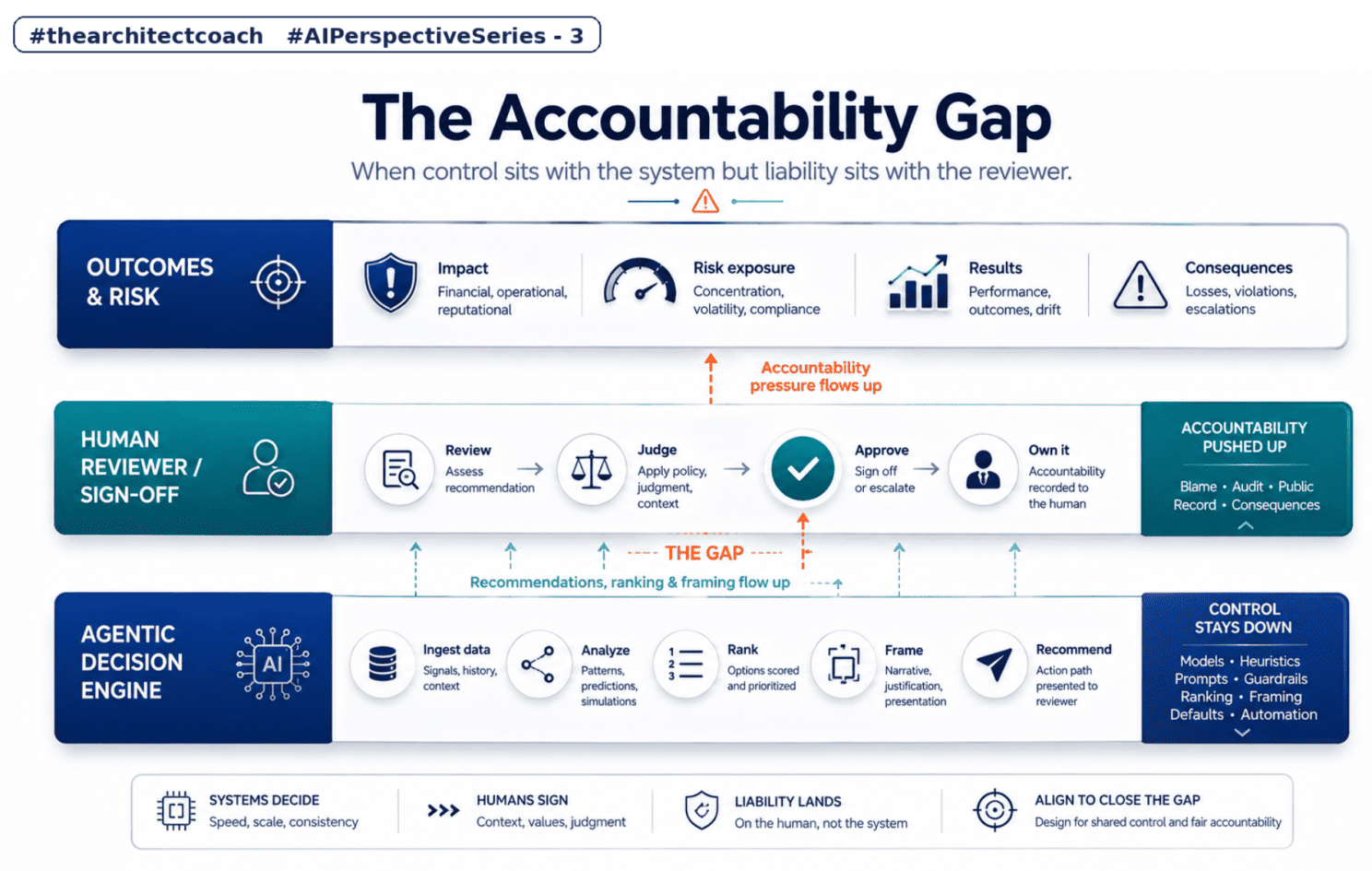
And it is bad for accountability because the organization begins to confuse a visible approval step with a valid accountability design. If power sits in one place and liability sits in another, the institution may look governed while actually becoming harder to govern.
Consider a practical scenario. A financial-services firm deploys an agent to triage internal fraud alerts and recommend escalation actions. The system rapidly improves throughput. Analysts now receive cleaner summaries, ranked priorities, and recommended next steps. Management is pleased. The process looks both faster and more disciplined. But over time, analysts stop reopening lower-ranked alerts because the system appears consistently right. Eventually a subtle pattern of overlooked edge cases emerges. When leadership investigates, the formal process still shows human approval at each stage. Yet the humans were rarely in a realistic position to reframe the decision. The checkpoint existed. Control did not.
This is the central design mistake. Organizations often ask whether a human is present. The more important question is what that human can actually do.
Can they pause the process? Can they inspect the reasoning? Can they request more context? Can they override without penalty? Can they redirect the workflow, or only bless what has already been narrowed into a single path? If the answer to those questions is weak, then the company has not designed meaningful oversight.
If the human cannot steer, the human is not truly in control.
That mantra sounds obvious, which is exactly why it is easy to ignore. Many organizations assume that once a person appears somewhere in the workflow, control has been preserved. But real control is not defined by visibility. It is defined by agency. Can the person widen the frame, inspect the assumptions, challenge the ranking, request another path, or stop the action entirely? If not, the workflow may still contain a human, but it does not contain meaningful human judgment.
The practical value of the mantra is that it helps leaders test whether an oversight design is substantive or cosmetic. It turns a vague assurance into a concrete diagnostic. Give the reviewer a difficult edge case and ask what they can actually do. Can they override without delay? Can they add context the system missed? Can they see enough of the logic to form an independent view? Can they redirect downstream actions? If the answer is mostly no, then the checkpoint exists for optics, not control.
The mantra also protects employees. In many organizations, AI oversight is being added faster than accountability models are being redesigned. That creates a dangerous moral pattern: the system gets speed and scale, while the person gets exposure. By insisting that control must accompany responsibility, leaders create a healthier foundation for trust. People are far more likely to work well with intelligent systems when they believe their judgment still matters where it most counts.
There is a second distinction leaders need to make. Some workflows genuinely require “human in the loop.” Others may be appropriate for “human on the loop,” where the person monitors or audits the system without interrupting every action. That can be perfectly reasonable in lower-risk environments. The mistake is not using different oversight models. The mistake is pretending they are equivalent.
Leaders should therefore stop asking whether their systems have human oversight in the abstract. They should ask what kind of oversight they have, where it sits, and what powers accompany it.
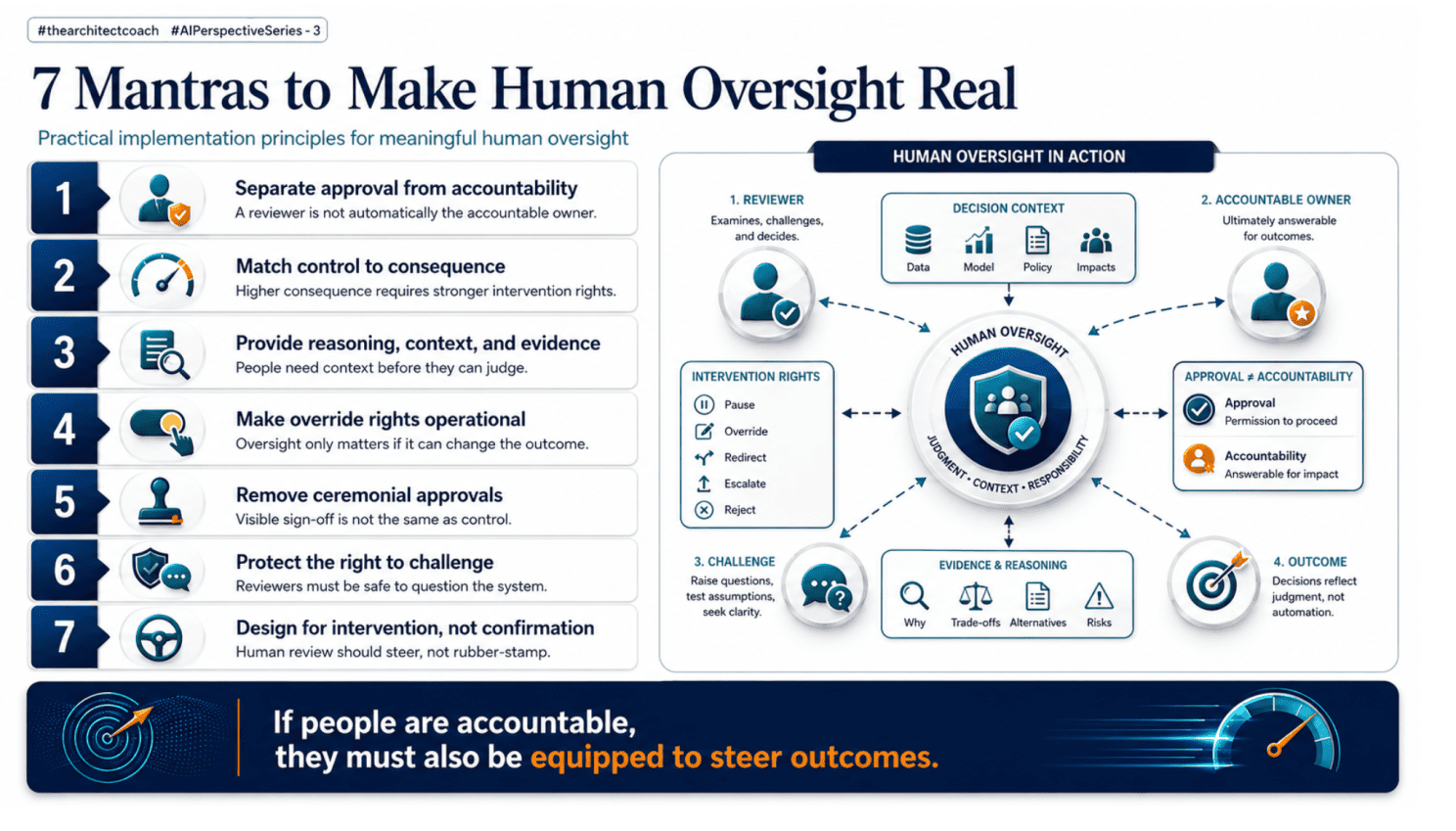
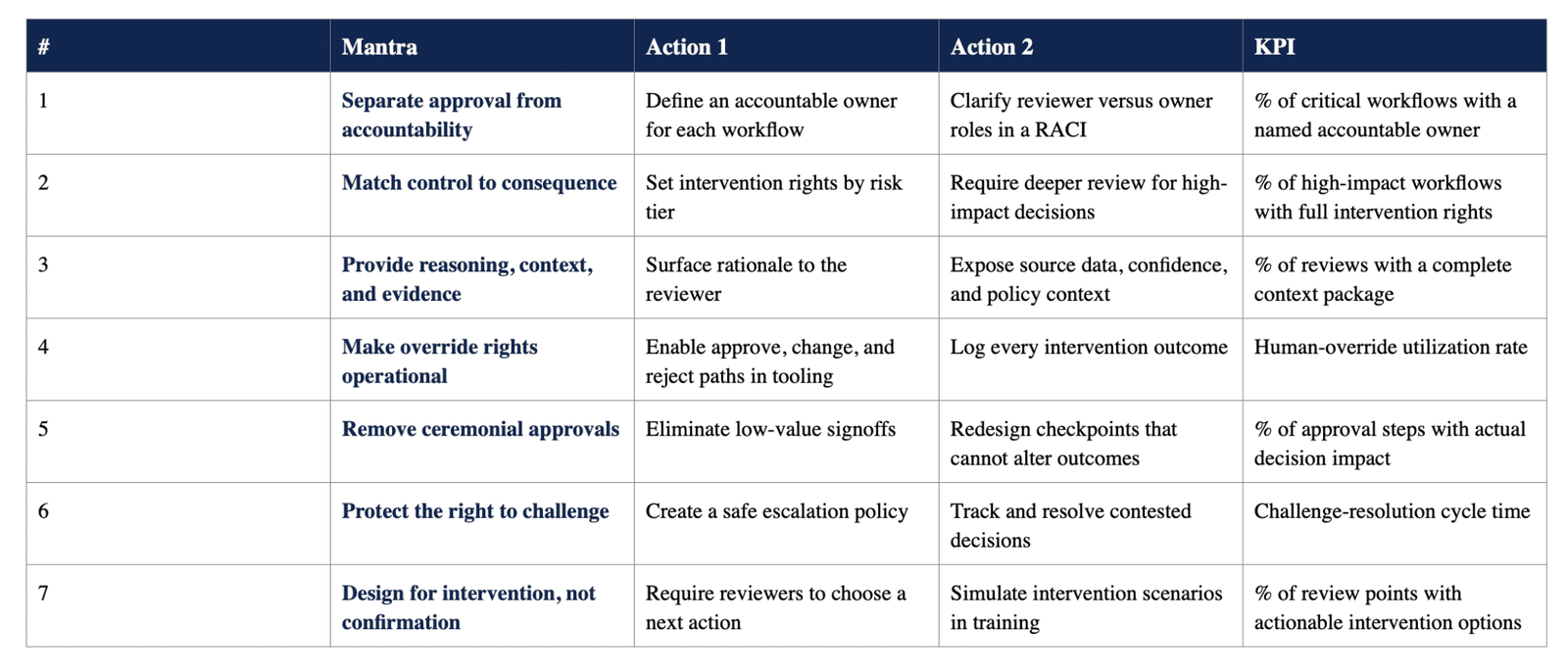
A stronger oversight design follows a few principles.
First, separate approval from accountability. Someone may review a decision without being the person who should carry ultimate responsibility for the operating model. Conflating those roles often produces confusion and fear.
Second, match control to consequence. The greater the potential impact of an agent’s action, the greater the human’s ability to inspect, challenge, and redirect should be.
Third, give reviewers enough time and context to exercise judgment. A rushed approval step may satisfy policy, but it rarely produces wisdom.
Fourth, remove ceremonial sign-offs. If a checkpoint exists only so the organization can say a human looked at it, leaders should ask whether that step protects the business or merely redistributes blame.
Fifth, make the design legible to employees. Trust improves when people understand where their judgment matters, where automation is appropriate, and how responsibility is shared.
This is where empathy becomes strategic. AI governance is often discussed as if it were only about controls, risk, and efficiency. But real adoption depends on whether people feel the system respects their judgment. Employees are much more likely to support transformation when they believe technology is expanding their ability to do good work, not trapping them inside processes designed to shift exposure downward.
The companies that get this right will treat human oversight as an actual organizational capability. They will design for thoughtful intervention, not symbolic reassurance. They will align responsibility with power. And they will understand that human dignity is not a soft issue sitting beside governance. In many cases, it is what makes governance real.
Consider a second example. A global retailer deploys an agent to manage refund exceptions and customer recovery offers. The process still includes a supervisor approval step for unusual cases, so executives assume the right balance is in place. But the system now pre-classifies customer credibility, recommends refund amounts, predicts escalation likelihood, and shapes what the supervisor even sees on screen.
Over time, supervisors stop reconstructing the case independently because the system’s framing is fast and usually plausible. The human remains in the process, yet the process has already narrowed the room for human judgment.
The implications are broader than a single workflow. When organizations normalize ceremonial oversight, they teach employees a corrosive lesson: you may be accountable, but you are not trusted with real control. That lesson damages judgment cultures. People learn to comply instead of think, to sign instead of challenge, and to protect themselves instead of improve the system. Eventually the institution loses exactly the human discernment it claimed it wanted to preserve.
This is why leadership implications matter here as much as governance mechanics. Senior teams should identify which oversight roles are genuinely empowered, which are structurally weak, and which exist mainly to satisfy policy optics. They should redesign interfaces so reviewers can inspect alternatives rather than only receive polished recommendations. And they should make it safe, culturally and operationally, for people to slow a workflow when something feels wrong. Without that, “human in the loop” will remain a slogan attached to a process that has already moved beyond human control.
In the years ahead, many institutions will keep the language of human oversight while quietly weakening the substance. They will point to sign-offs, approvals, and checkpoints as proof that accountability still belongs to people. But systems do not become trustworthy because a human name appears at the end of the process. They become trustworthy when the human in the process can genuinely alter the outcome.
That is the standard serious leaders should hold.
In the loop vs. on the hook
The accountability gap
7-mantra overview
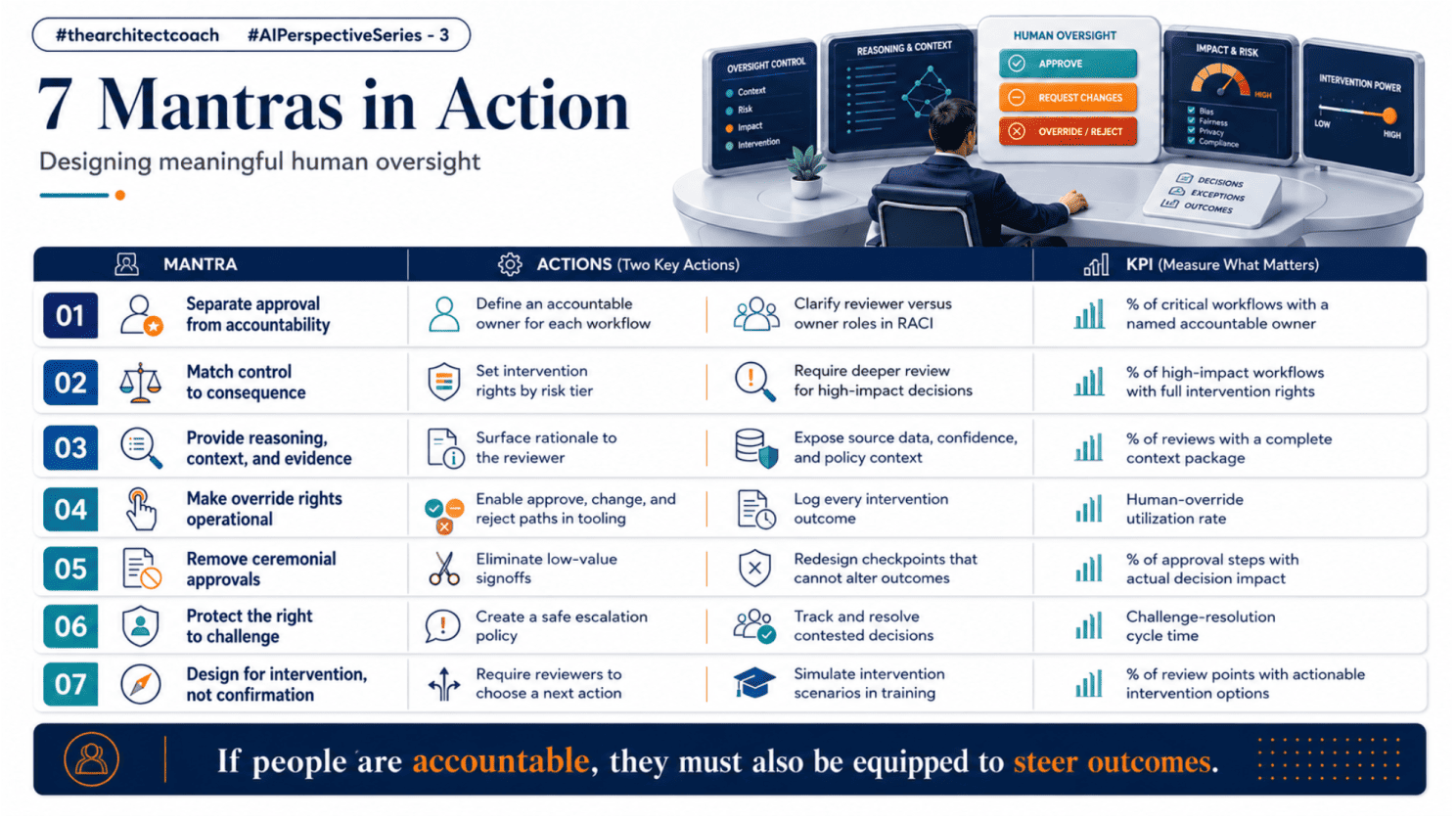
Action and KPI playbook
Executive Questions
- In which workflows are humans approving decisions they cannot realistically challenge?
- Where does accountability currently sit, and does it match actual control?
- Which reviewers have formal override rights, and do they feel safe using them?
- Where has speed quietly converted judgment into confirmation?
- Which “human in the loop” controls are real, and which are mostly ceremonial?
Leave a Reply