
From Modular AI Applications to an Enterprise AI Platform: A Board-Ready Architecture for Change


Enterprise AI rarely fails because the team chose the wrong framework.
It doesn’t work, because the system is harder to change than the business around it.
The original article makes a good engineering case for modularity: separate out APIs, services, retrieval, memory, evaluation, data, and deployment so that each can evolve independently. The implication at the board level is bigger.
Architecture is the mechanism by which an enterprise can absorb continuous change without rebuilding its stack over and over again as AI moves from pilot features to core workflows.
Models will evolve. Retrieval will be different. Agent frameworks will be changed. Governance will be improved. Costs will shift. New protocols will develop. “Multi-agent workflows are coming.
So the strategic question is not if the current architecture works.
The question is, is the architecture built to make future change routine?
Board Position: Optimise AI architecture for substitutability, governability and continuous evolution—not today’s model stack.
1) Changing the conversation — modularity is really about optionality
The article proposes the modular architecture as an advantage for the maintainability.
Modularity should be viewed as strategic optionality for enterprise leaders.
A tightly coupled AI platform embeds hidden commitments:
- models providers
- a retrieval mechanism
- a memory pattern
- one stack evaluation
- a path of deployment
- one-agent framework
Those choices might be good for today, and liabilities six months away.
A modular architecture introduces explicit substitution points.
Boards should be asking:
- How many critical AI components can be swapped out without rewriting the application?
- How long does it take to switch model providers?
- Are retrieval, memory and evaluation independently evolved?
- Are production controls embedded in the center or duplicated in applications?
- What percentage of the stack is dependent on a single vendor/framework?
Modularity isn’t code cleanliness. It’s how the enterprise hedges its bargaining power, and reduces the concentration of technology risk.
2) Distinguish capability layers from product choices

The most enduring idea of the article is its division of labour.
This should be elevated to an enterprise architectural principle.
The platform needs separate capability layers:
Experience Layer
APIs, streaming, user channels and interaction surfaces.
Orchestration Layer
Orchestrates workflows, prompts, models, tools, and business logic.
Knowledge Layer
Retrieval, search, semantic context, and enterprise data access.
Memory Layer
Stores session state, summaries, user context and durable interaction history.
Quality Layer
Assesses correctness, latency, cost, groundedness, and policy compliance.
Control Layer
Deals with identity, authorisation, approvals, auditability and governance.
Platform Layer
Deployment, observability, CI/CD, runtime infrastructure, and resilience
It’s not the number of layers that matter.
It’s that each capability has a defined contract, and can evolve independently.
3) Enumerate the failure modes of non-modular AI
AI platforms accumulate architectural debt quickly as the rate of change in the tech landscape is greater than traditional enterprise software.
Predictable ways of failure are:
Framework Lock-In
Business logic is no longer isolated from a particular agent or orchestration framework.
Model Lock-In
Prompts, schemas, tool contracts, evaluations assume the behaviour of a single provider.
Fragmentation of Evaluation
Every team measures quality differently, so you can’t compare enterprises.
Memory Entanglement
Mixing conversation history, retrieval context and persistent knowledge raises privacy and correctness issues.
Duplication of Governance
Security, policy and approval logic are reimplemented application by application.
Deployment Drift
Different release pipelines, observability and runtime controls on teams.
**Acceleration of Change
One small change in one component means updates across the platform.
These are not merely engineering problems. They raise migration cost, operational risk, and time-to-market.
4) Build an Enterprise AI Platform Control Model

A mature modular architecture requires more than just technical separation.
It needs an operating model that specifies how those modules work together.
“A minimum enterprise AI platform should include:
1. Standard Interfaces
Models, retrieval engines, memory stores, tools are linked with stable contracts rather than application specific wiring.
2. Common Orchestration Services
Work flow cross-cutting logic is reused instead of embedded independently in every application.
3. Central Evaluation
All major AI capabilities are evaluated against common criteria for quality, cost, latency, and risk.
4. Policy enforcement
Identity, authorisations, data classification, tool permissions, and human approvals are centrally managed.
5 Observability as Standard
The platform includes tracing, token usage, quality scores, failure modes and cost attribution.
6. Portable Deployment
Applications can be moved between environments without having to rebuild their architecture around a single runtime.
The platform needs to normalise control and maintain choice.
5) Measure architectural flexibility, not feature count
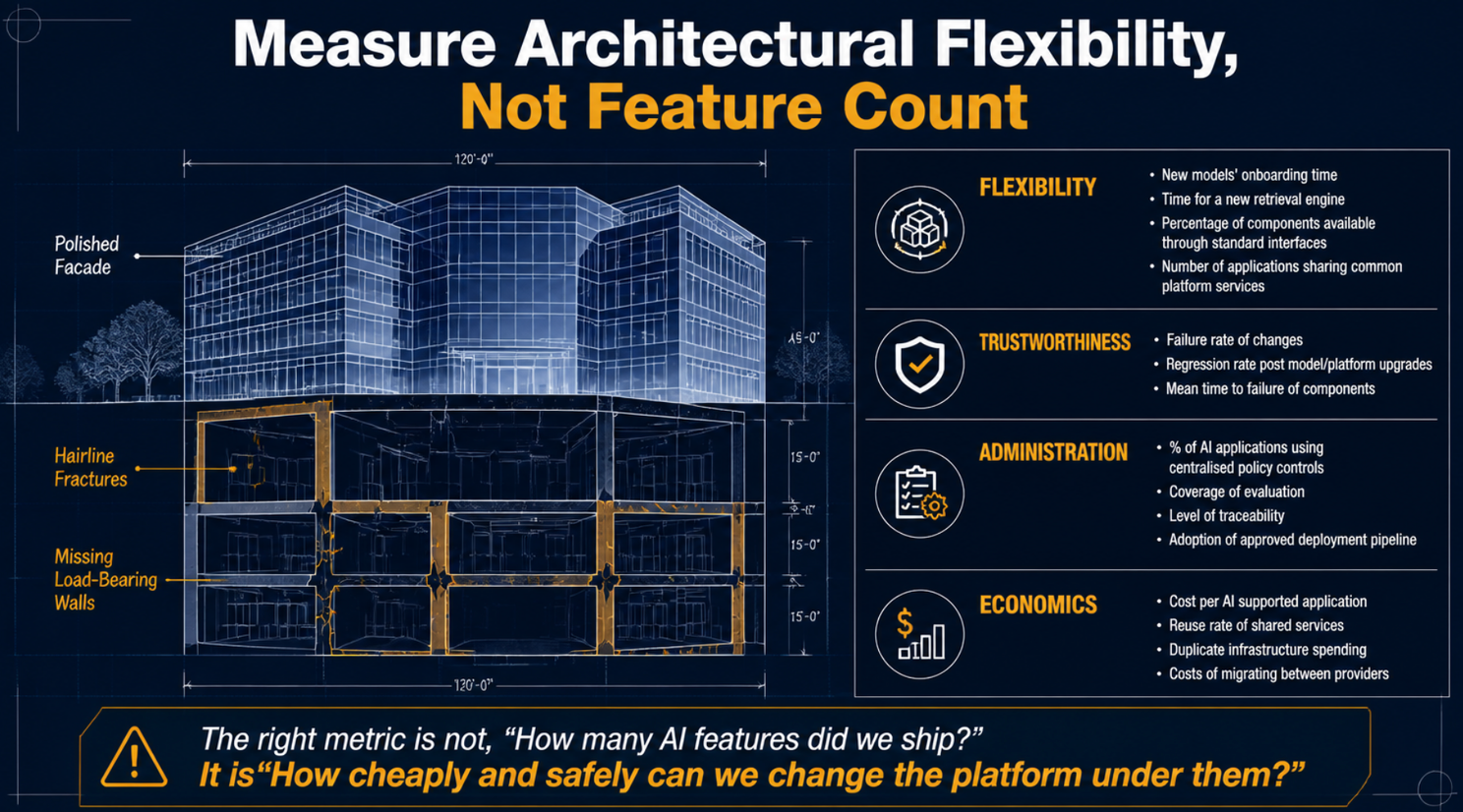
Many AI programs measure progress by the number of use cases they launch.
That can conceal structural weakness.
Boards need indicators of whether the platform is becoming easier (or harder) to evolve.
Flexibility
- New models’ onboarding time
- Time for a new retrieval engine
- Percentage of components available through standard interfaces
- Number of applications sharing common platform services
Trustworthiness
- Failure rate of changes
- Regression rate post model/platform upgrades
- Mean time to failure of components
Administration
- % of AI applications using centralised policy controls
- Coverage of evaluation
- Level of traceability
- Adoption of approved deployment pipeline
Economics
- Cost per AI supported application
- Reuse rate of shared services
- Duplicate infrastructure spending
- Costs of migrating between providers
The right metric is not, “How many AI features did we ship?
It is “How cheaply and safely can we change the platform under them?”
6) Modular AI Architecture Enterprise SLOs
If modularity is of strategic interest, it ought to be measurable.
Some practical SLOs are:
- Substitutability SLO: No impact on core business logic when replacing critical model integrations.
- Interface SLO: Shared AI capabilities expose versioned, documented APIs.
- SLO Assessment: All production AI workflows run a common regression suite before release.
- Observability SLO: Any request is traceable across orchestration, retrieval, model, tool, and output
- Central enforcement of security and governance controls as opposed to local embedding.
- Deployment SLO: Production releases follow standardised CI/CD and rollback patterns.
- Dependency SLO: No critical AI capability depends on a single vendor, absent an approved exception.
7) These SLOs make architecture a discipline of enterprise, not a design option. the components are not durable the architecture pattern is durable
It specifically calls out the technologies it uses: FastAPI, Docker, GitHub Actions, retrieval frameworks, and future MCP or multi-agent capabilities.
That’s an implementation choice.
The pattern is persistent and different:
- clear division of responsibilities
- explicit interfaces
- scalable independently
- controls can be reused
- central assessment
- infrastructure portability
- designed for replacement parts
That difference matters because the AI ecosystem is changing too fast for static standardisation.
Board implication: Contract standardisation not tech brand standardisation.
8) The operating model restructure the way AI teams are organised
Modular AI architecture has deeper organisational implications.
No more building each and every AI use-case as a separate application for teams.
The enterprise needs platform capabilities that product teams can consume, rather.
That passes the buck from:
- retriever is retrained for each project
- custom evaluation logic building
- replicating security controls
- wiring models straight into applications
toward:
- offering common platform services
- common control interfaces
- keeping reusable evaluation assets
- providing approved patterns for memory, retrieval, orchestration and deployment
- letting application teams move faster within defined guardrails
The AI platform team becomes a leverage function, not yet another delivery bottleneck in the center.
Final perspective
The greatest architectural risk with enterprise AI is selecting the wrong model.
It’s building a platform where any future change is expensive.
Architectures based on enduring assumptions can’t keep up with AI’s rapid evolution. The models will improve. Prices will drop. protocols will be created. Governance will become more stringent. New agent patterns will appear.
Successful scaling companies will be those that separate durable capabilities from temporary technology choices.
That’s the real value of modular architecture.
Not prettier code.
Better diagrams not.
The ability to pivot without having to re-architect the enterprise.
Board Question
With artificial intelligence technology evolving faster than enterprise planning cycles, are we building for today’s stack or building an architecture to absorb tomorrow’s change?**
Leave a Reply