
Enterprise Memory to Enterprise Learning: Why Self-Learning Agents Need an Operating Model, Not Just a Memory Store
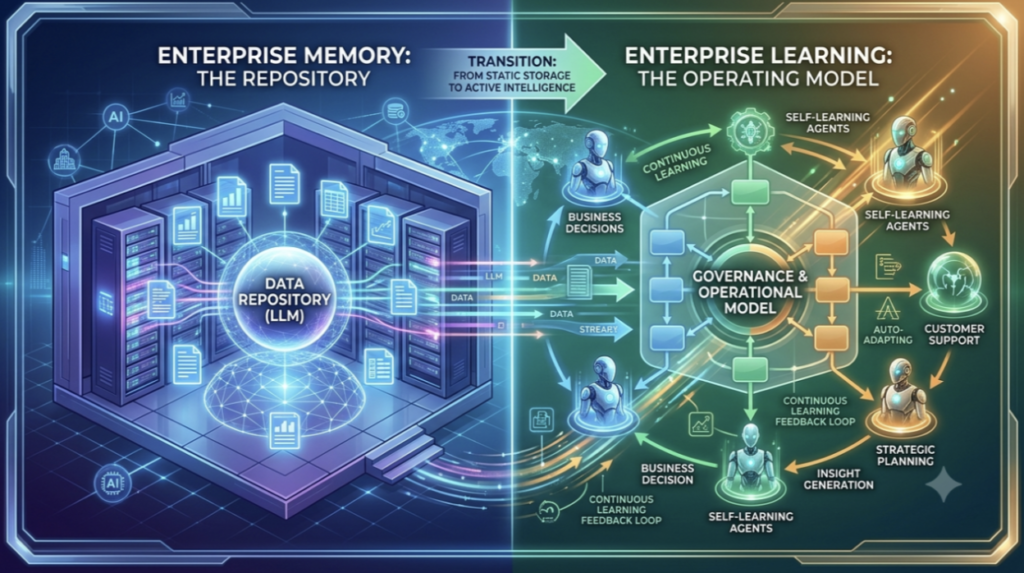
It seems like every week there’s a new “AI memory” product. Persistent memory. Long-term memory. Agent memory. Knowledge memory. They all provide agents that remember more, and do better.
It is seductive to say that if you give an agent memory it will keep on improving.
That’s only half correct.
Memory is necessary but not sufficient. The real problem is not to remember more, but learn better.
It won’t be which vector database or graph tech stores the memories that will define the next generation of enterprise AI. It will be determined by the organizations that construct a governed learning architecture that translates work into institutional intelligence on an ongoing basis.
It’s not a memory problem.
It’s a problem of an enterprise operating model.
1. Change the narrative: Memory is infrastructure. Learning is the faculty.

Most discussions assume that intelligence is produced by memory itself.
Boards need to question that assumption.
Memory contains facts.
Learning means better decisions.
These are capabilities that are fundamentally different.
A self-learning enterprise needs a closed loop system that continuously:
- models interaction
- measures outcomes
- distinguishes noise from useful knowledge
- refreshes enterprise knowledge
- improves subsequent reasoning
Without that loop, memory is just an ever-expanding archive.
The board question therefore becomes:
What’s the recall of our agents?
to
“How can our business get smarter with each decision it makes?”
That’s a much bigger strategic question.
2. Enterprise learning needs four separate capabilities, not just one memory database
The original article rightly points out memory is not enough. The bigger insight is that organizations need to stop thinking of “memory” as one technological component.
Enterprise learning comprises four independent capabilities.
Capture
Everything an agent does should make a mark.
- prompts
- Retrieved context
- Tools used
- Decisions made
- Approvals
- Results
The agent must not decide what is worth remembering.
Remember
Only retrieve relevant context.
Not a whole lot.
At runtime, enterprise memory should shrink, not grow.
The best learning systems learn only that which improves the decision at hand.
Consolidation
Few enterprises think of raw interactions as knowledge.
Most conversations are throwaway.
Some turn into reusable patterns.
Some of it becomes policy.
some becoming best practice
Thus, consolidation is a governance process, not a storage process.
Ongoing Improvement
The last step closes the loop.
Each execution should be better.
- prompts
- retrieval
- policies
- specifications
- workflows
- evaluation datasets
This is where the learning happens.
Memory is input.
3. The real architecture is a learning loop (not a memory stack)
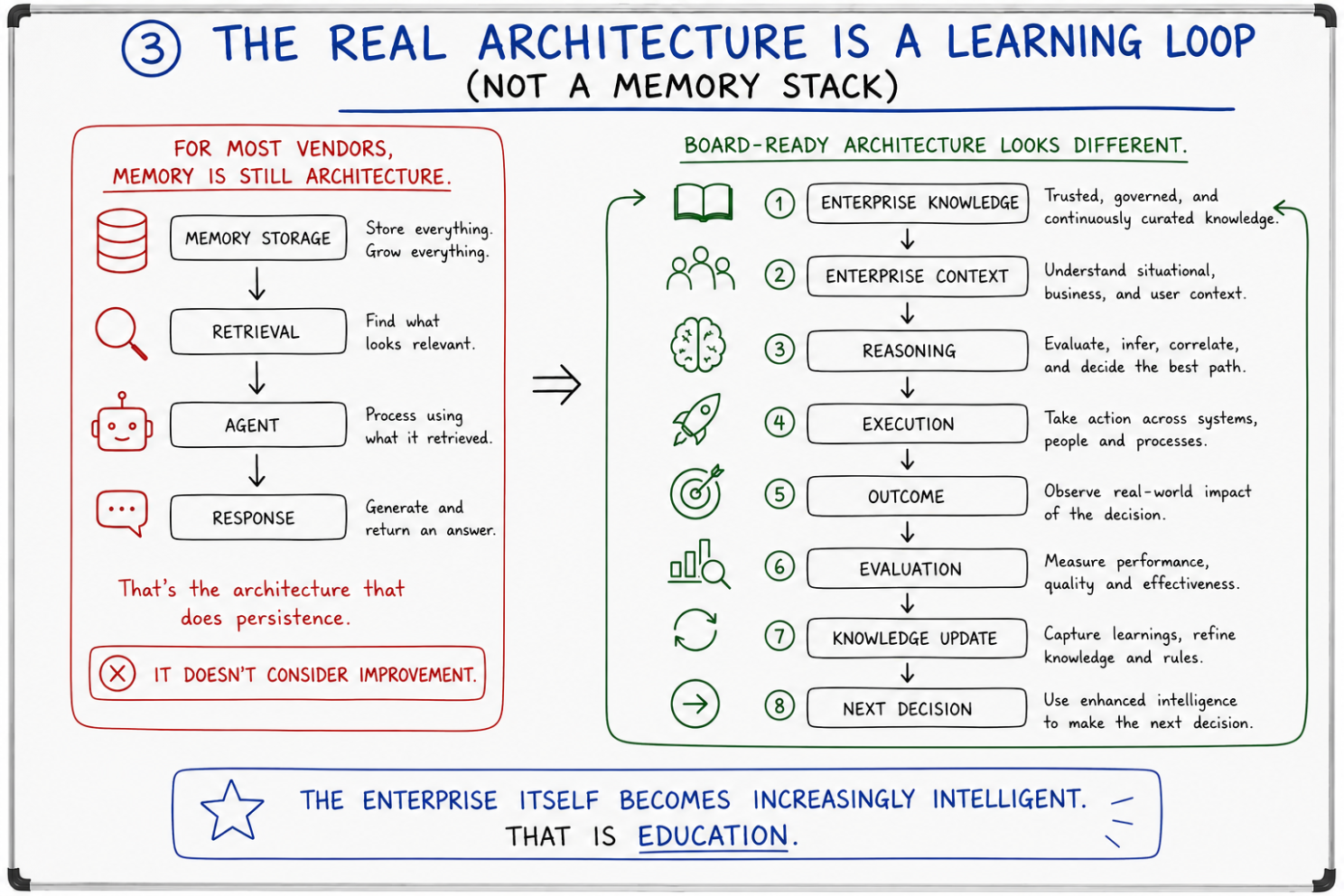
For most vendors memory is still architecture.
Memory storage
↓
Retrieval
↓
Agent
↓
Response
That’s the architecture that does persistence.
It doesn’t consider improvement.
Board-ready architecture looks different.
Enterprise Knowledge
↓
Enterprise Context
↓
Reasoning
↓
Execution
↓
Outcome
↓
Evaluation
↓
Knowledge Update
↓
Next Decision
The enterprise itself becomes increasingly intelligent.
That is education.
4. Organisational knowledge: The missing context all agents are lacking
One of the strongest ideas to come out of the article is the notion that all interaction contains three types of intent.
- user purpose
- agent purpose
- organizational purpose
This deserves even more emphasis.
It takes months for human employees to learn an organisation’s intent.
They find:
- company parlance
- acceptance norms
- previous decisions
- political realities
- exceptions
- unwritten rules
Large language models don’t know any of this.
And this is why enterprise AI often produces answers that are technically correct but organisationally wrong.
The answer is not another prompt.”
It is making explicit the knowledge of the organisation.
This means that:
- business glossaries
- policies
- lineage
- ownership
- historical decisions
- governance rules
- semantic models
This is the enterprise reasoning layer.
5. Context is more important than data
Traditional architectures tried to centralise enterprise data.
Agentic architectures flip the problem on its head.
The data stays where it already is.
Context is what moves.
Such context includes:
- quality
- possession
- freshness
- policy
- relations
- permissions
- historical decisions
The difference in strategy is slight. But profound.
Competitive advantage is increasingly not about having more data, but about having richer, more trustworthy context for reasoning.
Hence, boards should treat semantic architecture as strategic infrastructure, not metadata administration.
6. Enterprise learning has to be managed, not automatic
A major difficulty for self-learning systems is the assumption that every interaction should be converted into knowledge for future use.
It shall not.
Don’t let bad decisions become institutional memory.
Instead, enterprises need clear learning governance.
Each learning candidate is to be classified.
Temporary Experience
Only useful for one workflow.
Practice that can be reused
Helpful in similar workflows.
Enterprise Standard
Validated and approved for use across the organisation.
Policy .
Mandatory adherence at time of execution.
Learning without governance just scales inconsistency faster.
7. Test learning, not memory
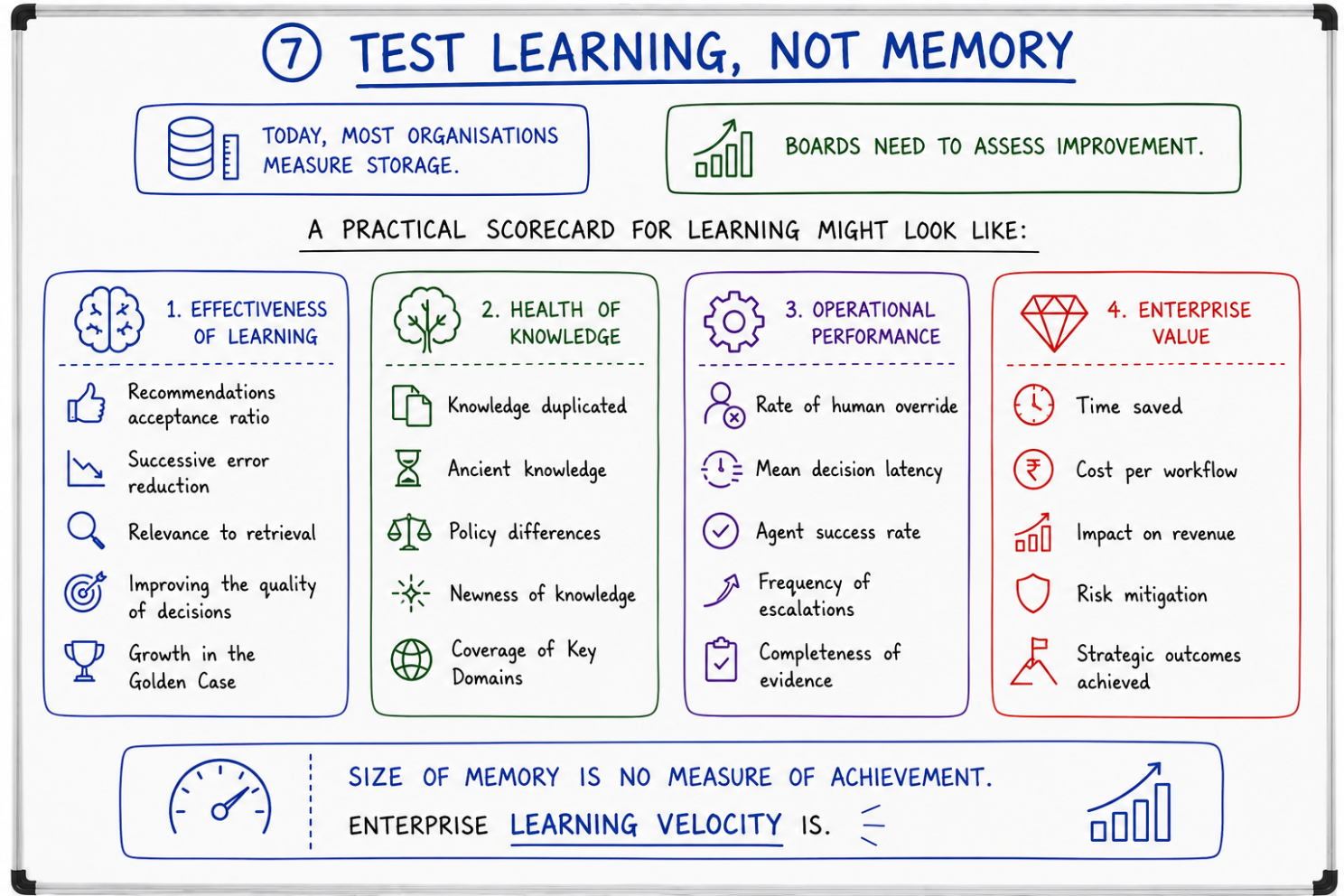
Today, most organisations measure storage.
Boards need to assess improvement.
A practical scorecard for learning might look like:
Effectiveness of Learning
- Recommendations acceptance ratio
- Successive error reduction
- Relevance to retrieval
- Improving the qua
- lity of decisions
- Growth in the Golden Case
Health Knowledge
- Knowledge duplicated
- Ancient knowledge
- Policy differences
- Newness of knowledge
- Coverage of Key Domains
Operational Performance
- Rate of human override
- Mean decision latency
- Agent success rate
- Frequency of escalations
- Completeness of evidence
Enterprise Value
- “Time saved
- Revised text removed
- Cost per workflow
- Impact on revenue
- Risk mitigation
Size of memory is no measure of achievement.
Enterprise learning velocity is.
8. The technology changes more than the operating model
The original article is correct in pointing out that self-learning systems are architectural, not algorithmic.
The implication is organisational more generally.
The human work is gradually moving from the repetitive execution to the maintenance of the enterprise intelligence.
Future enterprise teams will spend less time doing work, and more time improving how work gets done.
New responsibilities are coming up:
- validating learning
- curating golden cases
- defining semantic models
- to govern enterprise knowledge
- designing evaluation frameworks
- to improve specifications
- monitoring reasoning quality
The enterprise starts to regard knowledge as a strategic asset, not an accidental by-product of operations.
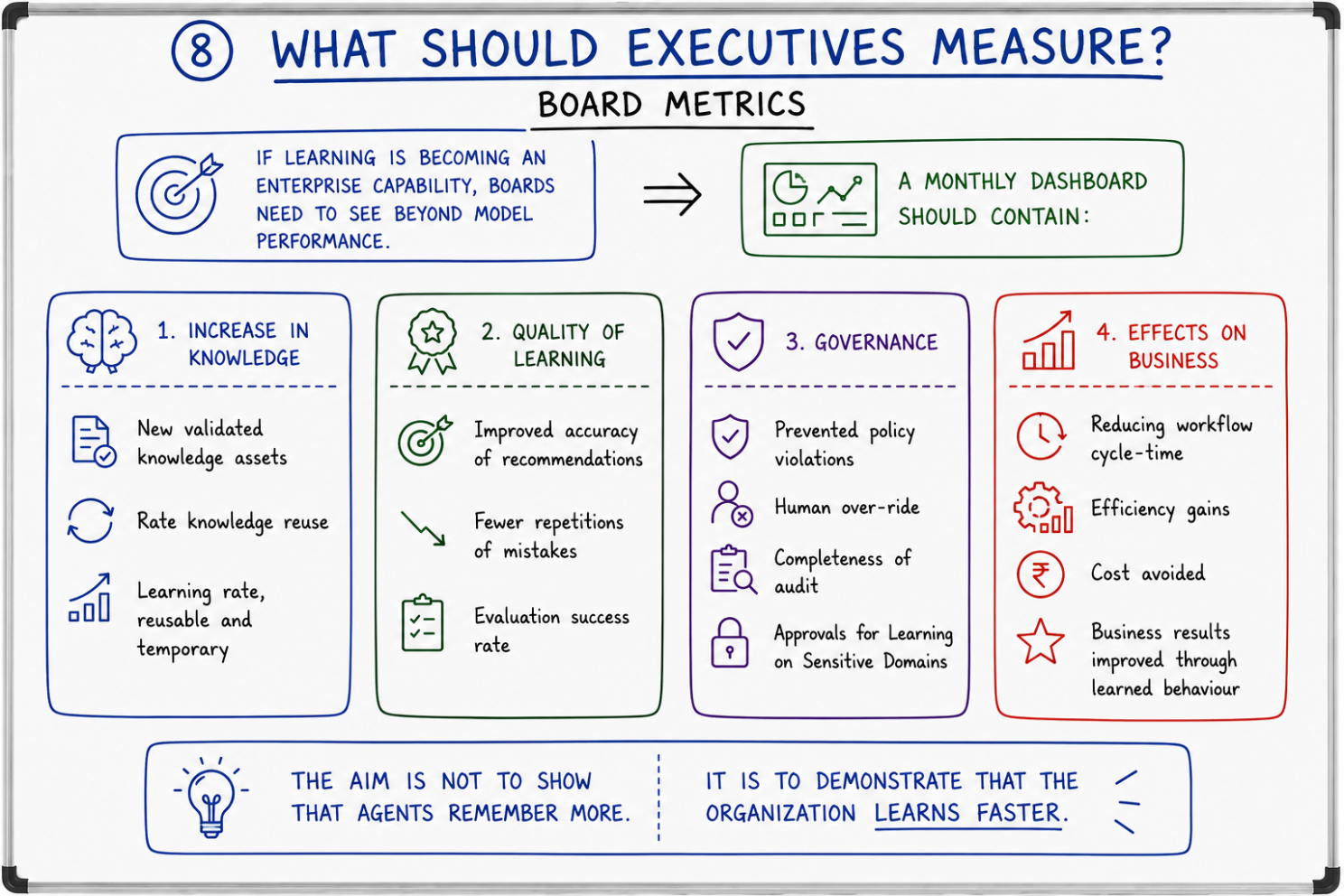
What Should Executives Measure? Board Metrics
If learning is becoming an enterprise capability, boards need to see beyond model performance.
A monthly dashboard should contain:
Increase in Knowledge
- New validated knowledge assets
- Rate knowledge reuse
- Learning rate, reusable and temporary
Quality of Learning
- Improved accuracy of recommendations
- Fewer repetitions of mistakes
- Evaluation success rate
Governance.
- Prevented policy violations
- Human over-ride
- Completeness of audit
- Approvals for Learning on Sensitive Domains
Effects on Business
- Reducing workflow cycle-time
- Efficiency gains
- Cost avoided
- Business results improved through learned behaviour
The aim is not to show that agents remember more.
It is to demonstrate that the organization learns faster.
Closing Perspective: Institutional Intelligence and Competitive Advantage
Today the market is in a race to build better memory agents.
That is unlikely to be a sustainable differentiator.
The organisations that create sustainable advantage will build something much harder to copy: a governed enterprise learning system that continually captures experience, judges outcomes, enhances organisational knowledge and improves future decisions.
Memory is the repository of the past.
Learning makes the future better.
That distinction moves where enterprises should invest.
“Question for the Board Room”
Are we building AI systems that simply recall prior interactions or are we building an enterprise learning operating model where each governed decision adds to the institutional intelligence?
The question – not which memory technology to choose – will determine which organisations build compounding advantage in the agentic era.
Leave a Reply