
AI Specs Are Becoming the Enterprise’s New Operating System

(Why Specification Engineering, Not Prompt Engineering, Will Determine Which Organizations Successfully Scale AI)
For years enterprise software delivery followed a familiar pattern. Business leaders defined objectives Architects translated objectives into designs Engineers translated requirements into code Testing validated the result
Generative AI essentially compresses this life cycle.
Today AI agents can generate code, tests, infrastructure, documentation, workflows, and increasingly entire applications. However, despite significant progress in model capabilities, enterprise AI initiatives continue to produce mixed results.
The answer is quite simple.
AI does not carry out strategy. It implements the specifications.
The original article makes a good point that bad specs makes bad code. The larger implication is far more important. With AI as the execution engine for software delivery, specifications become enterprise assets, not engineering artifacts. They are the mechanism by which organizations convert business intent into executable outcomes.
This is no longer a conversation about software engineering.
This is a conversation around enterprise operating model.
1) Shift the conversation – AI quality is increasingly a specification quality problem
The enterprise AI debate mostly revolves around model selection, benchmarks, and coding assistants.
Instead, boards should be asking:
How well does our organization express business intent in a way AI can execute?
Benchmark models, instead of setting an enterprise baseline:
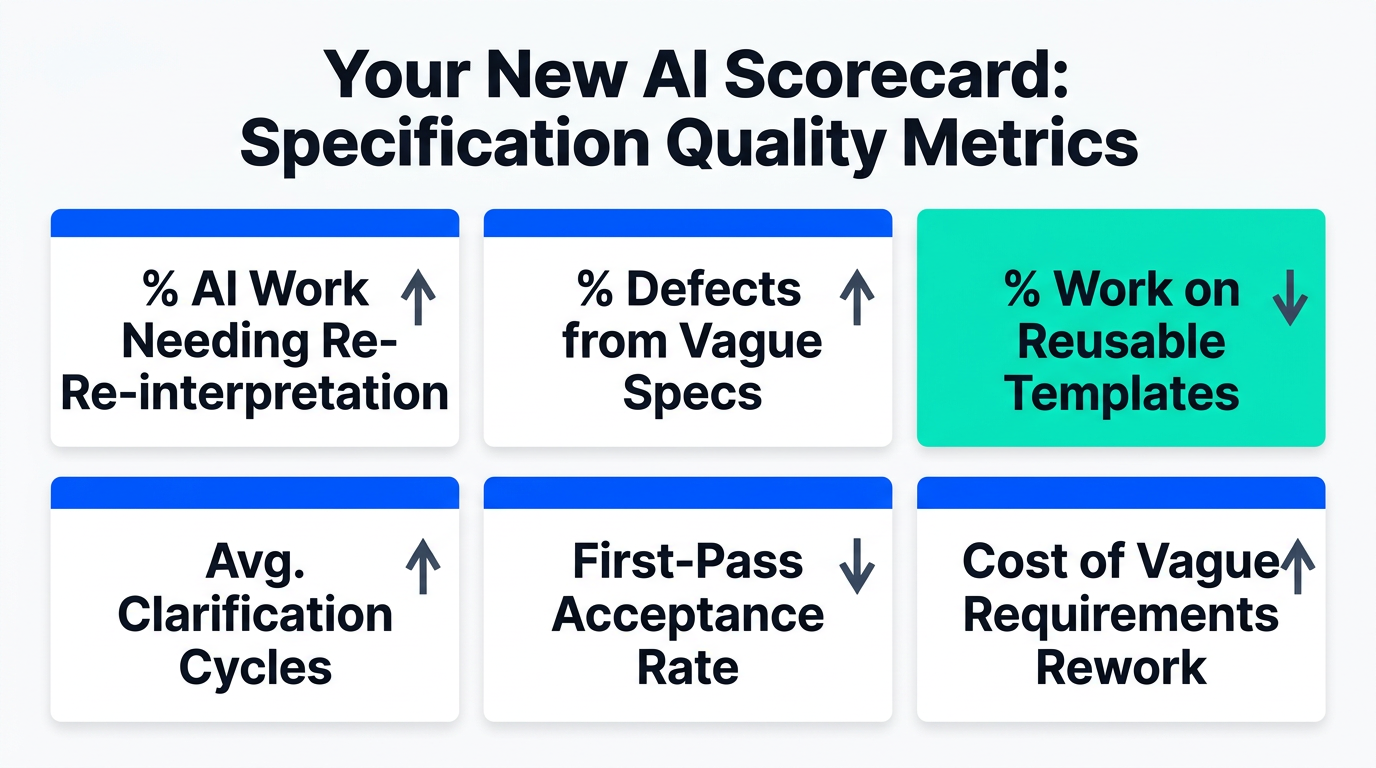
Intent Quality Measures
- Percentage of AI generated work requiring significant human re-interpretation
- Percentage of delivery defects attributable to vague or incomplete specifications
- % of delivery work supported by reusable specification templates
- Average cycles of clarification between business and engineering and AI
- First pass acceptance rate of AI generated outputs
- Cost of rework due to vague requirements
Board Perspective: Consider specification quality a key measure of AI performance, not an afterthought in the post-engineering phase.
2) Separate intent from execution
The article is right that AI fills in gaps in assumptions with statistical patterns.
The strategic implication is that enterprises must distinguish between what AI does and what humans must define.
AI is good at execution
- Code creation
- “Creating tests.
- Documentation Refactoring
- Automating Infrastructure
- workflow deployment
Humans still responsible for intention
- Aims of business
- Regulatory interpretation
- Customer experience decisions.
- Appetite for risk
- Architecture Design Principles
- Company regulations
- Trade-offs between functions
This creates a new enterprise capability:
Specification Engineering – the art of translating business intent into precise, executable instructions that can be trusted to be operationalized reliably by AI systems.
Board policy: specifications are controlled business assets, not disposable engineering documents.
3) New enterprise failure modes identification
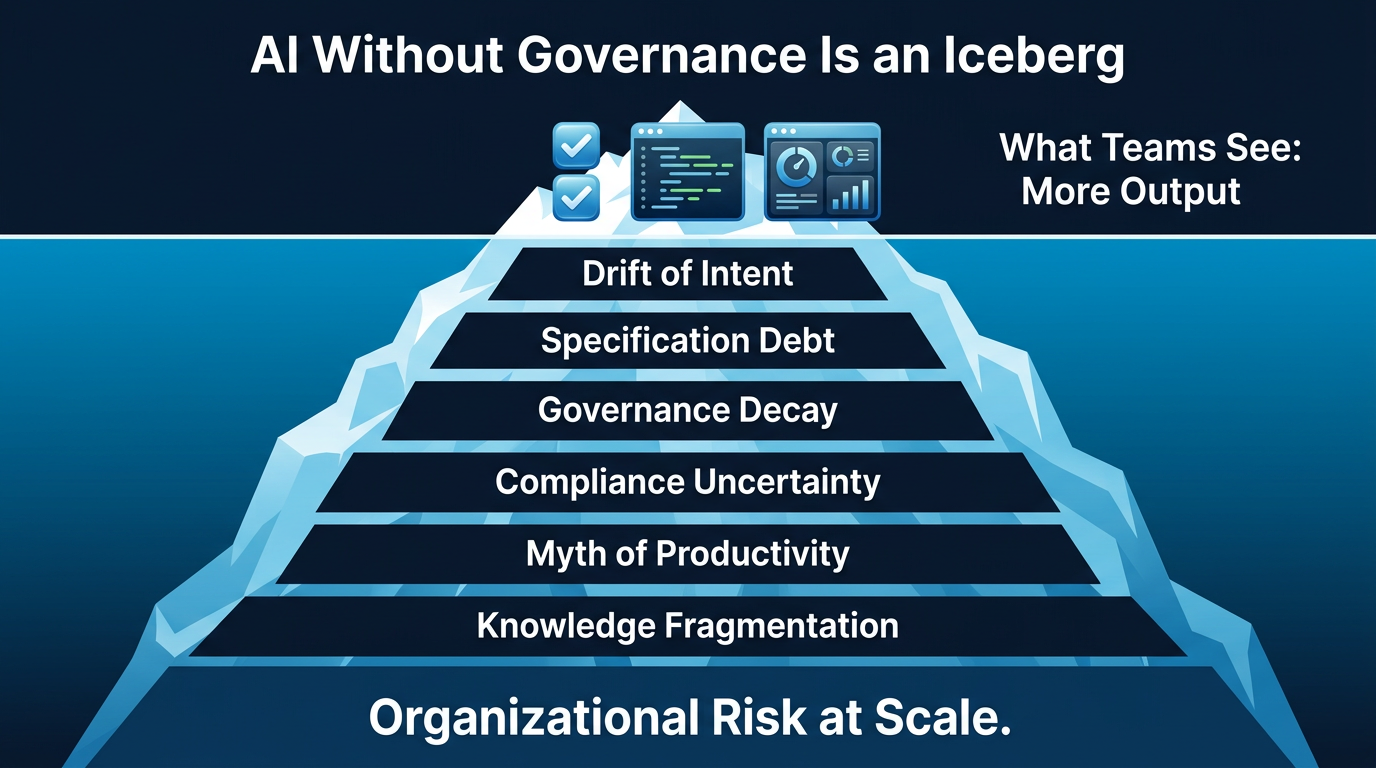
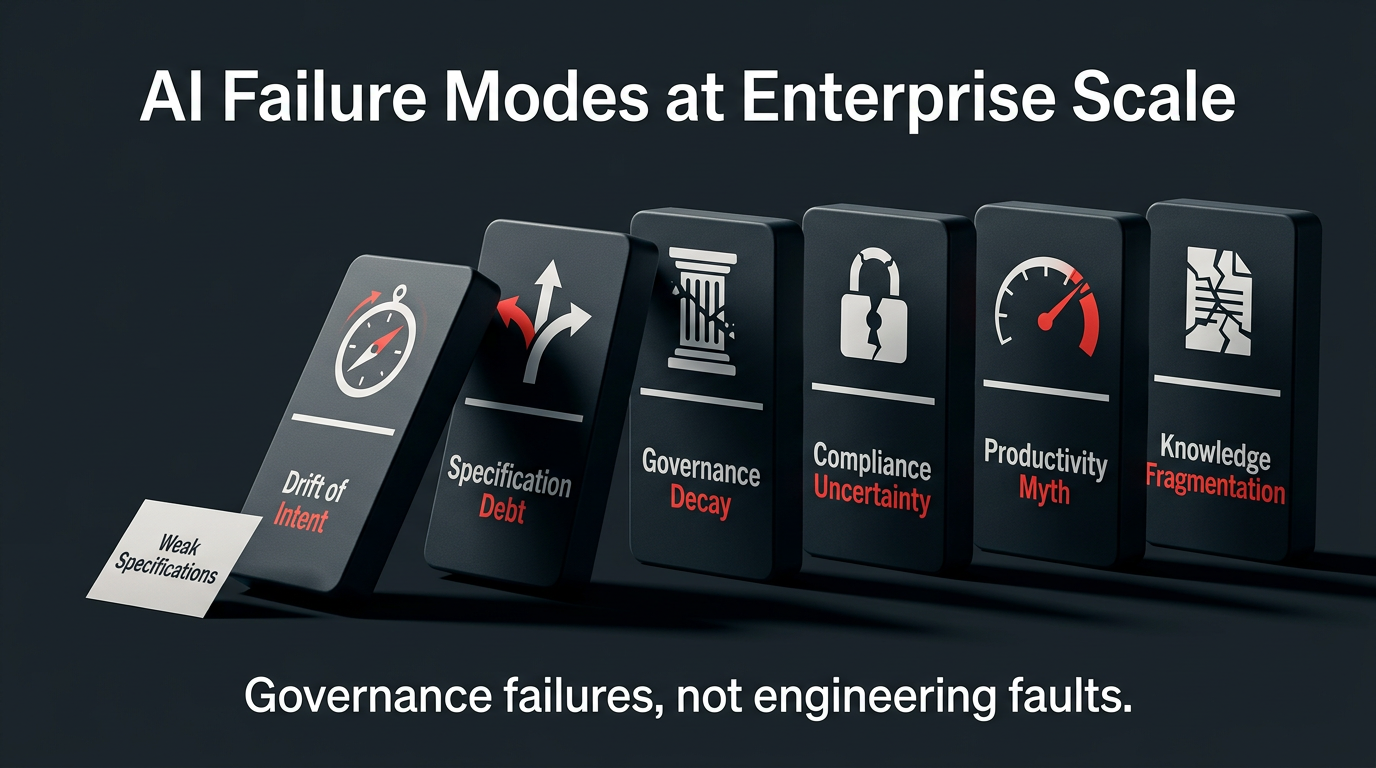
Weak specifications can no longer lead to isolated coding errors.
They create organizational risk at scale.
Expected failure modes are:
Drift of intent
AI faithfully implements an interpretation that is different than the intended business outcome.
Debt Specification
Different teams have different requirements and this results in different AI behaviours for similar business problems.
The Decay of the Governance
Conflicting policies, acceptance criteria and operational constraints set by various business units.
Compliance Uncertainty
AI makes assumptions about security, privacy or financial controls because of unclear regulatory boundaries.
Myth of productivity
More downstream validation effort means teams produce significantly more output.
Fragmentation of Knowledge
Organizational knowledge is only stored in the individual prompts, not in enterprise specifications that can be reused.
These are governance issues, not engineering faults
4) Develop an Enterprise Intent Operating Model
Most organizations have governance for applications, infrastructure, security and data.
Very few rule enterprise intent.
The next operating model should have:
1.Enterprise Specification Library
Reusable specifications for common business capabilities, regulatory obligations, architectural standards, operational patterns.
2. Policy & Constraint Engine
Built-in security, compliance, architecture, data handling and engineering standards for every AI-aided task.
3. Validation Framework:
Business acceptance criteria, automated testing, policy evaluation and human approvals before going into production.
4. Learning Loop
Enterprise specs that are constantly being improved by rejected outputs, clarifications, and production feedback, instead of being locked up in teams.
5. Governing Council
Cross functional ownership across technology, risk, security, legal, architecture and business operations .
Board translation: The future control layer is not prompt centric. It is built around governed enterprise specs.
5) Measure prompt activity maturity, not specification
Boards need to understand if AI adoption is building institutional capability or just isolated productivity gains.
Maturity of the Enterprise
- Percentage of reusable specifications throughout the organization
- Reuse of specifications
- Business capabilities coverage
- Ownership coverage specifications
- Specification review conformance
Delivery Performance
- AI first pass acceptance rate
- Human validation work
- Shorten delivery cycles
- Rephrasing because of unclear intention
Risk & Governance
- Policy violations avoided
- Specification inconsistencies detected
- Regulatory exceptions
- Production incidents due to specification defects
Economics
- Cost per validated AI generated deliverable
- Cost of ambiguous requirements
- Engineering capacity moved to higher value work
- Return of reusable specification assets
Boards should measure the maturity of enterprise intent, not just the productivity of AI tools.
6) SLOs for Specification Engineering Business
Scaling AI requires operational commitments that render the quality of specifications measurable.
For example:
- Intent Completeness SLO: All Tier 2 and Tier 3 AI initiatives include outcomes, constraints, non-goals, business rules and measurable acceptance criteria before execution.
- Ownership SLO: All enterprise specs have a responsible business owner and technical owner.
- Traceability SLO: All production AI output is traceable to an approved specification and validation evidence.
- Reuse SLO: Specifications are reused for equivalent business capabilities before creating new specifications.
- Policy Consistency SLO: Security, privacy, and regulatory constraints are consistent across all specification libraries.
- Continuous Improvement SLO: Production learnings update enterprise specifications through defined governance cycles.
These SLOs make sure that AI scales organizational knowledge—not organizational ambiguity.
7) The operating model is universal. The tooling is not.
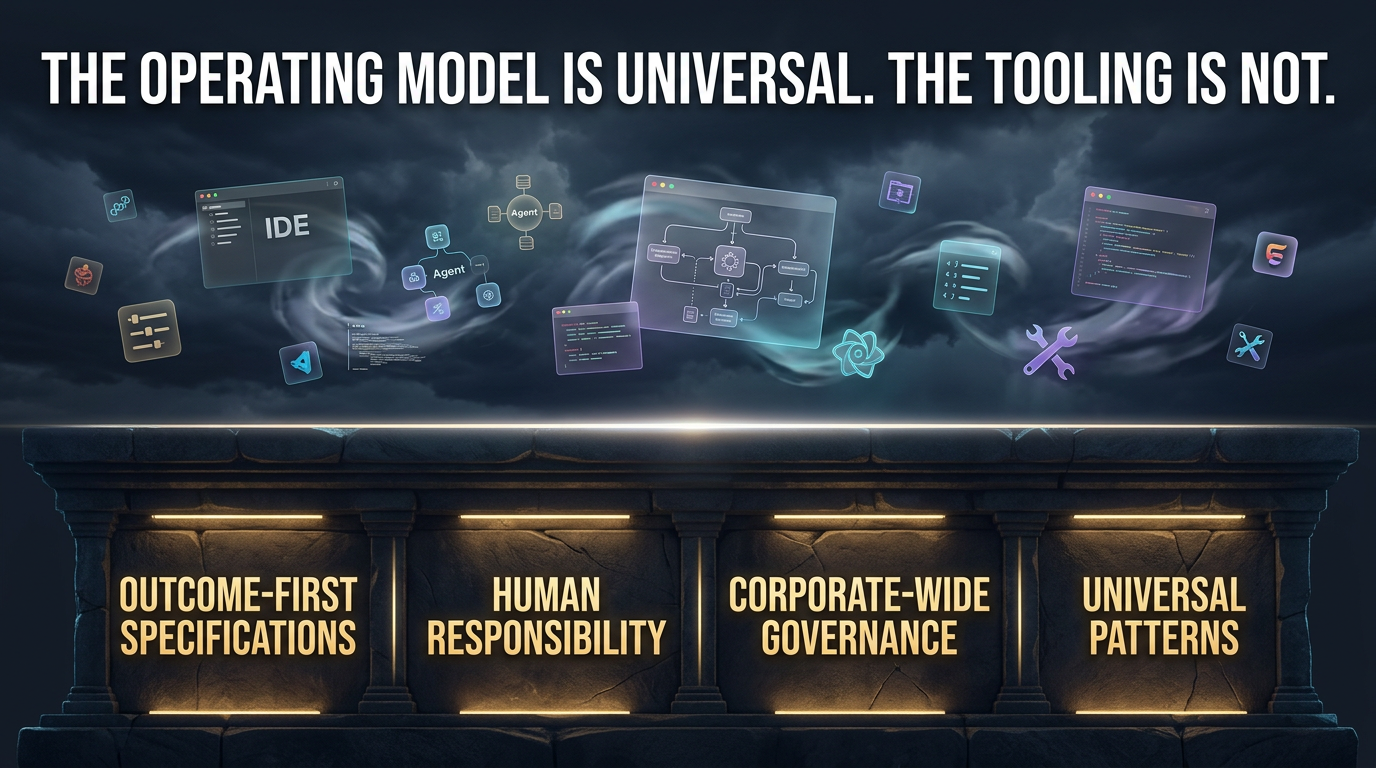
AI coding assistants, autonomous agents, and orchestration platforms will keep evolving.
The enterprise capability will not be changed.
Universal patterns
- Outcome-first specifications
- Specific business constraints
- Reusable specification assets
- Human responsibility for intention
- AI accountability for implementation
- Ongoing validation
- Corporate-wide governance
Platform accelerators
- IDE’s for AI
- Repository-aware agents
- Automation testing
- policy as a code
- Orchestration of multiple agents
- Knowledge retrieval systems
Board implication: Competitive advantage will not be in selecting the best model. It will be the product of institutionalizing the best specification discipline.
8) The organizational redesign – from Prompt Engineering to Specification Engineering
The original article ends with a call to developers to write better specifications.
Much broader are the enterprise implications.
AI takes the role of execution, and human value drifts toward intent setting.
Technology companies will continue to invest in:
- AI Solution Architects
- Enterprise Policy Engineers
- AI Governance Leaders
- Business Capability Architects
- AI Quality and Validation Specialists
- Specification Engineers
This implies a change in the capacity of the organisation.
The competitive advantage of enterprises will not be the amount of code they produce.
It will be judged on its ability to turn business strategy into executable specifications that can be consistently interpreted by thousands of AI agents.
Board translation: This is not a tooling change. It’s the birth of a new enterprise discipline.
Concluding Perspective
The first wave of enterprise AI was driven by models.
The second was on agents.
The third will be intent.
It will be hard for organizations that continue to treat specifications as temporary project documents to govern increasingly autonomous AI systems. Those who industrialize Specification Engineering will build a reusable layer of institutional knowledge that compounds the value of every future AI investment.
Board Question: Are we creating an enterprise where AI is just automating tasks, or creating an enterprise where governed specifications are the strategic interface between business intent and autonomous execution?
Leave a Reply