
Agent Identity Is the New Security Perimeter: A Board-Ready Operating Model for Autonomous AI

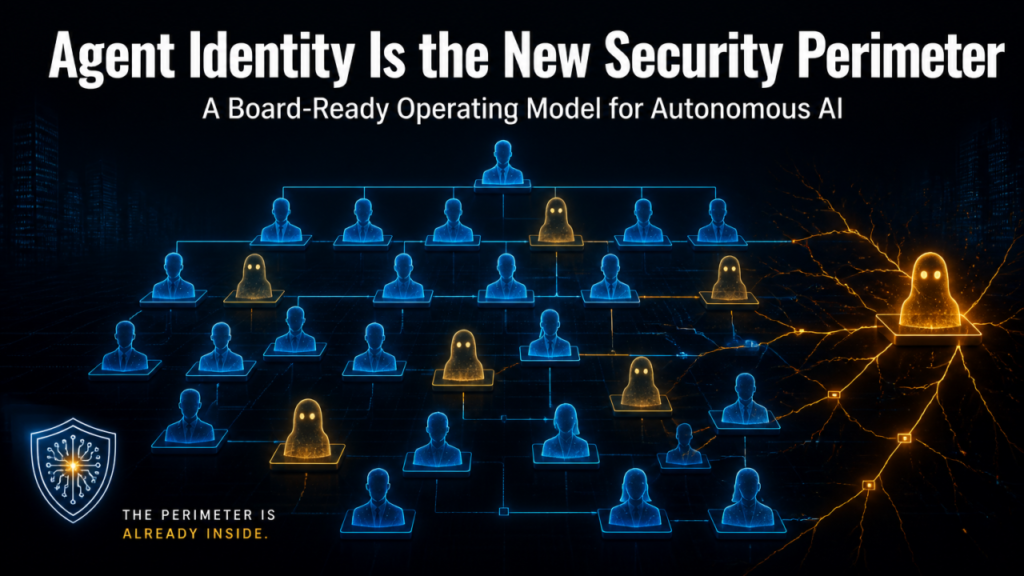
Enterprise security is built around people, apps, devices, and services.
Agentic AI brings in a new player.
AI agents can pull sensitive data, call APIs, orchestrate workflows, make recommendations and increasingly take business actions on behalf of employees and customers. But many organisations are still protecting these agents with controls designed for a less autonomous age: shared service accounts, static credentials, broad application roles and host-level trust.
That model is not scalable.
It explains how agents can be given unique, short-lived cryptographic identities using Google Cloud’s Agent Identity and SPIFFE. The wider boardroom implication is that machine identity is becoming the new security perimeter of the agentic enterprise.
The strategic question is not anymore whether an agent can reach a system.
It is whether the enterprise can show which agent instance actually did the acting, for whom it did the acting, under whose authority, with what permissions, and for how long.
1) Change the conversation – AI agents are principals, not apps
Most identity architectures still assume that a workload is fairly stable.
An application runs as a service account. The server inherits a cloud role. Multiple processes can share the same credentials. Logs identify the application or host, but not the exact runtime process that performed an action.
That is a weakness already in cloud environments. With autonomous agents this becomes a substantive control gap.
Agents are dynamic. They can be created on demand, run across containers, delegate work, call multiple tools and work for different users across different sessions. The complexity cannot be safely expressed by a generic service identity.
Therefore, boards should establish an internal identity baseline:
- Production agents share with different workload identities
- Percentage of agent actions attributed to a specific run time instance
- % of agents that have shared service accounts
- Percentage of credentials that are static or long lived
- Privileged Agent Actions Associated with a Human Principal (%)
- Average time to revoke compromised agent identities
Board Position: Treat each autonomous agent as an independent enterprise principal.
2) Agent identity separation, user authority and permission of action
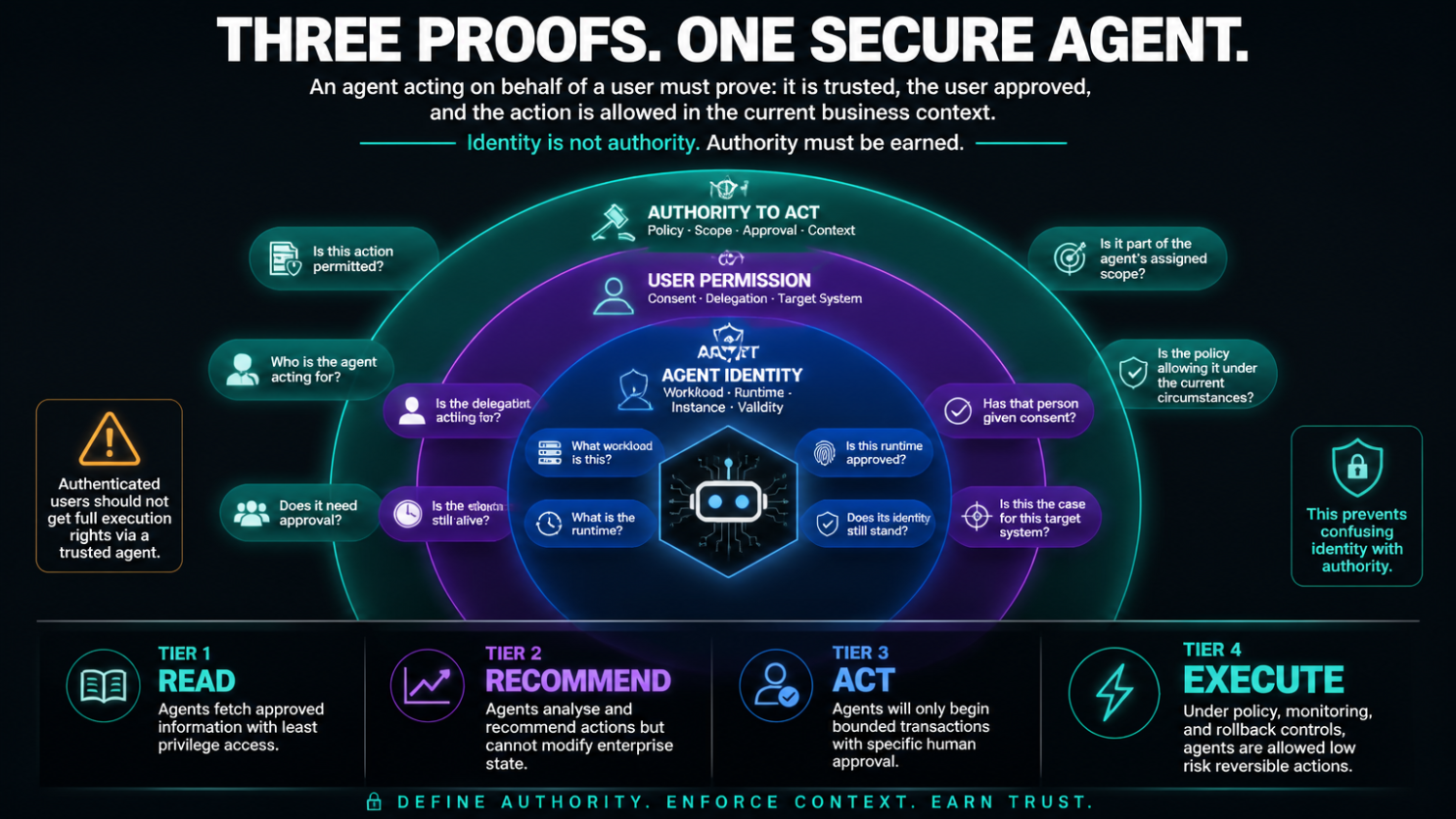
The article’s most important security insight is that an agent acting on behalf of a user must prove two things:
- The agent is trusted itself.
- The user approved the action.
Enterprise security requires a third proof:
- The action is allowed in the current business context.
These are different controls.
Identity of agent
Solutions:
- What workload is this?
- What is the run at?
- Is this the runtime instance that is approved?
- Does its identity still stand?
User permissions
Answers:
- Who is the agent acting for?
- Has that person given consent?
- Is the delegation still alive?
- Is this the case for this target system?
Authority to act
Answers:
- Is this action permitted?
- Does it need approval?
- Is it part of the agent’s assigned scope?
- Is the policy allowing it under the current circumstances?
Authenticated user should not get full execution rights via a trusted agent.
Board policy: Levels of authority of agents
Tier 1 – Read:
Agents fetch approved information with least privilege access.
Tier 2 — Recommend
Agents analyse and recommend actions but cannot modify enterprise state.
Tier 3 – Act with Approval
Agents will only begin bounded transactions with specific human approval.
Tier 4 – Execute
Under policy, monitoring, and rollback controls, agents are allowed low risk reversible actions.
This prevents confusing identity with authority.
3) Determine the new identity failure modes
Agentic systems have known security vulnerabilities.
Blindness to Shared Identity
Multiple agents use one service account which makes it hard to determine which runtime did an action.
Confusion of delegation
An unauthorised agent takes a valid user token and uses it out of the intended session.
Reuse of Identity
Compromised host or workload gets wide credentials that were never intended for process-level isolation.
Inflation is Privileged
Permissions are granted for convenience and not for the necessity of the task, so agents accumulate access across tools and systems.
Zombie Agents
Temporary agents are active after the completion of workflow, user session or business purpose.
The Auditing Ambiguity
A service accessed a resource but the full chain from user > agent > action could not be determined. (Logs show)
Downgrade to legacy
Agents dialling older services that cannot enforce stronger controls silently bypass modern identity protections.
These are not implementation details, They become audit, fraud, privacy, operational resilience and regulatory risks.”
4) Create an Enterprise Agent Identity Control Plane
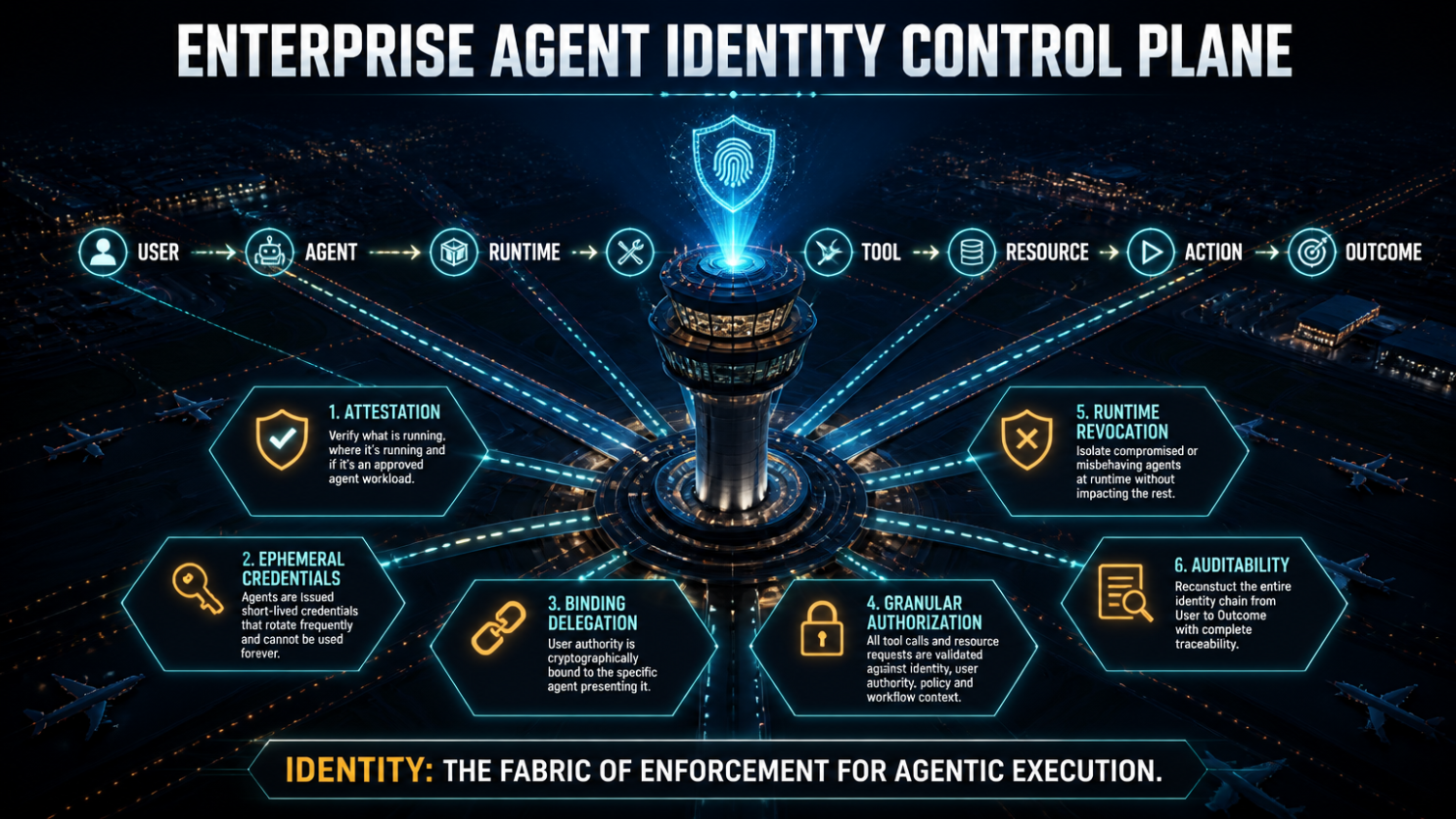
SPIFFE is useful because it provides a portable way to assign short-lived identities to workloads that are cryptographically verifiable.
The bigger enterprise need is an Agent Identity Control Plane.
Minimum control plane should contain:
1. Attestation of workload
Before issuing identity, the platform checks what is running, where it’s running and if it’s an approved agent workload.
2. TemporaryCredentials
Agents are provided with ephemeral credentials, which change regularly and cannot be used forever.
3. Binding delegation
A stolen token is less useful since user authority is cryptographically tied to the specific agent presenting it.
4. Granular Authorisation
All tool calls and resource requests are validated against agent identity, user authority, business policy and workflow context.
5. Revocation at Run-time
Ability to isolate compromised or misbehaving agent instances without having to disable an entire application or service account.
6. End to End Auditability
The enterprise can reconstruct the entire identity chain:
User → Agent → Runtime Instance → Tool → Resource → Action → Outcome.
Board translation: identity, the fabric of enforcement for agentic execution.
5) Measure identity assurance, not account coverage
Identity programs often report on how many applications are tied to IAM.
That is not sufficient for autonomous agents.
There are four dimensions boards need to track.
Identity Integrity
- Unique identity coverage
- Credential Reduction Sharing
- Lifetime of certificates
- Success rate of attestation
Assurance of Delegation
- Cryptographically bound % of user authorised actions to agents
- Delegation expiration enforcement
- Invalid delegation blocked
- Cross session token reuse found
Control Privilege
- Compliance with least-privilege
- Rate of privileged action
- Blocked unauthorised tool calls
- Permission exceptions under way
Resilience in Operations
- Time to take an agent out
- Time to quarantine a compromised runtime
- Identity incident frequency
- Success of audit reconstruction
The goal is not to provide proof that an agent authenticated.
It is to establish that the right agent performed the right act for the right principal, under the right authority.
6) Enterprise SLOs for agent identity.
Security for agents needs to be quantifiable commitments.
Practical examples of SLOs are:
- Unique Identity SLO: All production agents possess unique workload identities.
- Credential SLO: 0 static secrets for self-sufficient production agents.
- Delegation SLO: 100% of user delegated sensitive actions are associated with the executing agent identity.
- Least-Privilege SLO: Agents receive authorisations that are scoped to a task and time-limited.
- Traceability SLO: All material actions are traceable to a user, agent, runtime, tool and outcome.
- Revocation SLO: Compromised agent identities can be disabled within bounded number of minutes.
- Lifecycle SLO: Agent identities are temporary and are automatically revoked when the workflow ends.
These SLOs put zero-trust principles into practice.
7) Implementation is not global; security pattern is
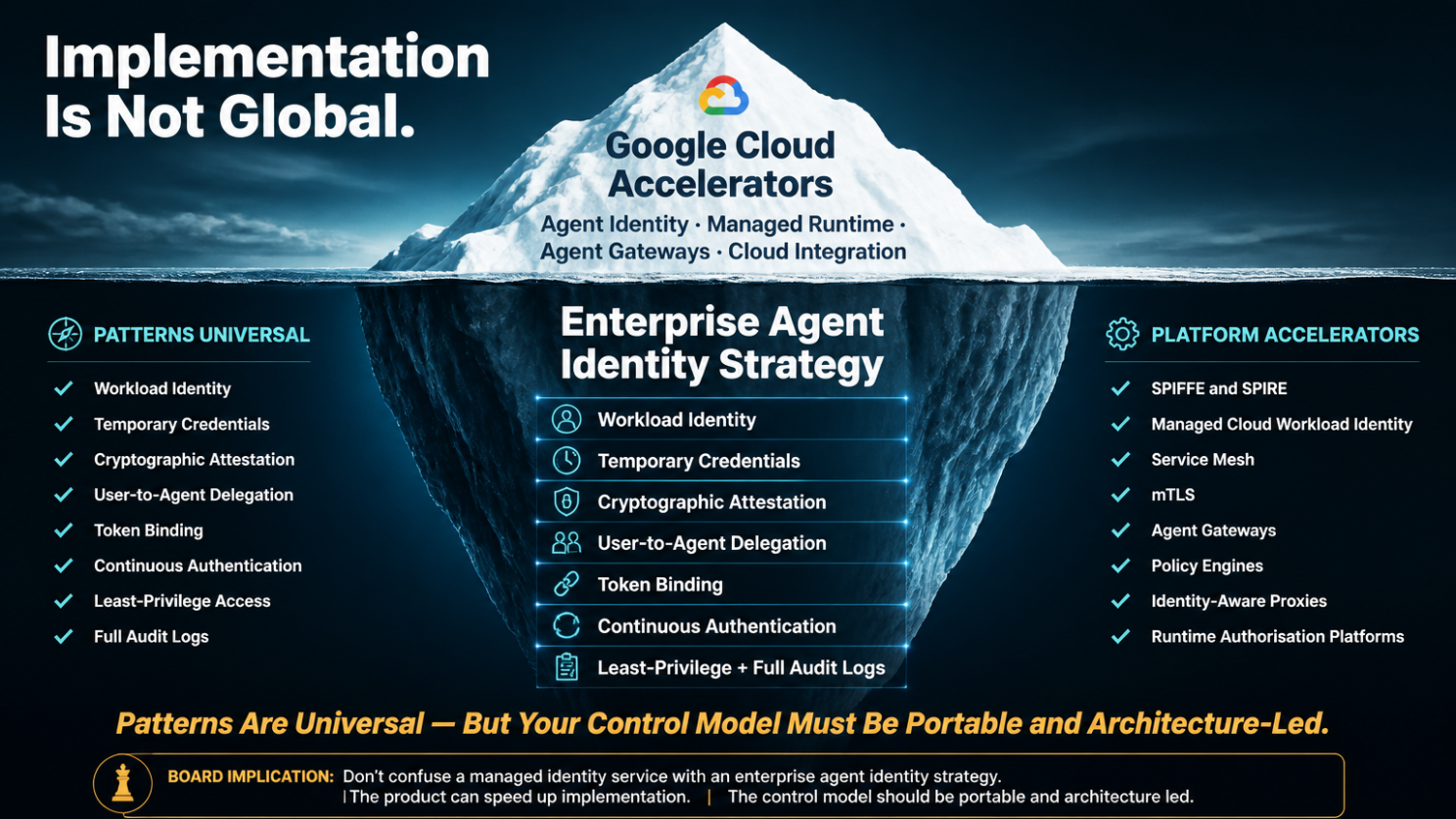
Speed up adoption with Google Cloud’s Agent Identity, managed runtime identity, agent gateways and cloud integration.
But the enterprise pattern is transportable.
Patterns universal
- different work load identity
- temporary credentials
- cryptographic attestation
- user-to-agent delegation.
- token-binding
- continuous authentication
- least-privilege access
- full audit logs
Platform accelerators
- SPIFFE and SPIRE
- managed cloud workload identity
- service mesh
- mTLS
- agent gateways
- policy engines
- identity-aware proxies
- runtime authorisation platforms
Board implication: Don’t confuse a managed identity service with an enterprise agent identity strategy.
The product can speed up implementation. The control model should be portable and architecture led.
8) Cybersecurity is transforming the operating model
SPIFFE: a technical approach to securing agents, described in the original article.
The larger implication is organisational.
Security teams will need to extend identity governance beyond human and application identities to autonomous machine actors.
This means new responsibilities:
- Registering and Classifying of Agents
- assigning responsibility to owners
- specifying delegation policies
- controlling tool access
- monitoring device behaviour
- identity revocation
- in auditing agent decision chains on the fly
- dealing with legacy service exceptions
IAM, cloud security, application security, AI governance and business risk can no longer be siloed.
Board translation: Agent identity is not just another IAM project. It is the foundation for responsible autonomous work.
Final Thought
Every major computing shift has brought with it a new identity challenge.
The web needed user identities.
Cloud needs workload identity.
APIs required a service identity.
Agentic AI demands delegated, instance-level, continually verified identity.
Shared service accounts and static credentials become less and less defensible as agents become more independent. Enterprises need to be able to show that not only did a trusted system access a resource, but that a particular agent instance acted on behalf of an authorised person, within an approved scope, under enforceable policy.
And that’s why SPIFFE matters. Not because it’s a trendy standard but because it indicates the path to the security model that autonomous systems require.
Board Question: As we see AI agents starting to act in significant enterprise workflows, can we trace for whom, who acted, under what authority, and with what result? Or are we still trusting autonomous systems through identities built for traditional applications?
Leave a Reply