
AG-UI and the Birth of Enterprise Interaction Architecture: A Board-Ready Operating Model for Human-AI Collaboration

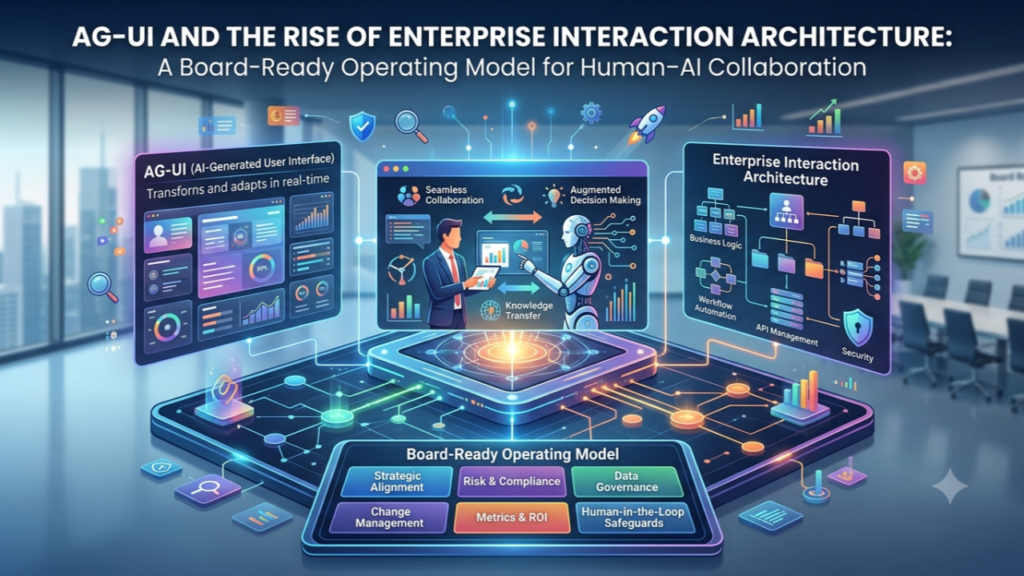
For three decades, mostly, enterprise applications have been built with a predictable interaction model. A user sends a request . The application executes business logic . The system returns a response . APIs standardized communication between applications and event-driven architectures enabled scalable integrations in increasingly distributed systems.
Agentic AI contradicts that assumption on its face.
AI agents do more than just respond to requests. They use multi-step reasoning, call enterprise tools, collaborate with other agents, wait for approvals, stream intermediate results, and update the application state in real-time. The interaction is no longer transactional, but persistent, stateful and collaborative.
This creates a new architectural gap.
Organizations already have standards around how applications talk to each other (APIs), how agents connect to enterprise tools and data (MCP) and how agents collaborate with each other (A2A). What’s been lacking is a standardized approach for enterprise users and autonomous agents to collaborate on long-running business workflows.
Such is the strategic importance of AG-UI.
The innovation is not the protocol itself. The innovation is understanding that human and AI collaboration is an enterprise architecture layer that requires governance, observability, and operating discipline.
The question for the board is no longer whether employees can chat with AI. It’s about whether the enterprise is creating an interaction architecture that can govern how humans and AI work together.
1) Reconsider conversation: from user interfaces to interaction architecture
“Most organizations still look at AI through the user experience lens.
They slap chat windows on existing apps and call it transformation.
That’s the mindset of the previous generation of software.
Enterprise agents are embedded in workflows across many systems, stakeholders, approvals, and decisions. They gather information, call for tools, coordinate sub-agents, ask for clarification, and adapt to a changing business context.
This is not a dialogue.
It’s a team effort.
So boards should measure interaction maturity, not chatbot adoption.
The practical readiness baseline should include:
- % of enterprise workflows with human-agent cooperation
- % of agent actions requiring structured approvals
- Percentage of applications that can maintain shared interaction state
- Average time to interruption and approval
- Percent of AI interactions logged in auditable event streams
Board position: Human-agent interaction is evolving from a frontend feature to enterprise infrastructure.
2) Conversation, Collaboration and Authority Break-Up

One of the key architectural separations is to separate communication from decision rights
• Future enterprise interaction models will need three separate layers.
Dialogue
Conversations in Natural Language Between Users and AI.
Working together
Context sharing Streaming progress Workflow orchestration Interruptions Multimodal interactions Coordination between humans and agents execution
Authority.
Policies, approvals, security controls, segregation of duties, and business accountability that define what actions are allowed.
An agent can explain, recommend and coordinate.
This does not automatically grant execution.
Levels of Interaction Autonomy Board Policy
Tier 1 – Informing
Agents Answers questions and surfaces enterprise knowledge.
Tier 2 – Work Together
Actions are proposed by agents, who coordinate stakeholders and collect information.
Tier 3 – Direct
Agents prepare approvals, initiate workflows and coordinate many systems.
Tier 4 – Act
In places with governance, rollback and accountability, agents can only perform limited operational actions.
That’s the difference between smart teamwork and going it alone.
3) Name the interaction failure modes
Predictable risks arise as enterprises scale human-agent collaboration.
Context fragmentation
Different applications maintain different views of the same interaction. The user experience is thus inconsistent.
Approval override.
Of course, agents do things because they have technical ability, not business authority.
Drift in interaction
Interaction patterns are not standardized so users get different behaviors on channels, devices or applications.
Unseen reasoning
Agents produce recommendations without revealing the intermediate reasoning, evidence or workflow state.
Workflow abandonment
Long-running interactions fail when users move between devices, applications, or sessions, losing context.
These aren’t problems of user experience.
They are operational resilience, audit and governance challenges.
4) Develop an Enterprise Interaction Control Plane (EICP)

AG-UI is not meant to be another developer protocol.
It is the foundation of an Enterprise Interaction Control Plane.
A mature interaction architecture has:
Interaction Portal
A standard interface for communication between enterprise apps and AI agents, regardless of the underlying framework.
Shared State Layer
Keeps context in sync between users, agents, workflows and business applications.
Workflow Orchestration
Orchestrates long-running business conversations across multiple systems, agents and stakeholders.
human approval level
Ensures interruptions, escalations and business approvals follow governed workflows.
Interaction Visibility
Tracks each event, decision, transition, approval and outcome for audit, compliance and continuous improvement
Board Translation: Within the agentic enterprise, API governance is as crucial as interaction governance.
5) Measure Quality of Collaboration, Not AI Use

“Prompt counts and chat sessions don’t tell us much about enterprise value.
“Boards need to see if the collaboration between humans and agents is producing better operational outcomes.
Cooperation
- Workflow completion rate
- Rate of human intervention.
- Success in multi-agent coordination
- Average cycle time of a collaboration
Experience
- Customer satisfaction
- Context continuity between sessions
- Interaction lag
- Escalation Responsiveness
Governance
- Blocked Unauthorized Actions
- Approval adherence
- Audit thoroughness
- Intercepted policy violations
Business Value
- Reduction in cycle time
- More productivity
- Cost savings from workflow automation
- Improvement in customer response time
The goal isn’t to measure conversations with AI.
It is to gauge collaborative execution.
6) Enterprise SLOs for Human–Agent Collaboration
Interaction architecture requires service commitments at the enterprise level.
Examples of practical SLO’s are:
- All production interactions are wholly auditable.
- Every business action has a responsible owner.
- Shared workflow state stays in sync across apps.
- Sensitive actions are always subject to governed approvals.
- Agent interruption is routed to the responsible stakeholder within defined response times.
- Each completed interaction generates evaluation signals for ongoing improvement.
Such commitments make collaboration a quantifiable business capability.
7) The operating model is universal. The protocol is pluggable.
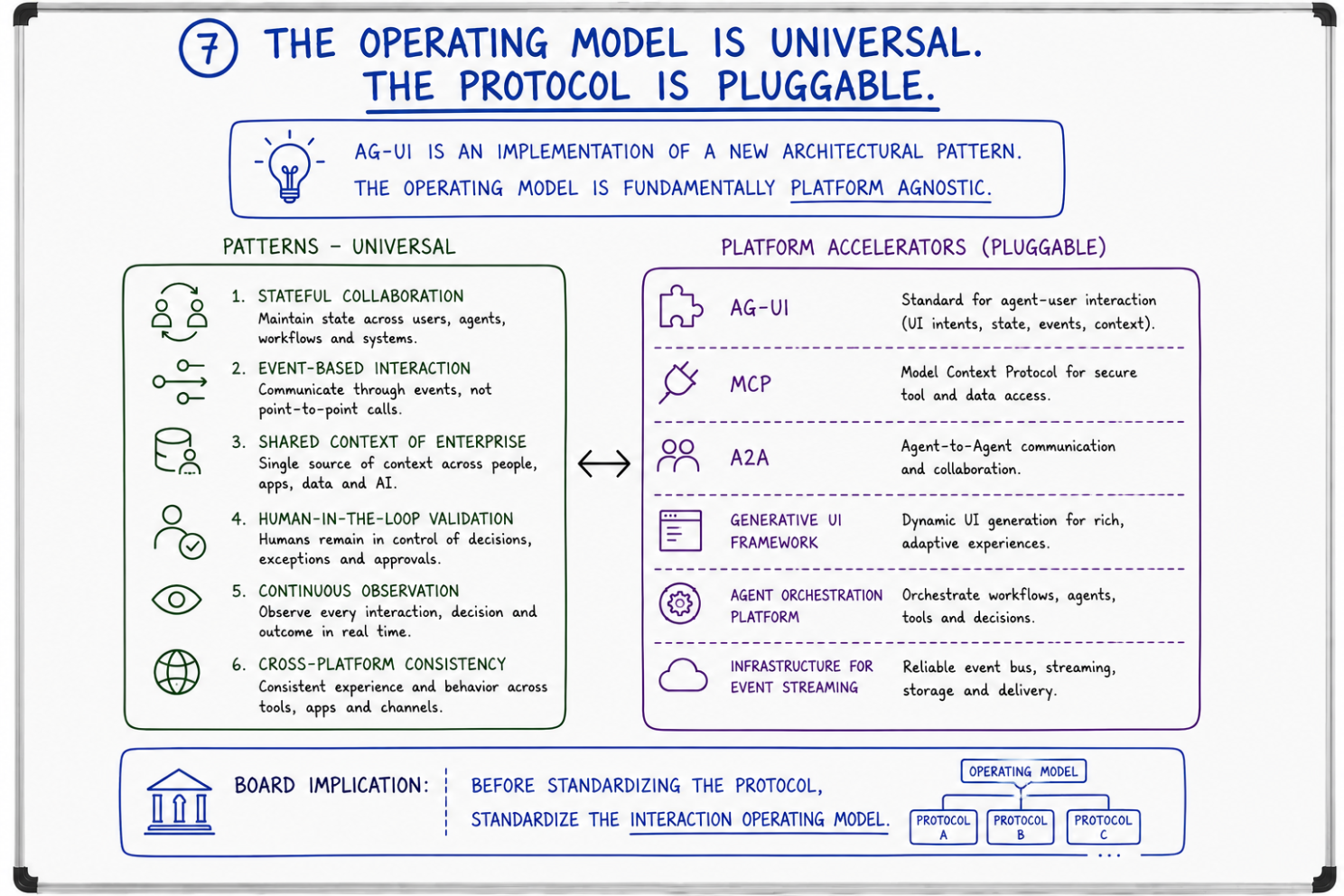
AG-UI is an implementation of a new architectural pattern.
The operating model is fundamentally platform agnostic.
Patterns universal
- Stateful collaboration
- Event-based Interaction
- Shared context of enterprise
- Human-in-the-loop validation
- Continuous observation
- Cross-platform consistency
Platform accelerators
- AG-UI
- MCP
- A2A
- Generative UI framework
- Agent orchestration platform
- Infrastructure for event streaming
Board implication: Before standardizing the protocol, standardize the interaction operating model.
8) The operating model changes the design of enterprise applications
But the long term implication is broader than developer tooling.
Application teams will build more and more:
- collaborative workflows versus static screens
- interaction policies rather than UI logic
- approval journeys rather than clicks
- persistence conversations rather than isolation sessions
Enterprise applications are evolving from transaction processing systems into collaborative platforms where humans and AI work together to execute business processes.
This will necessitate new capabilities in architecture, governance, security, product design and operations.
Board translation: AG-UI is not a new frontend standard. It signals the rise of enterprise interaction architecture as a foundational layer of the agentic enterprise.
Closing perspectives
With each major shift in technology a new enterprise abstraction was introduced.
Graphical interfaces introduced by client-server.
The internet brought web architecture.
APIs became the basis of distributed computing with the cloud.
Agentic AI requires a new approach to regulated interaction between humans and autonomous systems.
The technical foundation is in protocols like AG-UI, but the lasting competitive advantage will be from organizations that design interaction as an enterprise capability, not just a conversational interface.
As AI agents become active participants in enterprise workflows, the quality of the interaction architecture will increasingly drive trust, governance, user adoption and business value.
Board Question
Or are we embedding AI into existing applications? Or are we building an enterprise interaction architecture where humans and autonomous agents collaborate with the same governance, consistency and accountability that define every other mission-critical enterprise system?
Leave a Reply