
The CXO Guide to AI Agent Platforms

The Next Enterprise Operating Model Is Being Written Right Now
The first wave of AI was about models. The second wave was about copilots. The third wave is about autonomous agent systems coordinating work across the enterprise.
We are witnessing the emergence of a new execution fabric — one where software no longer waits for human instruction but plans, acts, and adapts continuously. Most discussions about “agent platforms” are at the surface level. They focus on tools. But underneath it is a multi-layered architecture that will define how enterprises operate over the next decade. To make sense of the landscape, leaders need to understand one critical reality:
This is not one market. This is a full-stack. And each layer is being owned by a different class of player.
Enterprises won’t standardize on a single agent platform.Majority of them will assemble a stack.
Autonomous Enterprise Stack (AES)
The agent ecosystem is converging into five distinct control layers. Understanding these layers clarifies where each vendor, tool, and model truly sits.
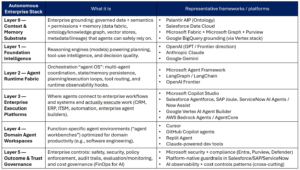
Layer 1 — Foundation Intelligence (Cognitive Core or Intelligence Layer)
These are the reasoning engines powering agents.
- OpenAI GPT
- Anthropic Claude
- Google Gemini
They provide: Planning capability, reasoning depth, tool use intelligence, adaptive decision loops, and memory patterns. They power the agents but are not agents themselves. In a true sense, they are not agent platforms by themselves. They are the cognition layer.
Layer 2 — Agent Runtime Fabric (Orchestration Layer)
This is the most strategic battleground forming right now.
- Microsoft Agent Framework
- OpenAI Frontier
- Google orchestration stack
- LangGraph style stacks and other emerging open agent frameworks
This layer manages: multi-agent coordination, memory persistence, planning/execution loops, policy & governance controls, and system observability.
This is becoming the operating system for autonomous work. Whoever controls this layer controls how work flows.
Layer 3 — Enterprise Execution Platforms
This is where business transformation becomes tangible.
- Microsoft Copilot Studio
- Salesforce Agentforce
- SAP Joule
- Google Vertex AI Agents
- AWS Bedrock Agents
- UiPath
These platforms connect agents to: enterprise workflows, enterprise data, and enterprise systems.
They translate intelligence into execution. This is the layer most organizations are adopting today.
Layer 4 — Domain Agent Workspaces
These are specialized environments where agents operate within a specific function.
- Cursor (software engineering)
- GitHub Copilot agents
- Replit
- Claude-powered dev tools
They are optimized for domain productivity, not enterprise orchestration. Think of this layer as agent workbenches.
Layer 5 — Outcome & Trust Governance Layer
This is the least discussed, but it will become mandatory. Responsible AI. AI Observability, FinOps for AI, and AI Security converge in this layer. This layer includes:
- AI safety systems, accuracy, and risk scoring
- Policy enforcement and compliance agents
- audit trails and explainability
- cost governance
This layer answers the question: Why did the agent act? Was it compliant? Was it safe? Was it cost-efficient?
Well There is this fifth and important layer that sits underneath Layer 1.
Layer 0 — Context & Memory Substrate (Context Fabric or Enterprise Memory Layer)
This sits below the Cognitive Core. And it will become the hardest problem in enterprise AI. This layer includes:
- Enterprise data fabric
- Knowledge graphs and Ontologies
- Vector memory stores
- Semantic context layers
- Metadata systems
- Identity + permissions context
- Historical decision traces
Agents are only as good as the context in which they operate. Without this layer:
- Reasoning collapses
- Hallucination risk rises
- Decision quality drops
- Enterprise Trust breaks
This is where companies like Palantir built their differentiation early. This is why Microsoft Fabric + Graph or BigQuery is a good fit. This is why Salesforce is pushing Data Cloud so hard.
I will discuss the top frameworks for each layer in separate upcoming articles. Let's talk about the top 10 Enterprise Agent Frameworks (across layers) Shaping the Autonomous Enterprise15 Enterprise Agent Frameworks Shaping the Autonomous Enterprise
Below are 15 frameworks and platforms that are shaping how enterprises design, deploy, and scale agents. 15 AI Agent Platforms Every Business Leader Should be Familiar With (How to Determine Which One Best Represents Your Starting Point)
We’ve shifted from “Can Gen AI write a good email?” to “Can an agent successfully execute a workflow, enable toolsets, and close the loop with guardrails?”And that also changes because, as noted, agents don’t just generate, they also plan, decide, and act. And that’s why, as mentioned above, the “conversation among boardroom executives has shifted from whether to explore AI to where to apply agentic work first, and how to do it safely.”
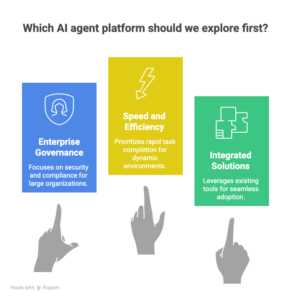
There have been many platforms over the last year touting an “AI workforce” – some designed for enterprise governance, some for speed, and some baked into the applications your teams already use (CRM, finance, automation, etc.). Here, you will discover an explanation of 10 fundamental agent platforms that any leader ought to be acquainted with, as well as a simple means of choosing where to start with respect to the best platform.
Ahead of the Platforms: A Leader’s Lens on Where Agents Fit.
This is, I think, the simplest way for CXOs to think about agent adoption: Agents work best when all three are true:
- There are repeatable goals (triage tickets, reconcile invoices, qualify leads).
- The work affects several systems (email, CRM, docs, approvals).
- There’s measurable success (cycle time ↓, errors ↓, revenue leakage ↓).
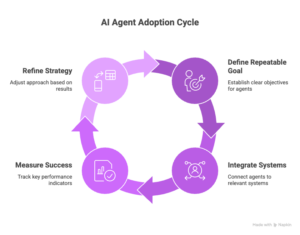
Once you have that, the conversation around the platform is less about hype and more about the ecosystem, governance structure, and time-to-value.
Note: Not all players below operate at the same layer. Some are orchestration frameworks, some are enterprise execution platforms, and some are intelligence runtimes. Together, they form the backbone of the enterprise agent ecosystem.
1) Google Vertex AI + Vertex AI Agent Builder & Project Astra
Google Vertex AI is Google’s enterprise foundation for building, deploying, and operating AI systems—now extending naturally into agents through Vertex AI’s agent-building capabilities. It provides the core platform services for connecting models to data, retrieval, tools, and scalable runtime execution.
Vertex AI Agent Builder sits on top of the Vertex AI environment, where intelligence is converted into operational agents grounded in enterprise data. Vertex AI Agent Builder is the layer that turns models and enterprise data into production agents with grounded responses and task execution.
From a business standpoint, Vertex AI helps enterprises industrialize AI—moving from experiments to governed, scalable deployments. Agent Builder accelerates the “last mile” from intelligence to outcomes: customer support agents, employee knowledge assistants, workflow agents, and search-to-action experiences that reduce contact center load and speed up decision cycles.
Google’s broader direction, highlighted through efforts like Project Astra, points toward persistent, multimodal agents that can operate continuously across contexts — signaling a future where agents move from task-based to environment-aware execution. Project Astra is a research prototype working toward a “universal AI assistant.” The technology is expected to be rolled out across Google services (Gemini Live, Search, and more).
- Vertex AI (platform layer): model lifecycle (training/hosting), integration with data/services, production deployment patterns, and operational monitoring for AI workloads. This is the “AI factory.”
- Vertex AI Agent Builder (agent layer): grounded retrieval over enterprise content, conversational orchestration, tool/function invocation, and multi-step task flows. This is the “agent assembly line.”
- Project Astra: Astra signals Google’s direction toward persistent, multimodal, context-retaining agents.
If your strategy begins with Google Cloud, and you are passionate about a strong foundation for building, scaling, and governing your agents, then Vertex AI Agent Builder is certainly a product worth considering.
Best For: Google Cloud-first enterprises, Multimodal + Search-centric agent experiences.
2) Microsoft Copilot Studio
Microsoft Copilot Studio is rapidly becoming the enterprise front door for deploying agents into day-to-day work. It sits directly inside Microsoft 365, Teams, Dynamics, and Power Platform, allowing organizations to embed agents into collaboration, productivity, and operational workflows where employees already spend their time.
It provides a low-code environment for designing and deploying task-oriented agents grounded in enterprise data via Microsoft Graph, and for securing them with Microsoft Entra identity and compliance controls. This makes agents identity-aware, permission-aware, and deeply integrated into the enterprise context from day one.
Operationally, Copilot Studio accelerates the last mile of execution — HR assistants, IT support agents, finance copilots, and internal workflow automation that can retrieve context, trigger processes, and take action across connected systems. Its real strength is distribution. Agents don’t live in a separate portal—they live in Outlook, Teams, SharePoint, and business apps.
Copilot Studio acts as the execution surface where intelligence is converted into daily work.
Microsoft is positioning Copilot Studio as the primary enterprise interaction layer where employees collaborate with agents as part of their normal workflow.
Best for:Knowledge workers, Enterprise workflow automation, Organization-wide copilots. Teams living inside Teams/365/Power Platform who want fast, workflow-first automation.
3) Microsoft Agent Framework
Beyond individual copilots, Microsoft is building a deeper orchestration fabric with its Agent Framework. While Copilot Studio is the interface layer, the Agent Framework is the coordination layer where multi-agent systems begin to operate as structured execution networks.
This is where enterprise automation shifts from isolated productivity boosts to coordinated, cross-departmental execution. The framework supports planning loops, memory persistence, agent coordination, task delegation, and long-running execution across enterprise systems.
It enables scenarios where multiple agents collaborate across applications — one gathering data, another analyzing it, another triggering workflows — creating a coordinated chain of execution rather than single-point assistance.
Over time, this layer will determine how enterprise work is orchestrated between agents, humans, and systems.
While still evolving, this framework signals Microsoft’s long-term strategy: moving from isolated assistants to coordinated agent ecosystems capable of managing complex enterprise tasks. This is where large-scale, multi-agent enterprise automation will likely take shape.
While Copilot Studio is the interface layer, Microsoft’s Agent Framework is the coordination layer.
Best For: Enterprises planning multi-agent automation across departments, large-scale workflow orchestration, complex enterprise processes.
4) OpenAI (Frontier Framework Direction)
OpenAI is evolving from a model provider into a foundational intelligence and execution layer for custom agent systems. OpenAI’s Frontier direction represents the evolution from “LLM-as-a-chatbox” to an agent-capable intelligence and execution substrate.
In practical terms, Frontier is the combination of frontier-grade reasoning models and the surrounding primitives that make agents reliable: structured tool use, multi-step planning, state/memory patterns, and execution control. Its capabilities in reasoning, tool interaction, and multi-step planning are driving many of the most advanced agent deployments today.
Frontier enables enterprises to build domain-specific agents for research, support, operations, and engineering, and fundamentally move from copilots that assist to agents that deliver outcomes—research synthesis, incident triage, customer resolution, finance ops, and software engineering tasks that require long-horizon reasoning and tool interaction. Technically, Frontier is best understood as an agent runtime direction: reasoning-first models, deterministic tool calling, and workflow/state management patterns that allow agents to plan, act, observe results, and iterate safely. This is why OpenAI increasingly sits not only in the model layer but also influences how enterprises design their entire agent-operating architecture.
Best For: Intelligence-heavy use cases, custom agent development, research, engineering, and decision support environments.
5) Amazon Bedrock (including Bedrock Agents + AgentCore )
AWS is positioning itself as the infrastructure-grade foundation for agent-driven systems. AWS Bedrock is AWS’s enterprise foundation for consuming and operationalizing foundation models securely within AWS environments. Within that, Bedrock Agents and the AgentCore direction represent AWS’s orchestration and runtime path for building agents that plan, call tools, and execute multi-step workflows reliably.
- Bedrock (foundation layer): model access abstraction, security and identity integration, enterprise controls, and native alignment with AWS services (data, compute, networking). This is the “model and enterprise guardrails layer.”
- Bedrock Agents (agent layer): task planning, tool/API invocation, orchestration of multi-step actions, and integration patterns for workflows that span AWS services and internal APIs. This is the “agent executor.”
- AgentCore (runtime layer): a clearer move toward an agent runtime fabric—standardized execution primitives (state, memory patterns, observability hooks, and long-running orchestration) that make agents production-grade at scale. This is the “agent operating substrate” that reduces bespoke glue code and improves reliability.
AWS positions AgentCore as an agentic platform to build, deploy, and operate agents securely at scale without having to manage infrastructure and with “memory and controlled access to tools and data. If you are already deep inside AWS services, AgentCore is a natural path to production-grade agent rollout with enterprise security patterns.
Best for: AWS-native enterprises prioritizing security, scale, and production operations. If your enterprise architecture is AWS-centric and you want deep control over security, integration, and execution, this stack provides a strong foundation.
6) Salesforce Agentforce
Salesforce is positioning the CRM as the central execution hub where customer-facing agents operate continuously across the lifecycle. Salesforce Agentforce embeds agents directly into customer-facing workflows across sales, service, revenue operations, and marketing operations. It transforms CRM systems from passive record systems into active execution environments powered by agents.
- Salesforce platform layer: CRM data models, workflow triggers, event-driven automation, and enterprise integrations across customer systems.
- Agentforce execution layer: contextual agents that assist with case resolution, sales qualification, customer engagement, and workflow automation across channels. It enables faster customer response times, automated case handling, smarter sales assistance, and more proactive engagement, driven by real-time customer context.
Salesforce Agentforce operates inside the Salesforce ecosystem, grounding decisions in unified customer profiles, interaction history, and operational data. The business value is immediate in sales, service, and marketing — faster response, smarter engagement, and more proactive customer operations driven by CRM-grounded context. Technically, the strength comes from deep integration with customer data models, workflow triggers, and process automation layers. Agents operate inside the customer graph, not outside it.
This gives Salesforce a strong position in customer-centric agent orchestration.
Best for: Enterprises with Salesforce footprint. Revenue, service, and customer operations leaders who want agentic automation close to CRM truth.
7) SAP Joule
SAP Joule introduces agent capabilities into the ERP core, embedding intelligence directly into finance, supply chain, procurement, and operational workflows.
- ERP platform layer: deep integration with structured enterprise data models, process definitions, and operational workflows.
- Joule agent layer: contextual assistance, process-aware automation, and decision support embedded directly into ERP execution environments.
Inside SAP environments, Joule can provide contextual recommendations, assist with process execution, and support operational decision-making grounded in enterprise data models and workflows. Agents operating here influence planning, forecasting, cost optimization, and process coordination — areas that directly affect business performance.
This is not surface-level productivity automation. It is operational intelligence embedded into the backbone of enterprise execution.
If your enterprise runs on SAP and you want agents embedded into operational decision-making, Joule becomes strategically important.
Best For: SAP-centric enterprises. Operations-heavy enterprises, finance, and supply chain transformation.
8) UiPath – UiPath Platform + Autopilot + AI Center
UiPath has evolved from Robotic Process Automation (RPA) into an AI-driven execution platform where agents operate across structured enterprise workflows. UiPath is transitioning from task-level automation to intelligent process execution, where agents understand workflows, adapt their decisions, and continuously optimize operations.
- The UiPath Platform forms the foundation, while Autopilot and AI Center represent the layers where intelligence is introduced into process execution.
- The UiPath Platform (execution foundation) provides process orchestration, system integration, and automation across legacy and modern applications.
- AI Center introduces model lifecycle management and AI integration into workflows, while Autopilot brings agent-like assistance into task execution, decision points, and operational workflows.
- Process mining capabilities add another layer by discovering how work actually flows across systems, enabling agents to operate with real operational context rather than predefined scripts. This enables organizations to modernize operations without replacing core systems — by layering intelligence on top of repetitive, process-heavy environments such as finance ops, claims processing, and compliance workflows.
From a business standpoint, UiPath enables enterprises to transform operations by embedding intelligent agents into repetitive, process-heavy environments such as finance operations, claims processing, compliance workflows, and back-office execution. It allows organizations to extend existing automation investments rather than replacing systems.
Best for: enterprises that have legacy apps, heavy ops workflows, and “UI-level” automation needs.
9) Automation Anywhere — Automation Anywhere Platform + Automation Co-Pilot + Process Discovery
Automation Anywhere provides an enterprise automation platform that is now expanding into AI-driven execution through its Automation Platform, Automation Co-Pilot, and process discovery capabilities. It focuses on structured, governed automation environments where intelligent agents can operate with strong alignment with compliance requirements.
- The Automation Anywhere Platform(execution layer) orchestrates workflows across enterprise systems and applications.
- Automation Co-Pilot introduces AI-assisted task execution inside employee workflows.
- Process Discovery tools map how work actually happens and identify opportunities for intelligent automation.
From a business standpoint, the platform enables enterprises to automate large volumes of operational work while maintaining visibility, control, and auditability — particularly important in regulated sectors such as banking, healthcare, and insurance. As AI capabilities mature, the platform is evolving from rule-based automation into an environment where agents can interpret context, assist decision points, and execute multi-step operational tasks with governance controls.
Automation Anywhere is positioning itself as a compliance-first execution layer that enables intelligent agents to operate safely within structured enterprise boundaries.
Best For: Regulated industries, compliance-heavy environments, large-scale operational automation.
10) LangChain + LangGraph
LangChain and LangGraph form the developer-first orchestration backbone for building custom agent architectures. Rather than being a packaged platform, they provide the building blocks needed to design agents aligned with internal workflows, data environments, and domain logic.
They support memory management, tool chaining, stateful execution, and multi-agent coordination patterns. Many internal enterprise agent platforms are being assembled on top of these frameworks, particularly where customization and flexibility matter more than out-of-the-box capabilities. These frameworks are becoming the foundation for bespoke enterprise agent platforms designed by internal engineering teams.
- Orchestration layer: memory management, tool chaining, multi-step execution pipelines.
- Coordination layer: support for multi-agent workflows, stateful execution, and planning chains.
Best For: Engineering-led organizations, custom agent platforms, internal automation ecosystems. Organizations building proprietary automation systems rather than adopting pre-built enterprise agents.
11) Anthropic Claude + Claude Tools Ecosystem
Claude operates as a reasoning-first intelligence layer known for depth, long-context understanding, and safety alignment. It often serves as the cognitive engine inside enterprise tools where analysis, documentation, and structured reasoning are critical.
Claude is positioning itself as a trusted intelligence substrate powering enterprise-grade analytical agents. Its strength lies in processing large volumes of information, maintaining context, and supporting complex analytical workflows across research, compliance, and knowledge operations.
Rather than positioning itself as a full enterprise platform, Claude often powers agents embedded within other systems — acting as the thinking layer behind analytical and content-heavy use cases.
- Claude models (intelligence layer): large-context processing, structured reasoning, and safety-aligned outputs.
- Tool interaction layer: integration with enterprise tools for analysis, synthesis, and decision support.
Best For: Knowledge-heavy environments, research, compliance, document intelligence.
12) Cursor + AI Coding Agent Stack
Cursor represents a new class of AI-native development environments, where agents operate directly inside the software engineering lifecycle. These tools allow agents to understand entire codebases, assist with refactoring, generate code, and support debugging and testing.
They are optimized for developer productivity, not enterprise orchestration — acting as domain-specific agent workbenches where engineers collaborate with intelligent systems during development. This accelerates prototyping, internal tool development, and software delivery velocity, reduces engineering cycle times, and enhances code quality across product teams.
Software engineering is one of the earliest domains to adopt full-scale agent-driven transformation.
- Development environment layer: deep contextual understanding of repositories and dependencies.
- Agent layer: automated code generation, refactoring, debugging assistance, and test generation.
Best For: Product companies, engineering organizations, developer productivity acceleration.
13) ServiceNow AI Agents + Now Assist
ServiceNow is embedding agents into enterprise workflows across IT, HR, and operations through its Now Assist and AI Agent capabilities. ServiceNow is positioning itself as the operational nerve center where enterprise service workflows become agent-driven.
- ServiceNow platform layer: workflow orchestration across enterprise operations.
- Now Assist layer: AI-powered assistance embedded into service workflows.
- AI Agents layer: contextual agents that handle requests, route tasks, and execute operational workflows.
Because ServiceNow already sits at the center of enterprise operations, agents here operate close to execution reality. From a business standpoint, this enables automation of service operations, ticket resolution, workflow management, and enterprise support functions. This turns service workflows into partially autonomous systems where routine work is assisted, triaged, and executed with minimal human intervention.
Best For: Enterprise operations automation, IT service management, workflow orchestration.
14) Palantir AIP (Artificial Intelligence Platform) + Ontology-Driven Agents
Palantir AIP is an enterprise agent platform built on Palantir’s ontology-driven data foundation, designed to turn enterprise data models into operational decision-making agents. Unlike many platforms that focus on conversational assistants, AIP focuses on operational intelligence embedded into real-world execution environments.
- Palantir Ontology layer (context fabric): structured enterprise knowledge graph connecting entities, relationships, and operational states across systems. The ontology layer connects entities, relationships, and operational signals across systems, providing agents with a deeply structured understanding of enterprise reality.
- AIP agent layer (execution): agents that operate on top of the ontology to monitor, recommend, and execute decisions across workflows and environments. This allows agents to monitor, recommend, and execute decisions in high-stakes environments such as supply chain optimization, defense operations, manufacturing, and financial risk management. It allows organizations to move from dashboards to decision automation grounded in a structured enterprise context.
Palantir’s approach signals a future where enterprise agents are grounded in structured semantic context rather than prompts, making them more reliable in operational environments.
Best For: Data-dense enterprises, operations-heavy industries, decision-centric environments.
15) Oracle AI Agents + OCI Generative AI
Similar to Salesforce and SAP, Oracle is embedding AI agents directly into enterprise applications across finance, HR, supply chain, and customer operations through its OCI Generative AI stack and application-layer AI agents. Oracle is positioning enterprise applications themselves as agent-enabled execution environments, where workflows become semi-autonomous by default.
- OCI Generative AI layer (foundation): model access, enterprise security integration, and connectivity with Oracle Cloud Infrastructure services.
- Oracle application agents (execution layer): agents embedded across Oracle Fusion applications supporting finance automation, procurement workflows, HR assistance, and operational analytics.
Oracle’s strength lies in application-native automation. Instead of building agents separately, it embeds them inside enterprise software workflows where business processes already live.
Best For: Oracle application customers, finance-led organizations, enterprise process automation inside ERP/HCM stacks.
Some of the other frameworks worth knowing (especially in the SMB segment) are :
A) HubSpot Breeze Agents
With this, HubSpot positions its Breeze Agents as AI-powered teammates for marketing, sales, and service automation. They would be discoverable via a marketplace and manageable via Breeze tooling. This categorization matters because it makes agent adoption operational for many SMB and mid-market teams—without standing up a separate AI platform.
Best for: smb/mid-market growth teams that want fast wins inside HubSpot.
B) Zapier Agents + Canvas
Zapier Agents seek to develop ‘AI teammates’ able to work across over 8,000 apps, i.e., precisely why it is relevant to business leaders. Zapier Canvas makes it much easier to visually map your workflows, allowing you to go from “process intent” to automation blueprint.
Best for: Cross-SaaS orchestration, lightweight automation at speed, and teams that need breadth of integrations.
C) QuickBooks (Intuit) AI
Intuit is putting its agents at the center of financial processes. Take, for instance, the Payments Agent, which can help automate invoices and speed up the payment process. This is important because finance is one of the clearest “agent-ready” domains, with repeatable processes, well-defined outcomes, and high administrative load.
Best For: For SMB finance teams seeking quick ROI from collections, reconciliation, and accounting activities.
D) Replit Agent 3
Agent 3, launched by Replit, is a product of the “vibe coding”trend—where agent systems don’t just generate or propose code but also create and test it. The company’s focus is on the longer execution period and self-testing loops. For those of us who lead, the question is not “how can all employees become developers?” but rather, “how can prototyping, internal tool building, and automation apps be accelerated with an agentic build environment?”
Best for: Product teams and innovation groups that are building internal apps, especially those used as prototypes or workflow tools.
How To Choose Your “First Agent Platform”
Most organizations start with the wrong question: “Which agent platform should we pick?” The right starting point is: “Which workflow should we redesign?”
Agent adoption works best when it begins with a clear execution problem, not a technology decision. The first platform should simply be the one that sits closest to the work you want to transform.
Start with the Right Use Case, Not the Right Tool
Agent deployments succeed when three conditions are present:
- The outcome is repeatable (ticket triage, invoice reconciliation, lead qualification, onboarding workflows)
- The work spans multiple systems (email, CRM, documents, ERP, approvals)
- Success is measurable (cycle time ↓, errors ↓, revenue leakage ↓, cost-to-serve ↓)
If these signals are not present, even the most advanced platform will struggle to demonstrate value. If they are present, even a modest agent can produce meaningful results quickly.
The first decision is not “which platform.” It is “where is the highest-friction work that repeats every day?”
Start Where Your Execution Surface Already Exists
The fastest path to value is almost always inside the systems your teams already live in. This minimizes change management, accelerates adoption, and keeps governance aligned with existing controls.
If work is centered around productivity and knowledge flows Start where collaboration already happens.
- Microsoft Copilot Studio
- Google Vertex AI Agents
These are strong entry points when the opportunity sits in:
- Internal support automation
- Knowledge retrieval
- Cross-team coordination
- Document-driven workflows
These environments already hold context, identity, and activity signals. Agents simply plug into that surface.
If work is centered around customers and revenue Start where customer context already exists.
- Salesforce Agentforce
- ServiceNow AI Agents
These are natural starting points when the opportunity is:
- Case resolution
- Lead qualification
- Customer engagement workflows
- Ticket triage and routing
These platforms already contain the customer graph. Agents become execution extensions rather than standalone tools.
If work is centered around operations and transactions (and you have SAP/Oracle ERP), start where operational truth lives.
- SAP Joule
- Oracle AI Agents
These environments are ideal when the opportunity involves:
- Finance operations
- Procurement workflows
- Supply chain coordination
- Planning and forecasting support
Here, agents operate close to structured business processes, where even small efficiency gains translate into real economic impact.
If Your Strategy Is to Build Proprietary Agents
Some organizations are not looking to embed agents into existing tools. They want to design their own execution layer. This is where platform choice becomes architectural.
- Microsoft Agent Framework
- OpenAI runtime capabilities
- Google Vertex AI + Agent Builder
- AWS Bedrock + AgentCore
These are the right starting points when:
- Workflows are unique or differentiating
- Integration depth is critical
- You want control over orchestration logic
- Agents will become part of your core product or platform
This path is slower initially but creates long-term strategic leverage.
If Your Reality Is Legacy Systems + Fragmented Processes
Many enterprises operate across systems that don’t integrate cleanly. Work happens across screens, manual steps, and UI-driven workflows. In these environments, automation-first platforms often create the fastest ROI (if you are heavily invested in RPA and any the RPA tool):
- UiPath
- Automation Anywhere
These make sense when:
- Work happens at the interface layer
- APIs are limited
- Processes are repetitive and operational
- Automation already exists and needs intelligence layered on top
This is often the most pragmatic starting point in operations-heavy environments.
If Your Entry Point Is Engineering-Led
Some companies will see the fastest impact from the development side first.
- Cursor
- Claude
- GitHub Copilot agents
These environments accelerate:
- Internal tool creation
- Prototyping velocity
- Developer productivity
- Automation app development
This path works particularly well in product-led organizations where engineering throughput is the bottleneck.
The Real Decision Framework
Instead of asking: “Which is the best agent platform?”
Ask four better questions:
- Where does work already happen today?
- Which workflow has the most measurable friction?
- Which ecosystem are we already deeply invested in?
- Where can we deploy safely with governance from day one?
Your first platform should not be a bet on the future. It should be an extension of your current execution environment.
My Recommendation – Follow A Simple Starting Strategy
Start small. Start deliberately. Pick:
- One workflow
- One platform aligned to your ecosystem
- One measurable outcome
Start small. Start deliberately. Then scale: One agent → One function → One execution pattern → One operating model
This is how agent transformation grows without creating organizational resistance or governance gaps. The goal should not be to deploy the most advanced agents. The goal should be to deploy the first agent that delivers a real, trusted outcome.
First success will define: Internal confidence + Adoption velocity + Governance patterns + Investment direction
Choose the platform that gets you to your first measurable result the fastest — safely, visibly, and inside the systems where work already lives.
What This Means For Business Leaders
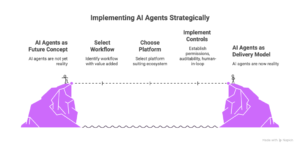
AI agents are no longer a concept of the future; they are a model of delivery. The key move for leaders is not “deploy agents everywhere.” It is, instead:
- Select one workflow where there is value added (time saved, errors reduced, revenues protected).
- Select a platform that suits your ecosystem.
- Implement controls from the beginning (permissions, auditability, human-in-the- loop)
- From one agent → one function → one operating model.
The competitive edge will not come from deploying more agents. It will come from deploying trusted, governed, measurable, and deeply integrated agents into how work actually gets done.
The winners will not be the companies experimenting the fastest. They will be the ones redesigning their operating model around agentic execution — safely, intentionally, and at scale.
Leave a Reply