
OpenAI Frontier and the Real Shape of Services-as-Software
Why the next platform war is not SaaS vs services. It is orchestration vs accountability.
OpenAI’s Frontier launch matters for a reason many will miss on first read. It is not an AI feature. It is an attempt to make agentic work governable inside real enterprises.
That distinction changes everything.
We have had two years of impressive agent demonstrations. What we have not had, at least not in a form procurement, security, and audit teams can accept, is a credible way to deploy agents that operate across systems with permissions, shared context, and operational oversight.
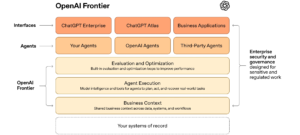
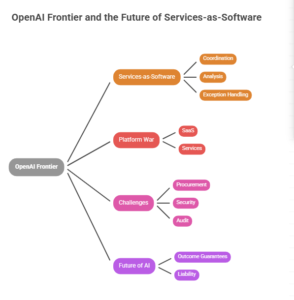
OpenAI’s Frontier is a clear signal of what HFS calls Services-as-Software (SaS). This is the convergence where services work such as coordination, analysis, exception handling, follow-ups, and reconciliations becomes embedded into software-like systems that can deliver outcomes repeatedly, not as one-off human effort.
The direction is right, and Frontier is a strong market signal.
However, leaders should be careful with the easy, dramatic version of this story. The narrative that says “SaaS is dead” and “AI will run the enterprise” is not how this transition will unfold. The change will be slower, more governed, and more economically driven than the hype suggests.
And it will not be won by the smartest models. It will be won by whoever can guarantee outcomes without inheriting unbounded liability.
The real shift: from tools to work systems
For a decade, enterprise software has largely been purchased as tools that people use.
The promise of agentic AI is structurally different. You describe intent, and the system assembles steps across tools and completes work. That is not a user interface upgrade. It is a change in how work is composed.
Frontier’s positioning reflects this reality. It is not trying to be another application. It is positioning itself as the coordination layer across the applications enterprises already have. In simple terms, it aims to become the operations layer for AI coworkers by provisioning them, constraining them, monitoring them, and measuring whether they deliver outcomes.
This is where Services-as-Software (SaS) lives.
SaS is not a better chatbot. It is end-to-end workflows delivered as outcomes. Work that historically required service teams to run and supervise is now being codified into managed, repeatable capabilities.
Why the “SaaS is dead” narrative is misleading
If SaS is interpreted as agents replacing SaaS, it will lead to the wrong architecture and investment decisions.
What is more plausible, and more disruptive, is that systems of record remain. What changes is the human wrapper around them.
That wrapper is where most service hours exist:
- Chasing approvals
- Updating multiple systems
- Reconciling mismatches
- Preparing leadership packs
- Responding to exceptions
- Escalating edge cases
- Documenting decisions across systems
Agents are well suited to this wrapper because it is largely language, coordination, and routine decision-making. This works only when access is constrained and outputs can be validated efficiently.
Disruption will not look like a graveyard of applications overnight. It will look like value migration. Fewer seats. More workflow consumption. More outcome-based contracts. Increased pressure on labor-heavy delivery. And a growing fight over who owns the work interface, the orchestration layer that sits above systems of record.
What Services-as-Software (SaS) looks like in practice
Consider a common, unglamorous workflow: procurement exception handling in a global enterprise.
Today, a purchase request hits a mismatch—budget code doesn’t align, vendor isn’t approved in one region, contract terms conflict with policy. A human in procurement (or a shared services team) does the wrapper work: emails the requester, checks policy, pings legal, updates the ERP, logs the decision, follows up again when someone doesn’t respond, and escalates if the requester is senior.
In a Services-as-Software model, the service becomes an orchestrated work system.
The agent receives the request and immediately normalizes it into the organization’s standard schema. It retrieves the relevant policy and contract templates from an approved source. It checks vendor status and budget alignment. It flags what’s missing, asks the requester targeted questions, and proposes a compliant path: approved vendor alternative, corrected cost center, or a formal exception request with the required approvals. It drafts the documentation, routes the approval, updates the system of record once approvals are collected, and produces an audit trail that shows what policy was applied, what approvals were obtained, and why the decision was made.
That is not “AI helping someone.” That is software delivering a service outcome.
But this only works when autonomy is bounded.
- The agent cannot have unlimited access.
- It cannot approve its own exceptions.
- It cannot update the ERP without controls.
- And it must escalate when uncertainty is high.
The decisive metric: cost per correct outcome
Here’s the reality check that determines whether SaS is a category or a buzzword: it wins only when it can guarantee an outcome cheaper than (a) software + humans operating it, or (b) services teams delivering it by labor hour.
Agentic systems introduce a new cost center: verification.
If verification is expensive, autonomy becomes rework. And rework destroys the unit economics.
So the metric that matters isn’t “cost per output.” It’s cost per correct outcome:
Cost Per Correct Outcome = Inference cost + Integration cost + Human review (HITL) + Remediation + Incident risk cost
Frontier is, implicitly, a bet that enterprises are ready to industrialize this layer. To treat agent workflows like software that must be evaluated, monitored, and operated continuously, not like assistants that are “usually right.”
The uncomfortable truth: outcome guarantees shift power and liability
Whoever guarantees outcomes wins. But guaranteeing outcomes means carrying liability (Security misuse. Compliance gaps. Customer-impacting errors. Operational failures at scale).
This transition will create two kinds of winners.
Some players will sell orchestration and governance platforms. They will own the control plane.
Others will sell managed outcomes. They will own the liability layer, priced and contracted like a service but delivered like software.
The fight will not be software versus services. It will be about who owns the orchestration layer and who is willing to own accountability.
The adversarial reality leaders can’t ignore
Agentic systems don’t just add productivity. They add an adversarial surface area.
The moment agents can act across tools, you invite new classes of failure: prompt injection, tool misuse, permission creep, data leakage, and “action taken on bad context.” The more powerful the control plane, the higher the blast radius when it’s misconfigured or compromised. That’s not a reason to pause forever. It’s a reason to treat governance as core product, not paperwork.
What leaders should do next (in plain language)
Agentic systems do not just add productivity. They expand the attack surface :
- Prompt injection
- Tool misuse
- Permission creep and privacy
- Data Leakage
- Actions taken on incorrect context
Don’t start by asking, “Where can we put agents?” Start by asking, “Which workflow has clear value, cheap verification, and bounded blast radius?”
Pick one. Then design it so the agent can act inside explicit boundaries:
- What the agent can access
- What it must cite
- When it must escalate
- How mistakes are rolled back
- How policy is enforced
- HITL
- How the escalation and exceptions would be managed
- Who would be accountable
- How the compliance, auditability and explainablity would be addressed
Build the measurement loop early. Economics will determine whether the model scales. If you do this, you’ll learn quickly whether you’re building Services-as-Software—or just generating more work faster.
The takeaway
OpenAI Frontier is meaningful not because it proves agents are ready to run everything, but because it signals a more sober reality: agentic AI becomes an enterprise category only when it becomes governable.
Services-as-Software is coming (almost here !!). But it won’t be won by the loudest claims or the smartest model. It will be won by the organizations that can make outcomes repeatable, auditable, and economically provable—while keeping liability bounded.
Services-as-Software will not be won by intelligence. It’ll be won by the fabric of trust.
Leave a Reply