
Agentic AI and the Autonomous Enterprise: How Technology Leaders Can Rewire for Intelligent Growth

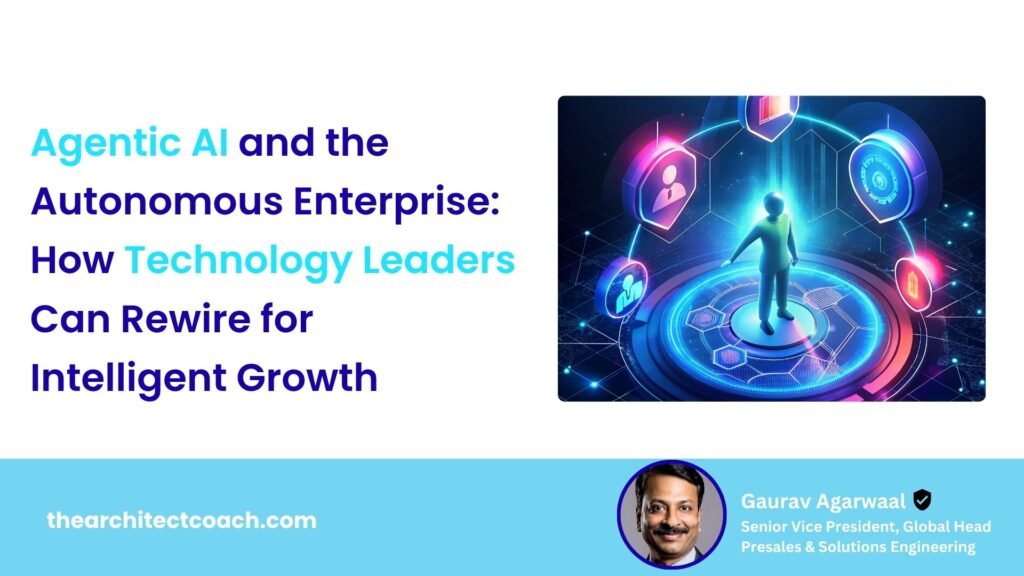
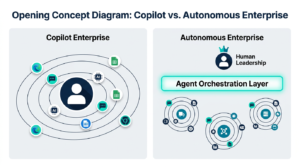
Enterprises are racing to deploy copilots, but the real divide won’t be between companies that do or do not use AI—it will be between those that sprinkle copilots on existing workflows and those that deliberately re‑architect themselves around agentic AI and autonomous workflows. Over the next three to five years, organizations that treat agents as first‑class “users” of the enterprise—able to perceive, decide, and act across systems—will unlock radically different productivity, resilience, and innovation curves.
“The question is no longer if you use AI, but what you are willing to let agents do on behalf of your enterprise.”
2. From copilots to autonomous enterprises
Most organizations are stuck in “copilot phase”: AI that sits next to a human in an app, waiting for prompts. Copilots reduce friction and accelerate individual tasks, but they keep the center of gravity with the human—AI acts only when asked, and only inside the app where it lives.
Agentic AI is a step‑change. Instead of waiting for prompts, agents are given goals and constraints. They interpret intent, break work into steps, call tools and services, monitor progress, and adapt. Rather than generating an email on request, an agent can track a renewal pipeline, identify at‑risk deals, draft outreach, coordinate meetings, and update CRM—end‑to‑end, within policy.
“Copilots accelerate tasks; agents own outcomes.”
3. A clear definition: What is an autonomous enterprise?
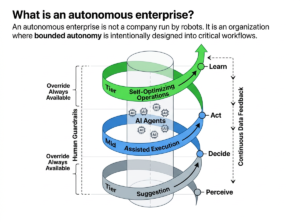
An autonomous enterprise is not a company run by robots. It is an organization where bounded autonomy is intentionally designed into critical workflows.
Three characteristics stand out:
- A material portion of decisions and execution in key processes is delegated to AI agents operating within defined constraints, with human override always available.
- Data from operations continuously feeds back into models, policies, and workflows, so the system learns over time.
- Autonomy is tiered—different processes operate at different levels of autonomy, from suggestion to self‑optimizing operations
4. Cloud‑platform lens: Agents as users and a new platform tier
Leading cloud platforms increasingly talk about AI agents the same way they talk about human users. Each agent is treated as an entity with identity, access rights, telemetry, accountability, and lifecycle. That framing has profound implications for enterprise architecture.
If agents are “users,” they need identities and profiles, roles and entitlements, lifecycle management, and monitoring and evaluation. This view also implies a new platform tier: an “agent layer” where much of the business logic and orchestration lives, sitting above traditional applications.
“The moment you treat agents as users, you stop doing AI demos and start designing AI systems.”
5. Ecosystem lens: Agents as the next form factor
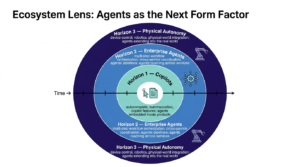
The broader ecosystem increasingly treats AI agents as a new form factor for computing, akin to the shift from desktop web to mobile.
Three stages are unfolding:
- Models embedded in products as features (autocomplete, summarization, copilots).
- Agents orchestrating multi‑step workflows across services on our behalf.
- Agents extending into the physical world, controlling devices and robots as naturally as they call APIs today.
This horizon view signals that today’s copilot experiments are only the first inning; architecture and operating‑model choices must keep the runway open for multi‑agent orchestration and eventual physical integration.
6. Architecting the agentic stack
To build an autonomous enterprise, you need an agentic architecture that sits alongside—and gradually reshapes—your existing systems. At a minimum, it has five layers:
- Data foundation
- Knowledge and policy layer
- Agent platform layer
- Integration and tool layer
- Experience and oversight layer
One useful way to think about this stack is that much of the business logic that previously lived in brittle process automation and custom code moves upward into the agent and policy layers. The system becomes more adaptable, but only if you design strong governance and observability into those layers from day one.
“The agent layer will become the new home of business logic.”
7. Designing high‑value agentic use cases
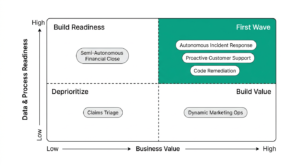
Not every process should be “agentified” first. The best early candidates sit at the intersection of high business value, rich digital exhaust, and well‑understood decision boundaries.
Examples include autonomous incident response, proactive customer support, semi‑autonomous financial close, dynamic marketing operations, claims triage, and code remediation.
Use a simple pattern: start from a clear business outcome, map the workflow, identify decision points and required data/policies, then ask where an agent could safely act if given the right tools and guardrails. Design the full loop—perception, decision, action, and learning—rather than a single step.
8. Rewiring the operating model: humans plus fleets of agents
Architecture alone cannot deliver an autonomous enterprise. Operating models must evolve to integrate fleets of agents as part of how work gets done.
Key shifts:
- From siloed functions to end‑to‑end value streams.
- New roles: agent product owners, policy designers, AI SREs, AI risk partners.
- Clear decision rights across leadership, domain owners, and frontline teams.
- New operational rituals: agent performance reviews, incident post‑mortems, backlog grooming for new agent capabilities. “Your org chart will increasingly show teams of people working alongside fleets of agents.”
9. Governance, risk, and levels of autonomy
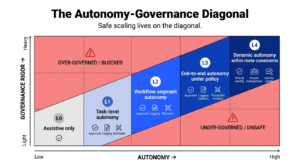
Autonomy without governance is a liability. To make autonomy safe and scalable, adopt a levels of autonomy framework—similar to mature industries like aviation and automotive.
A simple scheme:
- Level 0: Assistive only.
- Level 1: Task‑level autonomy.
- Level 2: Workflow‑segment autonomy.
- Level 3: End‑to‑end autonomy under policy.
- Level 4: Dynamic autonomy within meta‑constraints.
For each level and domain, define approvals, logging and explainability, testing and red‑teaming, and thresholds for rollback or escalation. Ensure identity, access management, and activity monitoring for agents are at least as robust as for human users.
10. Talent, culture, and the new division of labor
Agentic AI changes what work feels like before it changes org charts. As agents absorb repetitive, codified tasks, humans increasingly focus on problem framing, exception handling, creativity, and relationship‑building.
Priorities:
- Capability building in AI literacy and workflow design.
- Cultivating hybrid “workflow architect” skills.
- Establishing a culture of co‑evolution, where people are encouraged to question agent behavior, suggest improvements, and share new patterns. “The most valuable employees will be those who know how to design work for humans and agents together.”
11. Measurement and a 3‑horizon roadmap
Effective leaders track three families of metrics: business outcomes (cost, cycle time, revenue, satisfaction), system health and risk (uptime, intervention rate, incidents), and adoption and learning (coverage of workflows, frontline satisfaction, idea‑to‑pilot speed).
Tie these metrics into a three‑horizon roadmap:
- Horizon 1 (0–12 months): copilots and narrow agents, strong oversight, instrumentation.
- Horizon 2 (12–36 months): cross‑workflow enterprise agents, scaled platforms and governance.
- Horizon 3 (36+ months): early physical autonomy, with high safety and regulatory demands.
12. The leadership mandate: Architecting the autonomous enterprise
For technology leaders, the rise of agentic AI is a systems‑design challenge, not a procurement exercise. The mandate is to architect an enterprise where agents can safely do real work: a coherent stack, a re‑wired operating model, clear autonomy levels, robust governance, and a culture ready for a new division of labor.
Five leadership moves over the next 12–18 months:
- Set a clear narrative that autonomy is about building a more intelligent, resilient, and human‑centered enterprise—not about replacing people.
- Select and execute a small portfolio of high‑value, well‑governed agentic workflows that prove the concept in production.
- Invest in the agentic stack—data, policy, agent platform, integration, and oversight—rather than letting experiments hard‑code fragile logic.
- Stand up cross‑functional structures that own outcomes end‑to‑end for human and agent work.
- Commit to an autonomy roadmap with explicit levels, controls, and metrics. “The autonomous enterprise is not a future state. It is the operating model you begin to build with your very first agent.”
Leave a Reply