

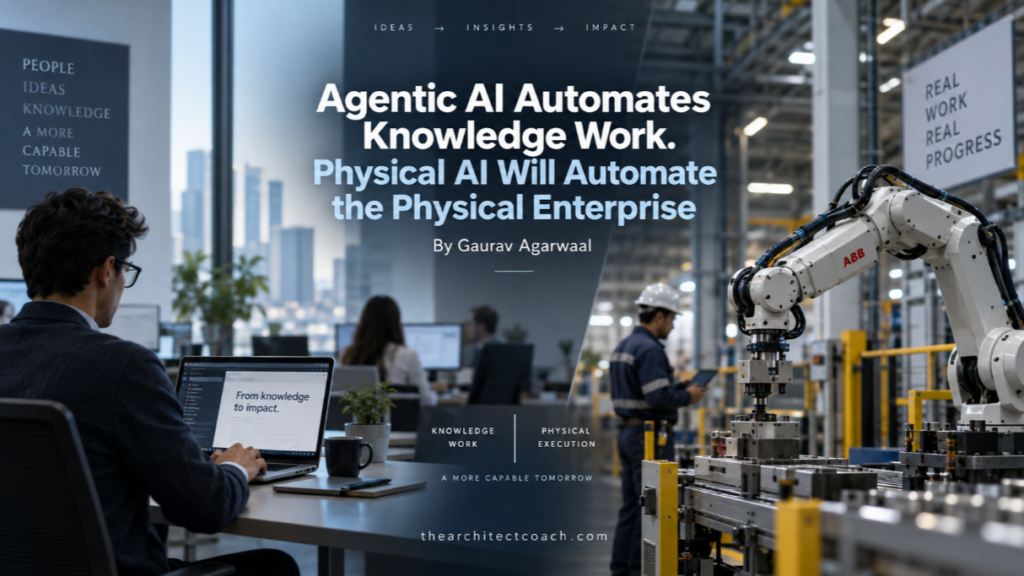
Physical AI changes that boundary.
The next generation of AI systems is being designed not only to interpret the world, but to perceive it, reason about it and act within it. Google DeepMind describes this as embodied reasoning: the ability for robots to understand physical environments and translate multimodal inputs into real-world action. Its latest Gemini Robotics systems are moving beyond narrow pre-programmed tasks toward whole-body control, dexterity and adaptation across complex environments. (DeepMind)
At the same time, industrial platforms are bringing together robotics, vision AI, digital twins, world models and edge computing into a much broader architecture for physical autonomy. NVIDIA now describes physical AI as the convergence of systems that can perceive, reason, simulate and act in real-world environments, while companies such as Siemens are already testing humanoid robots in live factory operations. (NVIDIA)
That is why I believe the next phase of enterprise AI will not be defined only by what software can think. It will be defined by what intelligent systems can do in the physical world.
The Digital Enterprise Learned to Reason. The Physical Enterprise Is Learning to Act.
Traditional industrial automation has always been powerful, but it has largely depended on predictability. Robots repeat programmed motions. Control systems respond to predefined conditions. Production lines are optimized around known processes. When the environment changes, engineers often need to reconfigure the system.
Physical AI introduces a different operating model. Instead of executing only fixed instructions, an intelligent machine can interpret sensor inputs, understand spatial context, reason about a changing environment and adapt its actions accordingly.
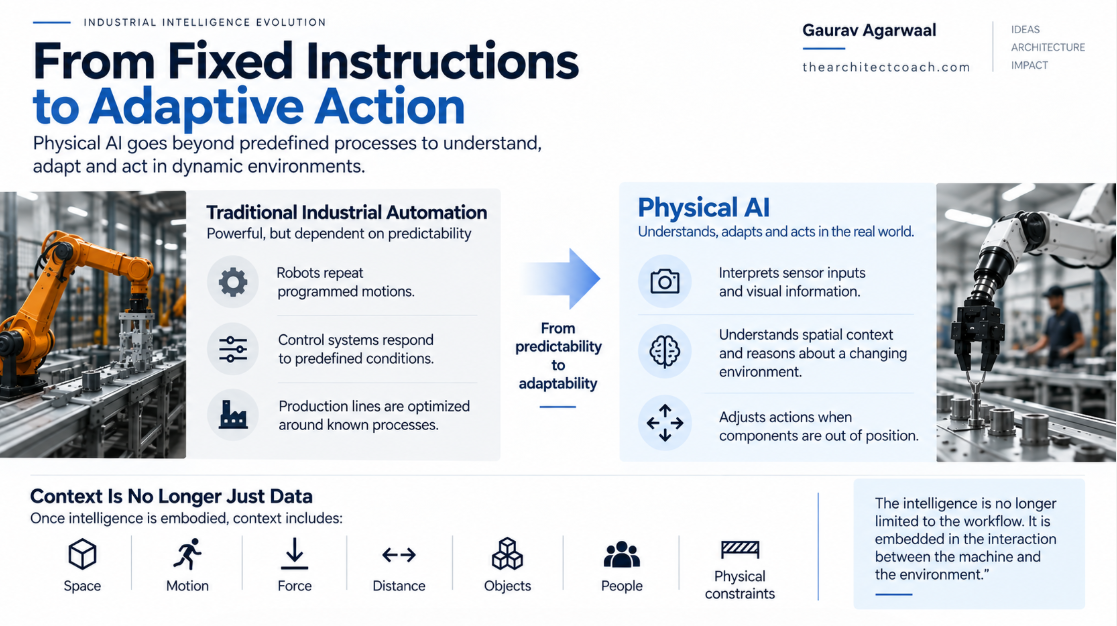
That distinction is important. A conventional robot may know exactly where a component is supposed to appear. A physical AI system has to recognize that the component is slightly out of position, understand what that means for the task, adjust its movement and continue safely. The intelligence is no longer limited to the workflow. It is embedded in the interaction between the machine and the environment.
Google DeepMind’s Gemini Robotics work reflects this shift. Its vision-language-action models translate visual information and instructions into motor commands, while newer systems emphasize spatial reasoning, multi-view understanding and physical adaptation. (DeepMind)
That moves enterprise AI into a fundamentally different domain. Once intelligence is embodied, context is no longer just data. Context includes space, motion, force, distance, objects, people and physical constraints.
Physical AI Needs a World Model, Not Just a Language Model.
This is where the architecture starts to change. Large language models learned patterns from digital information. Physical AI has to model what happens when actions interact with the real world.
A robot needs to understand that an object can fall, a surface may be slippery, two machines cannot occupy the same space, a worker may unexpectedly enter the operating area, or an action that is valid in simulation may fail under real-world friction and uncertainty.
That requires more than language. It requires a world model.
NVIDIA’s current physical AI stack increasingly centers on this idea. Its Cosmos world foundation models are designed to support physical reasoning, world generation, synthetic data creation, simulation and robotic control. (NVIDIA)
This matters for enterprise architecture because a physical AI system is not simply:
Model → Response
It looks more like:
Sensors → Perception → World Model → Reasoning → Policy → Action → Feedback
And that loop may run continuously at the edge. That makes physical AI much closer to an operating system for autonomous environments than another interface to a foundation model.
The Digital Twin Is Becoming the Training Ground for the Physical Enterprise.
This is why digital twins become strategically important. For years, digital twins were often positioned around visualization, monitoring and predictive maintenance. Those use cases remain valuable, but physical AI gives the digital twin a much larger role.
It becomes the environment in which intelligent machines can be trained, tested and challenged before they are deployed into the real world. A factory can be simulated. Robot fleets can be tested against changing layouts. Rare failure conditions can be generated synthetically. Safety policies can be evaluated repeatedly. Production changes can be validated before touching the actual line.
NVIDIA’s industrial digital twin architecture explicitly positions physics-based virtual facilities as both simulation environments and proving grounds for physical AI systems. Its Mega blueprint is being used to test and optimize multi-robot fleets before physical deployment. (NVIDIA)
AWS is moving in a similar direction with production-grade industrial digital twins that ingest live operational data, predict failures and evolve as physical assets change. (Amazon Web Services, Inc.)
This creates a powerful architectural loop:
Physical world → Digital twin → Simulation → Model training → Edge deployment → Physical feedback
The digital twin stops being merely a representation of the physical environment. It becomes part of the learning infrastructure of the enterprise.
Edge AI Is Where Physical Intelligence Becomes Operational.
Physical AI cannot depend on every decision traveling back to a distant cloud. A robot avoiding a collision, an autonomous vehicle navigating a facility or a vision system responding to a production anomaly often operates under latency and reliability constraints that require local decision-making.
That is why edge computing becomes a core part of the architecture. The cloud remains important for model training, fleet coordination, analytics and large-scale simulation. But real-world action increasingly requires inference close to the machine.

NVIDIA’s physical AI stack, for example, connects simulation and world models to real-time robotic control through edge platforms such as Jetson. Siemens is also building AI-ready industrial edge infrastructure designed to bring accelerated computing directly into production environments. (NVIDIA)
This creates a different enterprise AI topology. Instead of intelligence being centralized, intelligence becomes distributed across cloud, digital twin and edge environments. And that distribution introduces new architectural questions around model consistency, safety, updates, observability and governance.
If an AI agent makes the wrong decision in a spreadsheet, the impact may be reversible. If a physical agent makes the wrong decision around machinery, people or infrastructure, the consequences can be very different.
From Automation to Autonomy: The Real Safety Challenge
The hardest problem in physical AI will not be making machines more capable. It will be moving from automation to autonomy safely.
That distinction matters. Automation executes predefined processes. Autonomy interprets goals, evaluates its environment and decides what action to take next. As physical systems become more autonomous, enterprises will need to think beyond task performance and begin designing clear operating boundaries for intelligent machines.
A physical AI system needs to understand not only what it can do, but also what it must not do. That requires safety constraints, environmental awareness, human override mechanisms, policy enforcement and continuous feedback. Google DeepMind’s robotics work, for example, explicitly emphasizes safe deployment, while industrial implementations are increasingly using simulation to validate robotic behavior before systems enter production environments. (DeepMind)
This changes the architecture of control. The model reasons, the policy constrains, the edge system executes, the digital twin tests and the human supervises exceptions. Governance is therefore distributed across multiple layers rather than sitting around the AI model alone.
That is fundamentally different from traditional enterprise AI. Physical AI cannot simply be treated as “AI plus a robot.” It is a systems architecture problem in which intelligence, safety, machines, software and the physical environment have to operate together.
From Programmed Machines to Adaptive Physical Systems
For decades, software has been powerful because behavior could be changed without rebuilding the underlying machine. Physical AI begins to bring a similar level of flexibility into industrial environments.
A robot foundation model capable of learning a new task from a demonstration, adapting to a changed layout or transferring learned behavior across different machines could significantly change the economics of automation. Historically, changing a production process often required engineers to reprogram equipment, recalibrate systems and test new workflows manually. In the emerging physical AI model, that process may increasingly shift toward demonstration, simulation and validation.
We are already beginning to see signs of this transition. Skild AI, for example, introduced a robotic foundation model designed to learn previously unseen, long-horizon tasks from a single video demonstration without task-specific retraining. (NVIDIA Blog)
If this direction continues, the value of industrial automation will move beyond repetitive efficiency. Increasingly, the differentiator will be adaptability: how quickly a machine can understand a changed environment, learn a new task or respond to conditions it was not explicitly programmed to handle.
That has significant implications for manufacturing, logistics, warehouses, construction, energy, healthcare and virtually every sector where machines interact with the physical world.
Physical AI Is an Enterprise Architecture Shift, Not a Robotics Trend
It is easy to look at humanoid robots and assume that physical AI is primarily about new hardware. The more consequential transformation, however, is happening in the architecture underneath those machines.
World models, physics-based simulation, digital twins, synthetic data, computer vision, edge inference, robotic foundation models, autonomous policies and real-time feedback are beginning to converge into a new technology stack. Together, these capabilities allow intelligence to move beyond digital reasoning and into physical execution.
Siemens and NVIDIA are already working toward what they describe as adaptive, AI-driven manufacturing environments, while robotics companies are increasingly integrating simulation and foundation models into production workflows. (Siemens)
This is why the opportunity is much larger than robotics. Agentic AI is teaching software systems to reason and act across digital environments. Physical AI extends that capability into the operational world, allowing the enterprise itself to perceive, reason and act through machines.
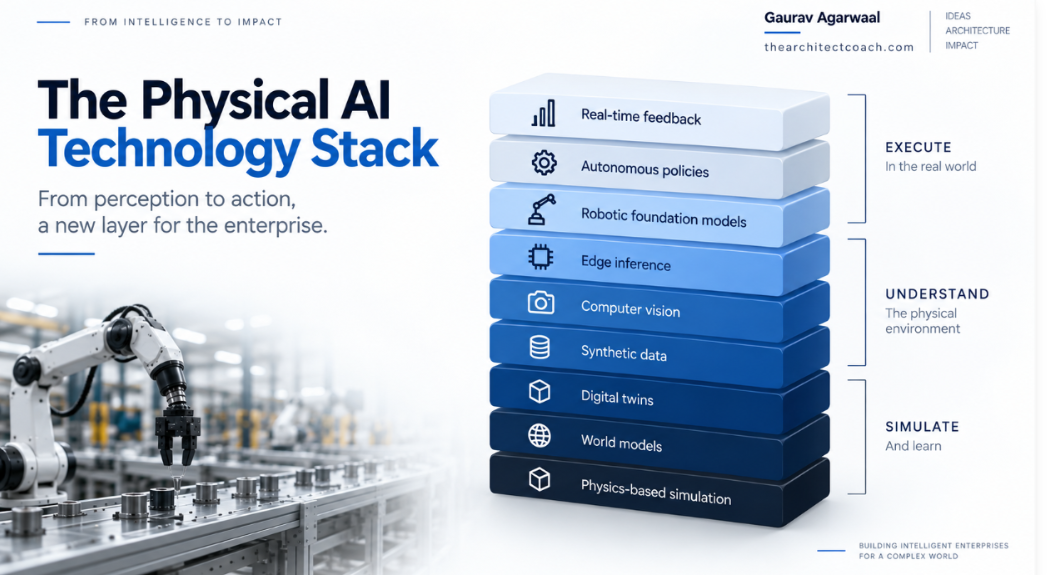
As these two layers converge, the traditional boundary between the digital enterprise and the physical enterprise will begin to weaken. Software agents may interpret demand signals, digital twins may simulate possible responses, autonomous systems may determine the appropriate action and physical machines may execute it—all within the same continuous decision loop.
Organizations leading this transition will therefore not simply be those deploying the largest number of robots. They will be the ones building an architecture in which the physical environment can be observed, simulated, learned from and continuously adapted.
That is the real promise of physical AI: not machines that simply look or behave more like humans, but enterprises that can become more responsive, adaptive and intelligent in how they operate.
Leave a Reply