
LLM Observability Is Not Monitoring, It Is the AI Enterprise Quality System

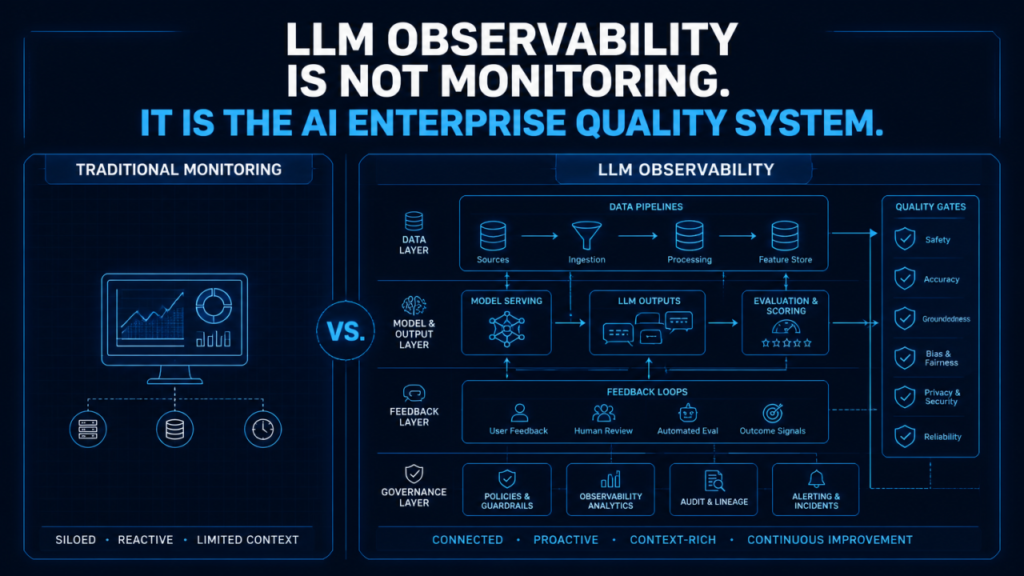
Traditional enterprise software answers a simple business question:
Did the system work?
Modern artificial intelligence systems pose a more difficult one:
Did the system give the right business result?
That difference changes the very nature of how enterprise applications need to be run.
A language model can produce a successful API response, within expected latency, consume an acceptable number of tokens, and still produce an answer that is factually incorrect, poorly grounded, or inconsistent with enterprise policy. Every infrastructure dashboard is green, business confidence quietly declines.
That’s why traditional application monitoring no longer suffices.
The uploaded article explains observability with the analogy of an aircraft’s black box that records every step of an AI request so that failures can be reconstructed later. The implication for the larger enterprise is greater.
LLM Observability is the new quality operating system for AI in the enterprise.
The boardroom question is no longer whether artificial intelligence systems exist.
It’s about whether the enterprise can consistently demonstrate that artificial intelligence (AI) systems are making trustworthy decisions.
1) Shift the conversation – AI quality is an operations problem, not a modelling problem
Most organisations are still evaluating AI at the development stage.
- Benchmarks for models.
- Testing prompts.
- Feedback from pilot users.
However, once deployed, artificial intelligence systems continue to learn from the changing business context, new knowledge, updated policies, evolving workflows and dynamic user behaviour.
AI quality cannot be certified once like traditional software.
It has to be measured all the time.
Boards must therefore set an artificial intelligence quality baseline that goes beyond traditional IT metrics.
A practical starting point is to add
- Business quality ratings of AI interactions (% of total)
- Share of recommendations backed by enterprise evidence
- Frequency of human override
- Hallucination rate / ungrounded answer rate
- Cost per successful business result
- Average quality score for production workflow
Board position: If AI is controlling, availability Observability tells you if AI is delivering value.
2) Execution, observation and evaluation individually
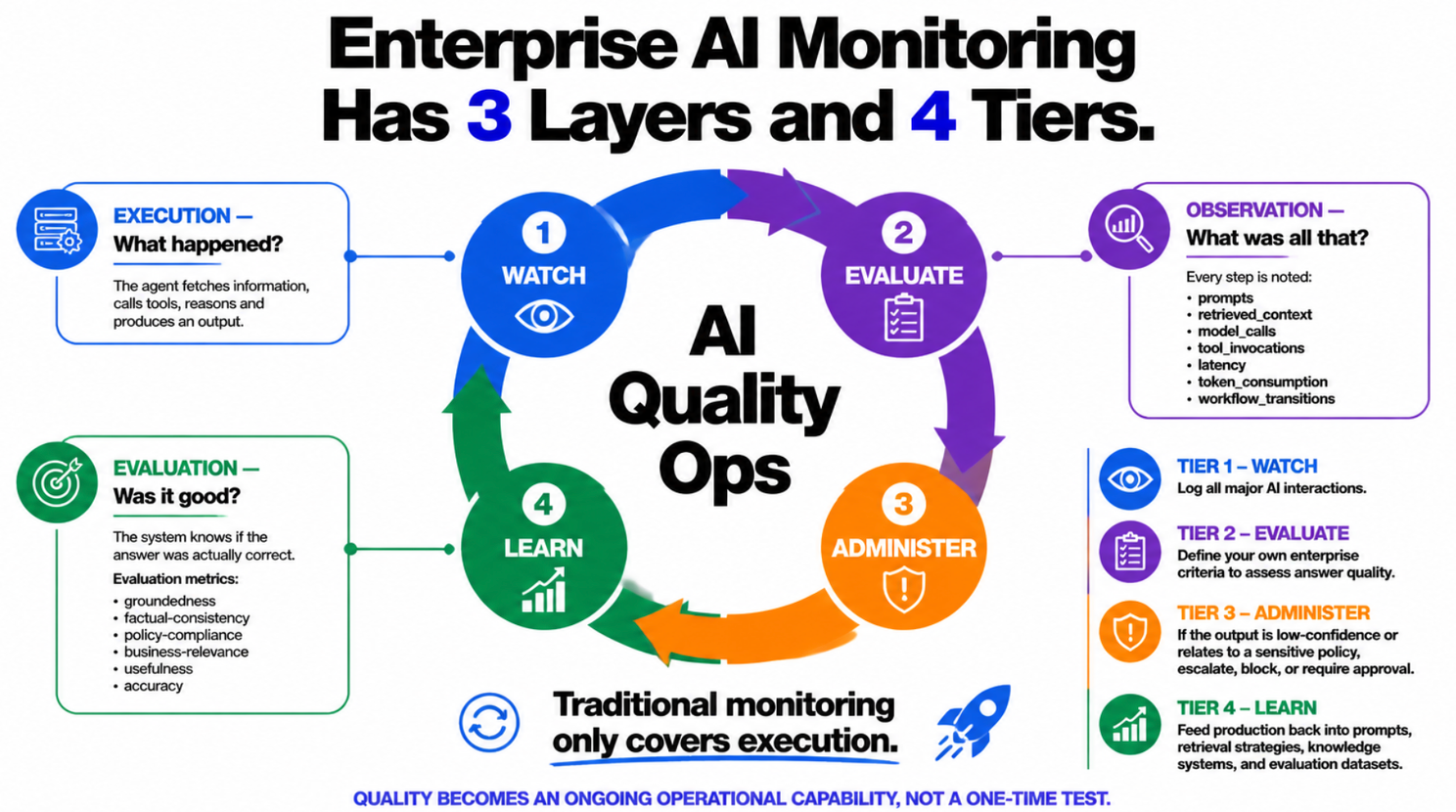
One of the article’s most powerful takeaways is that tracing alone is not enough.
Enterprise AI requires three different capabilities.
Carrying Out
The agent fetches information, calls tools, reasons and produces an output.
Observation
Every step is noted:
- prompts
- retrieved_context
- model_calls
- tool_invocations
- latency
- token_consumption
- workflow_transitions
Observation responses:
What was all that?
Assessment
The system knows if the answer was actually correct.
Evaluation metrics
- groundedness
- factual-consistency
- policy-compliance
- business-relevance
- usefulness
- accuracy
Evaluation responses:
Was it good?
Traditional monitoring is used to monitor execution.
Enterprise AI requires observation and assessment.
Board policy: AI Quality Assurance Levels
Tier 1 – Watch
Log all major AI interactions.
Tier 2 – Evaluate
Define your own enterprise criteria to assess answer quality.
Tier 3 – Administer
If the output is low-confidence or relates to a sensitive policy, escalate, block, or require approval.
Learn – Tier 4
Feed production back into prompts, retrieval strategies, knowledge systems, and evaluation datasets.
Quality becomes an ongoing operational capability, not a one-time test.
3) Define the enterprise failure modes
Production artificial intelligence can exhibit failure modes that traditional monitoring tools are not able to detect.
Hallucination Not Seen
Infrastructure reports success, but business information is wrong.
Failure to Fetch
The model is given the wrong evidence. The model behaves correctly but the reasoning is wrong.
Blindness to Evaluation
Organisations do not know whether the outputs were useful or correct, only whether they captured traces.
Prompt Drift
Incremental prompt changes degrade quality slowly without operational alerts.
Cost without benefit
Increased token usage with no change or decrease in answer quality.
Breaches of the silence policy
Responses could be technically correct but violate business rules, compliance requirements, or internal standards.
Starved For Feedback
Organisations gather production interactions but never convert them into learning datasets.
But these are not modelling failures.
They are failures of operational quality.
4) Develop an Enterprise AI Quality Control Plane
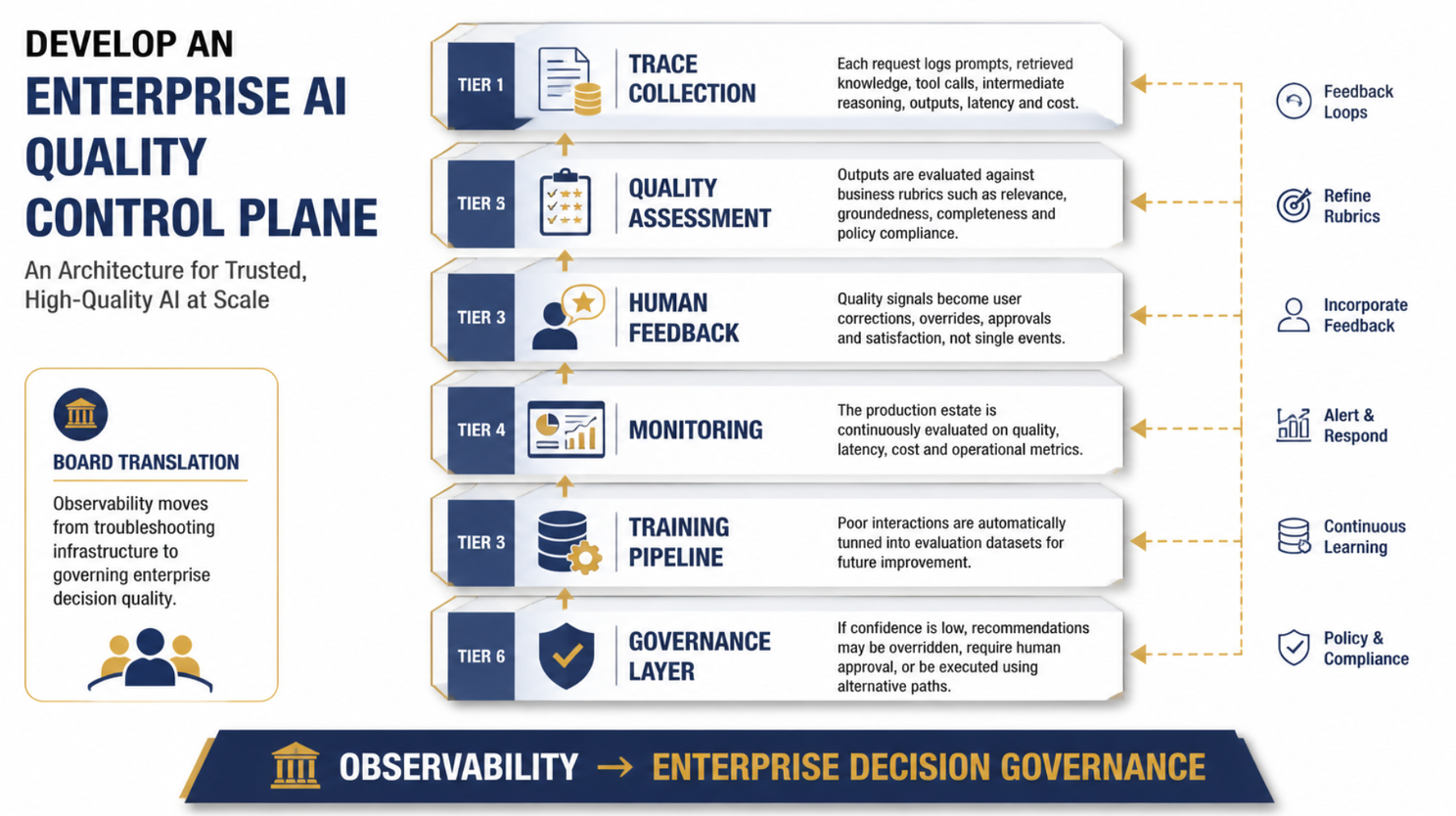
The article covers the individual capabilities of evaluation and monitoring and tracing.
Together they make an AI Quality Control Plane – through an enterprise architecture lens.
Minimal control plane should have:
1. Trace Collection
Each request logs prompts, retrieved knowledge, tool calls, intermediate reasoning, outputs, latency and cost.
2. Quality assessment
Outputs are evaluated against business rubrics such as relevance, groundedness, completeness and policy compliance.
3. Human Feedback
Quality signals become user corrections, overrides, approvals and satisfaction, not single events.
4. Level of Monitoring
The production estate is continuously evaluated on quality, latency, cost and operational metrics.
5. Training pipeline
Poor interactions are automatically turned into evaluation datasets for future improvement.
6. Governance Layer
If confidence is low, recommendations may be overridden, require human approval, or be executed using alternative paths.
Board translation: Observability moves from troubleshooting infrastructure to governing enterprise decision quality.
5) Measure the quality of the decisions, not the availability of the system.
The classic dashboard is about technical performance.
Enterprise AI needs business-quality scorecards.
Trust.
- Rooted response rate
- Evidence base (questionaires)
- Rate of hallucinations
- policy compliance
- integrity
- Humans acceptance rate
- Override percentage
- Accuracy of retrieval
- Usefulness of recommendations
Operational performance
- Latency
- Token Usage
- Workflow cost
- Success run of tool
Education
- Feedback collected
- Golden evaluation cases developed
- Prompt updates released
- Implemented retrieval improvements
The goal is not just to keep models online.
It is to continually improve enterprise decision quality.
6) AI Quality Enterprise SLOs
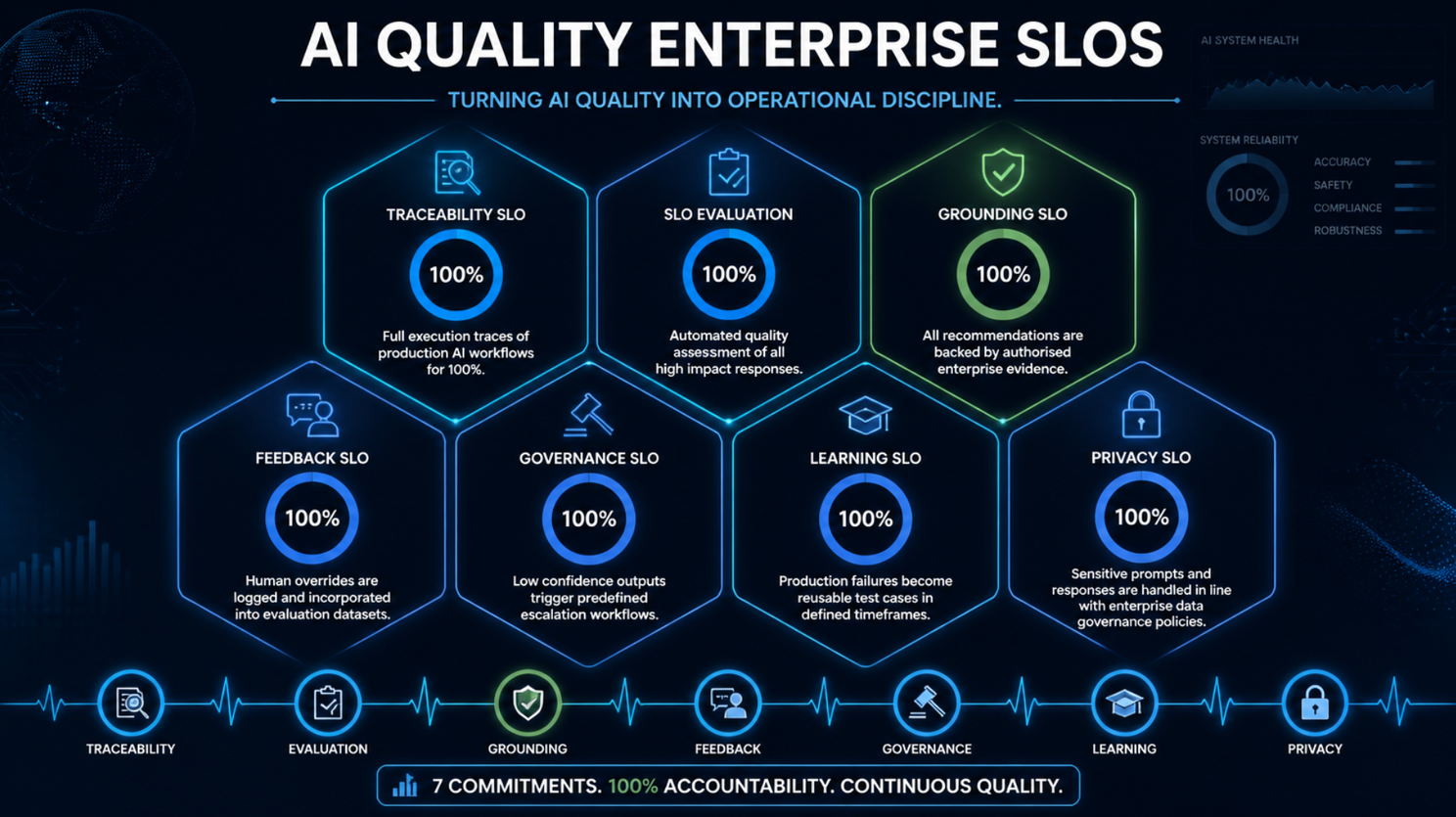
Organisations are demanding such operational commitments on AI quality more and more.
Pragmatic SLOs are
- Traceability SLO: Full execution traces of production AI workflows for 100%.
- SLO Evaluation: Automated quality assessment of all high impact responses.
- Grounding SLO: All recommendations are backed by authorised enterprise evidence.
- Feedback SLO: human overrides are logged and incorporated into evaluation datasets.
- Governance SLO: Low confidence outputs trigger predefined escalation workflows.
- Learning SLO: Production failures become reusable test cases in defined timeframes
- Privacy SLO: Sensitive prompts and responses are handled in line with enterprise data governance policies.
These commitments turn AI quality into an operational discipline.
7) The operating model is universal, observability tools are plug-and-play
Platforms like Langfuse, Arize Phoenix, Helicone, Braintrust, Weave, and OpenTelemetry-based tracing are mentioned in the article. It implies that the market is quickly standardising on observability capabilities, rather than on specific products.
Enterprise pattern is platform independent
Universal Capabilities
- execution tracking
- quality evaluation
- human feedback collection
- business scoring
- ongoing oversight
- governance integration
- learning cycles
Platform accelerators
- Langfuse
- Arize Phoenix
- Braintrust
- Weave
- Helicone
- OpenTelemetry
- Enterprise APMs
Board implication: Choose tools that match your operating model. Don’t let your tooling choices dictate how you govern AI quality
8) Changes in the operating model affect enterprise operations
The article importantly points out:
Traditional observability asks:
Did the request succeed?
LLM observability questions:
Did the request give the correct answer?
That one seemingly small distinction is the difference between enterprise operations.
AI operations teams are increasingly being asked to:
- developing evaluation rubrics
- quality control production
- validation of retrieval effectiveness
- managing AI outputs
- automated judge calibration
- developing golden datasets
- improving prompts through operational evidence
- closing the loop between production and continuous learning
The focus moves from the reliability of infrastructure to the reliability of decisions.
Board translation: AI Operations becomes the enterprise function to measure and improve machine decision quality on an ongoing basis.
Final Perspective
With each big technology shift came a new operational discipline.
Infrastructure observability was invented with cloud.
Distributed tracing was brought by microservices.
Cybersecurity applied continuous surveillance.
Agentic AI provides continuous evaluation of decisions.
The organisations that scale AI successfully won’t just monitor latency, uptime or token consumption. They will continuously measure whether autonomous systems are making trustworthy, data-driven, policy-compliant decisions that improve business outcomes.
That’s why LLM observability matters.
Not to assist engineers in debugging prompts.
It describes the quality operating system needed for trustworthy enterprise AI.
Board Question
As artificial intelligence systems take on more and more important business decisions, are we still measuring if our systems are available – or have we built an operational capability that is constantly proving that those systems are making the right decisions for the business?
Leave a Reply