

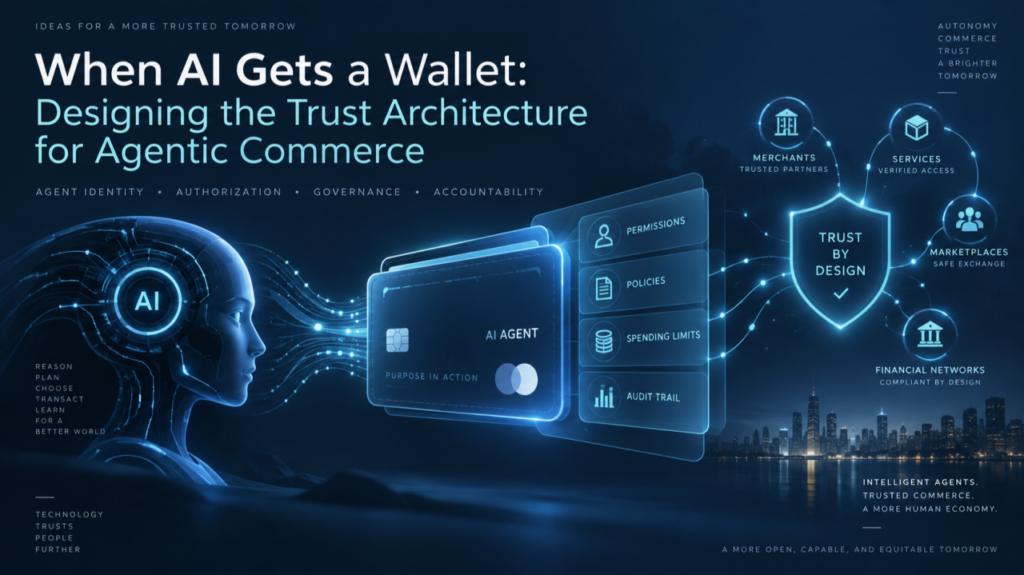
For most of the digital era, software participated in commerce without possessing economic authority of its own. Recommendation engines could rank products, travel platforms could identify flights, procurement systems could compare suppliers, and financial applications could surface better offers. But close to the point where money changed hands, the operating model usually returned control to a human.
Agentic AI is beginning to remove that checkpoint.
AI agents are evolving from systems that recommend an action to systems that can complete it. They can interpret an objective, compare options, invoke external tools, negotiate constraints, interact with merchants and increasingly participate in the payment flow itself. Visa, Mastercard and Ant International recently announced a joint initiative around common standards for identifying and verifying AI agents making purchases, another sign that agentic commerce is moving from concept toward infrastructure.
The adoption challenge is already visible. Visa’s September 2026 research found that while consumers are increasingly comfortable using AI during shopping, only 23% of surveyed U.S. consumers trusted generative AI to handle payments on their behalf.
That trust gap is understandable because once an agent can spend, the architecture has to answer a fundamentally different question. Traditional payments ask whether a transaction is authentic and authorized. Agentic commerce must also establish whether an autonomous system had the right mandate, intent, context and policy authority to make that particular decision.
This extends a theme I have explored in earlier work on runtime AI governance: governance cannot end once an AI system has been approved for production. It has to remain active while autonomous decisions are being made. Agentic commerce takes that principle into a more consequential domain: economic agency.
The question is therefore no longer simply, Can an AI agent transact?The more important question is:
What architecture allows enterprises to delegate economic authority without losing control of intent, policy, risk and accountability?
The Nine Strategic Trust Layers Shaping Agentic Commerce
I believe scalable agentic commerce will require nine interconnected capabilities:
- Agent Identity: Establishing which machine is acting and on whose behalf.
- Intent Binding: Preserving what the user or enterprise actually asked the agent to achieve.
- Delegated Economic Mandates: Converting broad permissions into purpose-bound authority.
- Runtime Policy Enforcement: Evaluating each proposed action against current enterprise rules.
- Transaction Boundaries: Constraining spend, merchants, geography, duration and transaction frequency.
- Decision Provenance: Preserving the evidence and context that shaped the agent’s choice.
- Runtime Risk Controls: Detecting anomalies, cascading actions and goal drift before execution.
- Human Escalation: Determining where autonomy should stop and judgment should return to a person.
- Economic Accountability: Reconstructing who authorized an action, why it happened and who ultimately owns the outcome.

The strategic shift is not from human payments to AI payments. It is from transaction authorization to governed economic autonomy.
1. Agent Identity | From User Authentication to Machine Identity
Identity is the natural starting point because a payment ecosystem cannot trust an actor it cannot identify. Traditional commerce has spent decades establishing ways to authenticate people, devices, merchants and payment credentials. Agentic commerce introduces another principal into that system: an autonomous machine acting on behalf of someone else.
That creates two identity questions rather than one. The enterprise must establish which agent is acting, but it must also know whose authority that agent represents. A procurement agent operating for a finance department should not be indistinguishable from a consumer shopping assistant, even if both happen to invoke the same model or payment network.
This becomes increasingly important as agents move across clouds, applications and third-party platforms. Identity should therefore be persistent enough to survive changes in execution environment while remaining connected to ownership, purpose and governance policy.
This aligns with my earlier argument around portable agent contracts. As autonomous agents spread across platforms, governance cannot remain attached only to infrastructure; the agent itself needs machine-readable attributes defining identity, permitted tools, policies and escalation requirements. (LinkedIn)
But identity solves only the first layer of trust. A legitimate agent can still make the wrong economic decision.
2. Intent Binding | From Understanding the Prompt to Preserving the Objective
Imagine a user tells an agent to book the cheapest nonstop flight to New York under $600. Several constraints exist inside that apparently simple instruction: destination, route type, price ceiling and implicit conditions such as traveler details and timing.
If the agent purchases a $590 connecting flight, the payment could be authentic, the agent could be legitimate and the transaction could remain within its spending limit. Yet the outcome is still wrong because the original intent was violated.
This exposes one of the weaknesses of conventional authorization. Transaction validity and intent alignment are not the same thing.
Traditional commerce often relies on the human at checkout to resolve this ambiguity. The buyer reviews the final option and catches the mismatch. Autonomous commerce removes that last inspection point, so the original intent cannot disappear after prompting the agent.
The instruction needs to become part of the persistent transaction context. Search, negotiation, selection and payment should remain traceable back to the original objective.
The operating shift is therefore:
Prompt → temporary instruction
to
Intent → durable control context
Agentic commerce becomes safer when systems can prove not only that an agent was authorized to act, but that the chosen action remained aligned with the objective that created the authority in the first place.
3. Delegated Economic Mandates | From Permission to Purpose-Bound Authority
Most access systems are built around permissions. A user may be allowed to access an application, invoke an API or approve a payment up to a certain amount.
Autonomous agents need something richer.
Suppose an enterprise gives a procurement agent permission to spend up to $25,000. That number alone says almost nothing about the actual scope of authority. Can it purchase any category of product? Can it transact with any approved vendor? Can it split purchases across multiple transactions? Does the authority last for one task, one week or indefinitely?
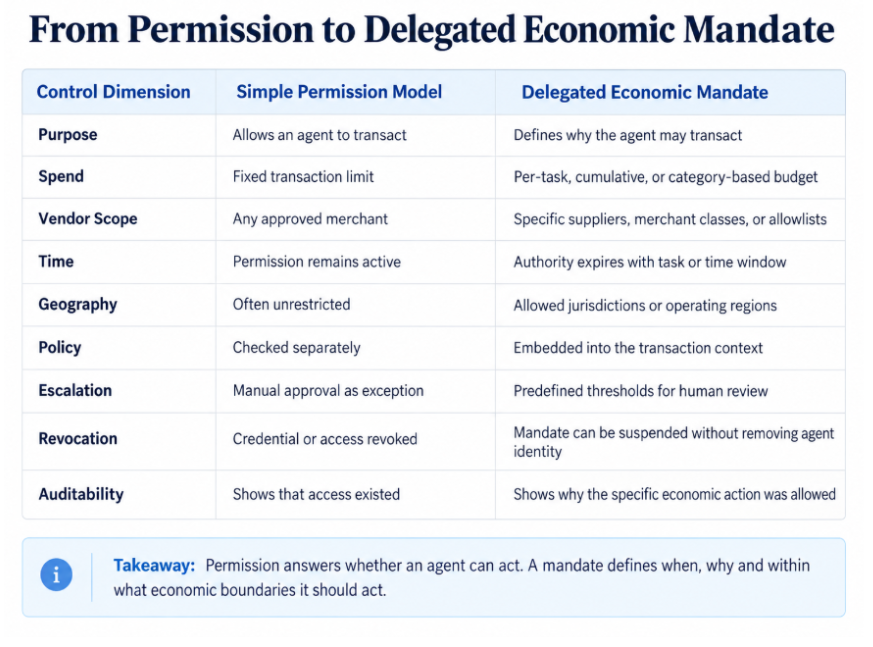
This is why I believe the more useful architectural concept is a delegated economic mandate.
A mandate connects authority to purpose. It can define the objective, approved merchant classes, budget, duration, jurisdiction, acceptable substitutions, required evidence and escalation thresholds. Once the task finishes, the mandate expires with it.
That distinction is important because autonomous capability should not automatically become standing privilege.
A well-designed agentic commerce architecture would therefore move:
Static permission → contextual mandate
The enterprise is not simply saying, “This agent can spend $25,000.” It is saying, “This agent can spend up to $25,000 to achieve this objective, with these suppliers, under these policies, during this period.”
That is a much more defensible basis for machine economic authority.
4. Runtime Policy Enforcement | From Approved Agent to Approved Decision
One of the central problems in autonomous systems is that approval is usually static while operating conditions are dynamic.
An agent may have been approved last month. The model may have passed evaluation. The payment credential may remain valid. Yet the transaction being proposed today can still violate current business conditions.
A supplier could become restricted. A sanctions list could change. A procurement threshold might be revised. A region could introduce a new regulatory requirement. A risk score could deteriorate between the beginning of the task and the point of execution.
This is why the runtime control plane becomes critical.
I previously argued that enterprise AI needs runtime governance rather than governance that ends at deployment. (LinkedIn) Agentic commerce provides a very practical example of why.
The system needs to evaluate the decision at the moment economic authority is exercised. Identity, mandate, supplier status, business policy, risk signals and transaction context all need to remain current.
The operating shift becomes:
Agent approved once → decisions evaluated continuously
That is what separates agent governance from traditional software access control.
5. Transaction Boundaries | From Spending Limits to Economic Guardrails
A budget is useful, but a budget alone is not a governance architecture.
An agent that is allowed to spend $5,000 can still produce an unacceptable outcome while staying perfectly within the limit. It might concentrate purchases with one vendor, repeatedly execute low-value transactions to avoid approval thresholds, purchase outside an approved geography or act during an invalid mandate window.
Economic authority therefore needs multiple dimensions of control.
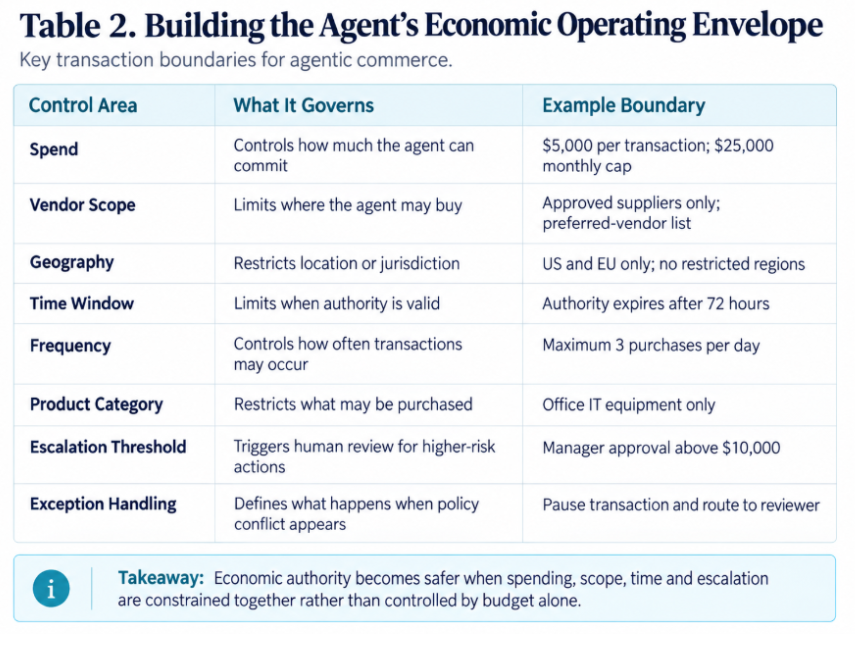
Depending on the use case, transaction boundaries could include spend ceilings, cumulative budgets, merchant categories, vendor allowlists, geography, currency, transaction frequency, contract type, time windows and escalation thresholds. Higher-risk actions can require additional verification or human review even when the agent technically possesses transaction authority.
The model resembles financial risk management more than conventional application permissions.
The enterprise is defining an economic operating envelope inside which autonomy is acceptable.
This is particularly important as agents become capable of handling ongoing functions rather than one-off purchases. A cloud optimization agent, for example, may continuously acquire compute capacity. Procurement agents may automatically replenish inventory. Travel agents may book across multiple employees and geographies.
In those environments, autonomy has to be bounded by a portfolio of controls rather than a single spending limit.
6. Decision Provenance | From Transaction History to Authority Lineage
A transaction ledger tells us what happened.
It does not necessarily explain why an autonomous system believed the action should happen.
That becomes a major limitation once economic decisions are made through AI reasoning. An enterprise may need to reconstruct which data the agent used, which options were considered, which policy was applied, which mandate was active and what caused the agent to choose one transaction over another.
This builds directly on my earlier work on data provenance as the trust layer for agentic AI. There, the central question was: What data made the system act? (LinkedIn)
In agentic commerce, that question expands:
What data made the agent act, and what authority made the action permissible?
This creates what I would call authority lineage.
The enterprise should be able to trace a completed action back through the active mandate, policy decision, transaction context and originating intent.
The operating shift is therefore:
Payment record → decision provenance
Without that chain, organizations may know that a transaction occurred while remaining unable to demonstrate why it was legitimate.
7. Runtime Risk Controls | From Fraud Detection to Autonomy Risk
Traditional payment risk focuses heavily on fraud: stolen credentials, unusual transactions, account compromise and suspicious merchants.
Agentic commerce introduces another category of risk: valid actors producing invalid outcomes.
An authentic agent can retry a transaction unnecessarily. Multiple agents can trigger cascading purchases. An optimization objective can unintentionally conflict with policy. One agent may delegate to another system whose behavior falls outside the original mandate. An outdated input can produce an otherwise rational but unacceptable transaction.
These are autonomy failures rather than conventional fraud events.
Risk systems therefore need to observe not only payment anomalies but also behavioral and decision anomalies. Sudden increases in agent transaction frequency, deviations from historical policy patterns, unexpected delegation chains, repeated failed attempts or major divergence from stated intent may all deserve intervention.
This is where economic controls and AI observability converge.
In my earlier work on observable autonomy, the core principle was that organizations should not grant agents more autonomy than they can observe and govern. (LinkedIn) Agentic commerce raises that principle from operational governance to financial risk management.
8. Human Escalation | From Human-in-the-Loop to Risk-Based Intervention
Agentic commerce does not require humans to approve every transaction. If it did, much of the value of autonomous execution would disappear.
The more useful design question is where human judgment adds the most value.
Routine, low-risk transactions inside well-understood mandates may proceed automatically. Higher-risk actions can trigger intervention based on transaction size, policy conflict, uncertainty, novel supplier relationships or abnormal agent behavior.
This creates a graduated autonomy model rather than a binary choice between human control and complete machine independence.
For example, an agent might automatically renew a standard subscription within a negotiated price range, request approval if the increase exceeds 10%, and completely stop if the contract introduces new data-processing terms.

The operating shift is:
Human approval everywhere → human judgment where risk justifies it
This model preserves the economics of automation while ensuring that unusual or consequential decisions still receive appropriate oversight.
The goal is not maximum autonomy.
It is appropriate autonomy.
9. Economic Accountability | From “What Happened?” to “Who Owns the Decision?”
The final challenge is accountability.
When a human makes a purchase, responsibility is relatively easy to locate. When an autonomous agent selects the supplier, another agent evaluates the contract, a third service approves the payment and an external platform completes the transaction, ownership becomes far less obvious.
Who is responsible if the action falls outside the enterprise’s intent? The business function that deployed the agent? The person who created the mandate? The AI platform? The payment provider? The merchant? The model provider?
Technology cannot resolve every legal and organizational question, but architecture can ensure that the evidence exists.
Accountability requires a traceable record of the delegation chain: who authorized the agent, what mandate existed, which policies applied, where the decision was made, what exceptions occurred and when human intervention was available.
That is a larger requirement than audit logging.
It represents a transition from:
transaction auditability → economic accountability
As agentic commerce scales, enterprises will need governance models in which autonomy does not dilute ownership.
Taken together, these nine capabilities do not appear overnight. Enterprises will likely move through stages of maturity as they increase the level of autonomy granted to agents. The important point is that economic autonomy should scale only as governance, observability and accountability mature with it.
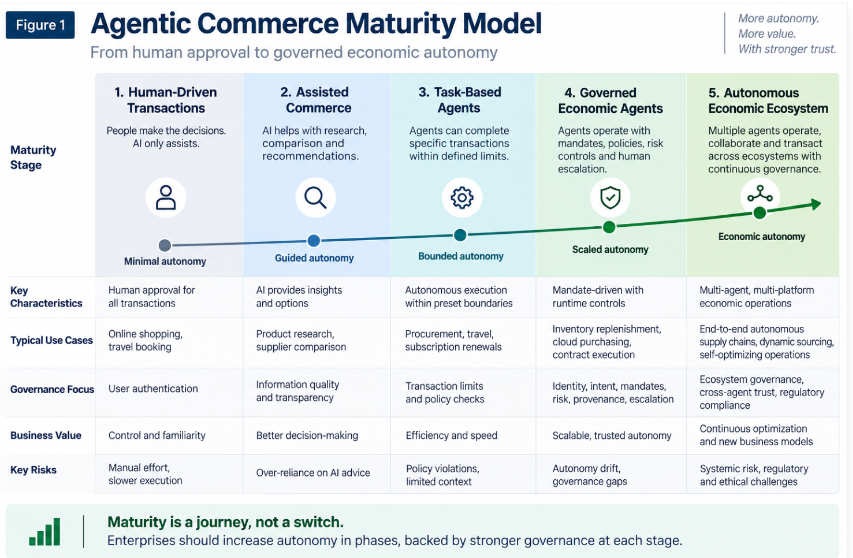
From Digital Transactions to Machine Economic Agency
Taken individually, these nine capabilities may look like extensions of technologies enterprises already use: IAM, policy engines, fraud systems, payment controls, provenance and observability. The larger shift comes from connecting them around autonomous economic decision-making.
That is what makes agentic commerce architecturally different.
Traditional commerce assumes a person sits somewhere near the final economic decision. Agentic commerce increasingly assumes that intent can be delegated, interpreted and executed by software.
The trust architecture therefore has to evolve from verifying a transaction to governing the entire chain of economic agency.
The progression is becoming clear:
Recommendation → Decision → Delegation → Transaction → Autonomous Economic Action
As that progression continues, the commercial role of agents will expand beyond shopping. Enterprise agents could purchase compute, replenish inventory, renegotiate low-risk contracts, acquire datasets, book logistics capacity or automatically source services when operational conditions change.
The strategic question is therefore not simply whether AI will participate in commerce. It is how much authority enterprises are prepared to delegate and what control architecture must exist before that authority scales.
The companies that get this right will not treat agentic commerce as another checkout capability. They will treat it as an economic operating model for autonomous systems.
When AI gets a wallet, the payment token is only one part of the architecture.
The more important asset may be the machine-readable mandate that proves why the agent was allowed to use it.
Leave a Reply