
Runtime AI Governance: Why Enterprise AI Needs a Runtime Control Plane, Not Just Responsible AI Policies

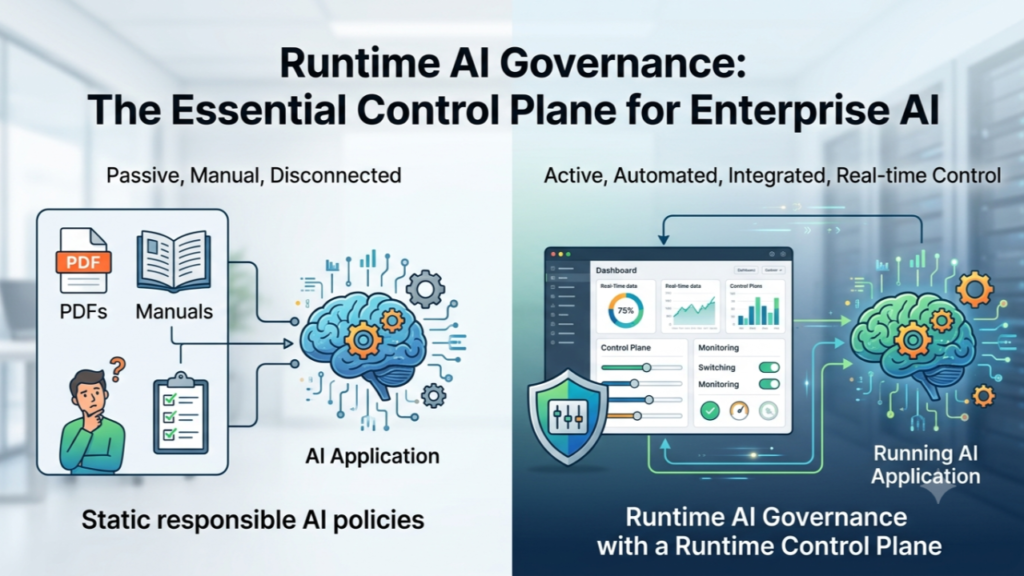
Governance is the foundation of any enterprise AI programme.
Model evaluation. Risk assessments are conducted. Security reviews are signed off. Data usage is approved by compliance teams. Solution reviewed by architecture boards prior to deployment.
Then the system goes live.
That’s exactly where traditional AI governance stops, and enterprise risk starts.
Unlike traditional software, artificial intelligence systems make decisions after they are deployed. They retrieve documents, invoke utilities, offer advice, steer processes and are playing an ever-greater role in managing business on a real-time basis. Every interaction creates new context, new evidence and new risks that can’t be fully anticipated at the time of design.
The implication is powerful.
Enterprise AI governance is no longer just about deployment. It is becoming an operational capability at run-time.
It won’t be the organisations with the most comprehensive Responsible AI policies that will scale AI safely. It will be those who build Runtime AI Control Planes that can observe, assess and manage every AI decision at the moment it’s made.
1) Reframe the discussion – Governance shifts from design time to run time
In traditional governance, risk can be governed before software is put into production.
AI breaks that assumption.
An AI transaction is not just a prompt to a model. This is a chain of decisions involving user identity, documents retrieved, enterprise policies, tool invocations, model reasoning, external APIs, and business workflows. Each stage produces a new governance checkpoint which, once during deployment, cannot be evaluated and assumed to remain valid.
Therefore boards should understand the difference between deployment governance and runtime governance.
A readiness baseline should include for practical purposes:
- Percent of AI decisions evaluated during execution
- Policy engine driven share of model interactions
- % of AI workflows with runtime audit trails
- Authorization of tool calls before running (%)
- Average time to detect and remediate AI policy violations
Board position: Responsible AI starts before deployment. AI is governed throughout execution.
2) Differentiate between Model Governance, Decision Governance and Execution Governance
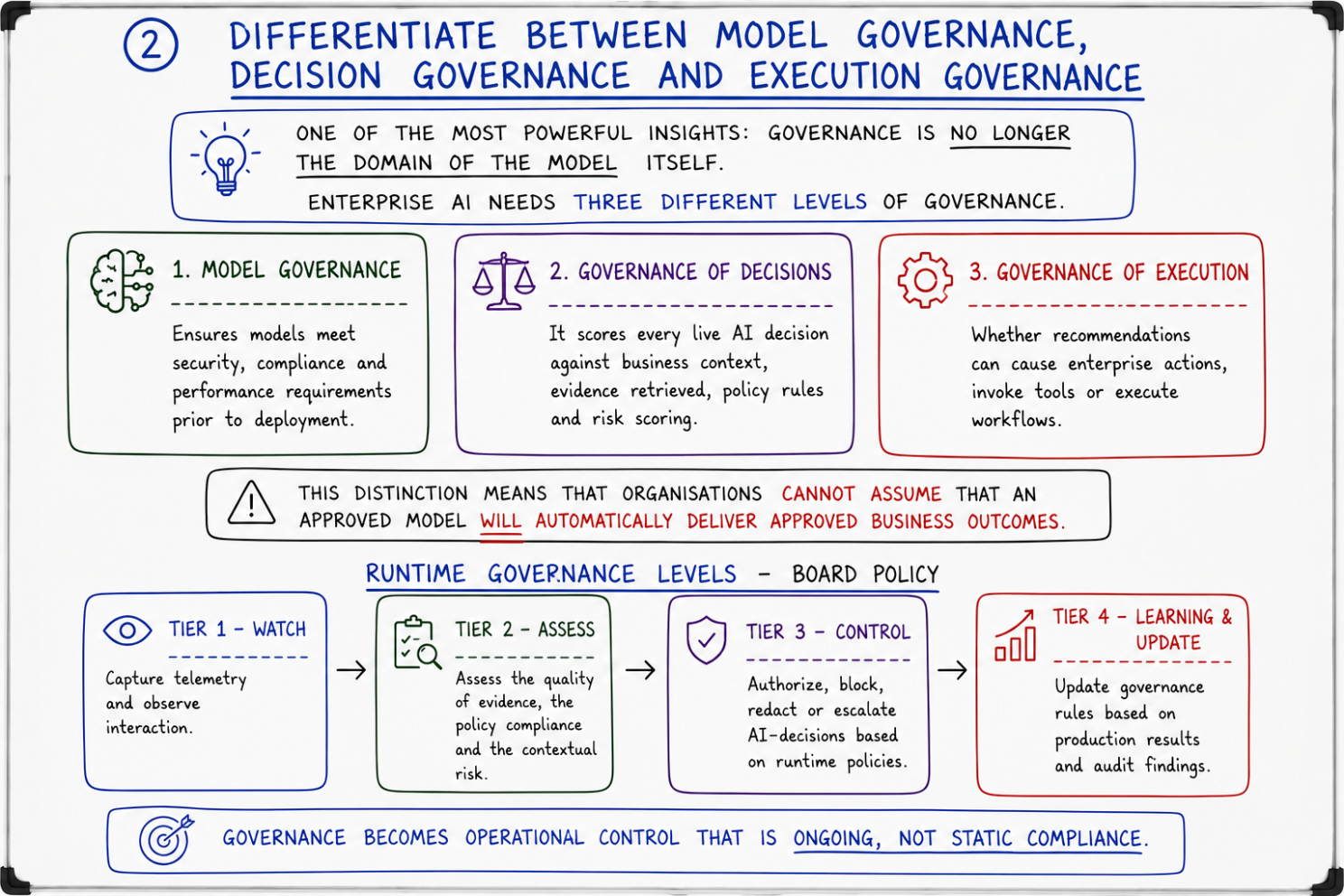
One of the most powerful insights from the article is that governance is no longer the domain of the model itself.
Enterprise AI needs three different levels of governance.
Model Governance
Ensures models meet security, compliance and performance requirements prior to deployment.
Governance of Decisions
It scores every live AI decision against business context, evidence retrieved, policy rules and risk scoring.
Governance of Execution
Whether recommendations can cause enterprise actions, invoke tools or execute workflows.
This distinction means that organisations cannot assume that an approved model will automatically deliver approved business outcomes.
Runtime Governance Levels – Board Policy:
Tier 1 – Watch
Capture telemetry and observe interaction.
Tier 2 – Assess
Assess the quality of evidence, the policy compliance and the contextual risk.
Tier 3 – Control
Authorize, block, redact or escalate AI-decisions based on runtime policies.
Tier 4 – Learning
Update governance rules based on production results and audit findings.
Governance becomes operational control that is ongoing, not static compliance.
3) List the failure modes at runtime
As artificial intelligence systems become more autonomous, governance failures are increasingly occurring at execution, not development.
Major failure modes include:
Evidence Drift
Recommendations are based on outdated, incomplete or unauthorized enterprise information.
Policy Bypass
At runtime, agents can call tools or access sensitive information without authorization.
Decision Deception
The answers sound plausible, but they’re not coming from reliable corporate sources.
Misaligned context
The same request results in different decisions as the business context changes during execution.
Invisible, but Automated
Autonomous workflows are run without adequate auditability or accountability.
These aren’t model failures.
They are failures of runtime governance.
4) Construct a Runtime AI Control Plane
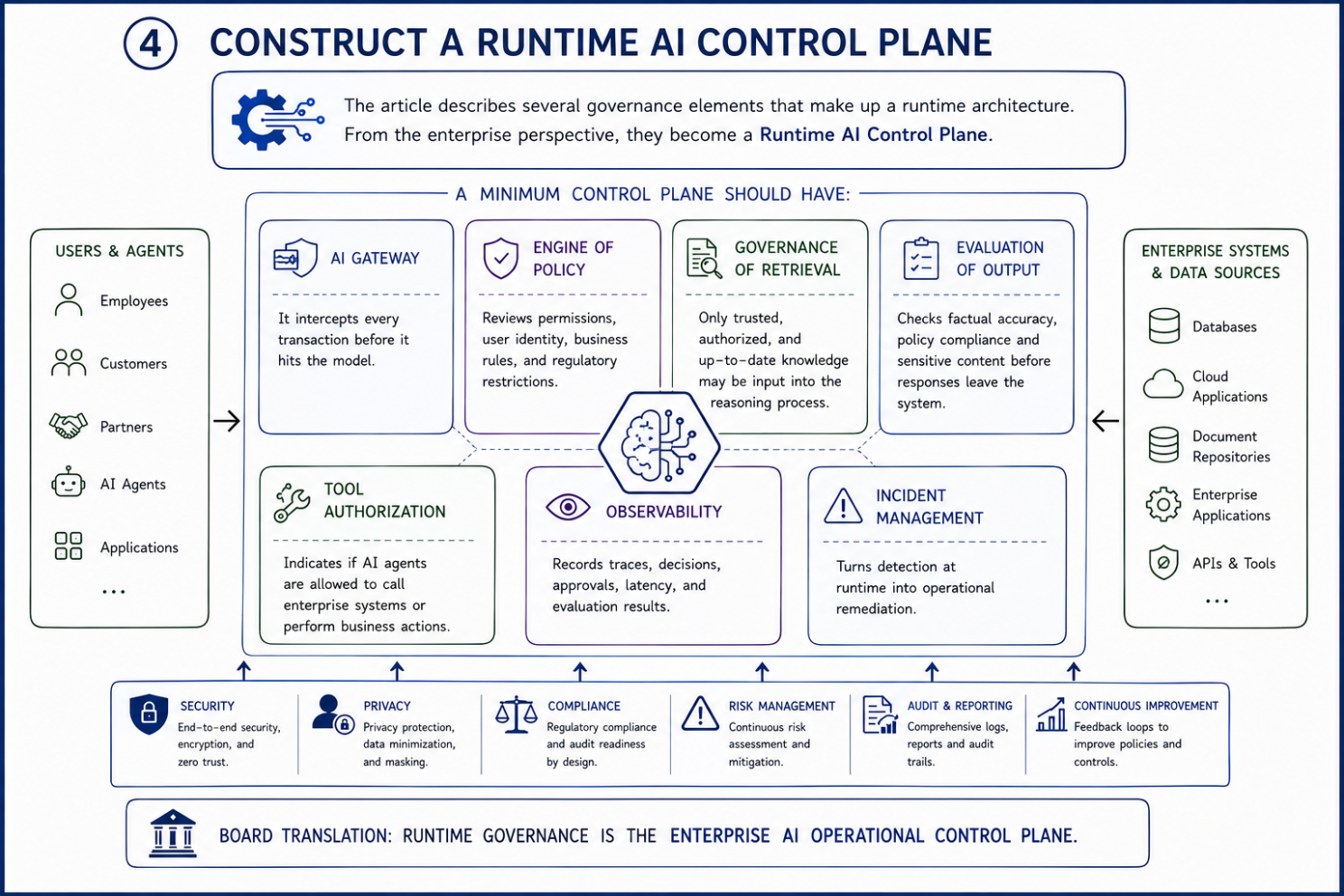
The article describes several governance elements that make up a runtime architecture.
From the enterprise perspective, they become a Runtime AI Control Plane.
A minimum control plane should have:
AI Gateway
It intercepts every transaction before it hits the model.
Engine of Policy
Reviews permissions, user identity, business rules, and regulatory restrictions.
Governance of Retrieval
Only trusted, authorized, and up-to-date knowledge may be input into the reasoning process.
Evaluation of Output
Checks factual accuracy, policy compliance and sensitive content before responses leave the system.
Tool Authorization
Indicates if AI agents are allowed to call enterprise systems or perform business actions.
Observability. .
Records traces, decisions, approvals, latency, and evaluation results.
Incident Management
Turns detection at runtime into operational remediation.
Board translation: Runtime governance is the enterprise AI operational control plane.
5) Measure the Effectiveness of Governance, Not Compliance Activity
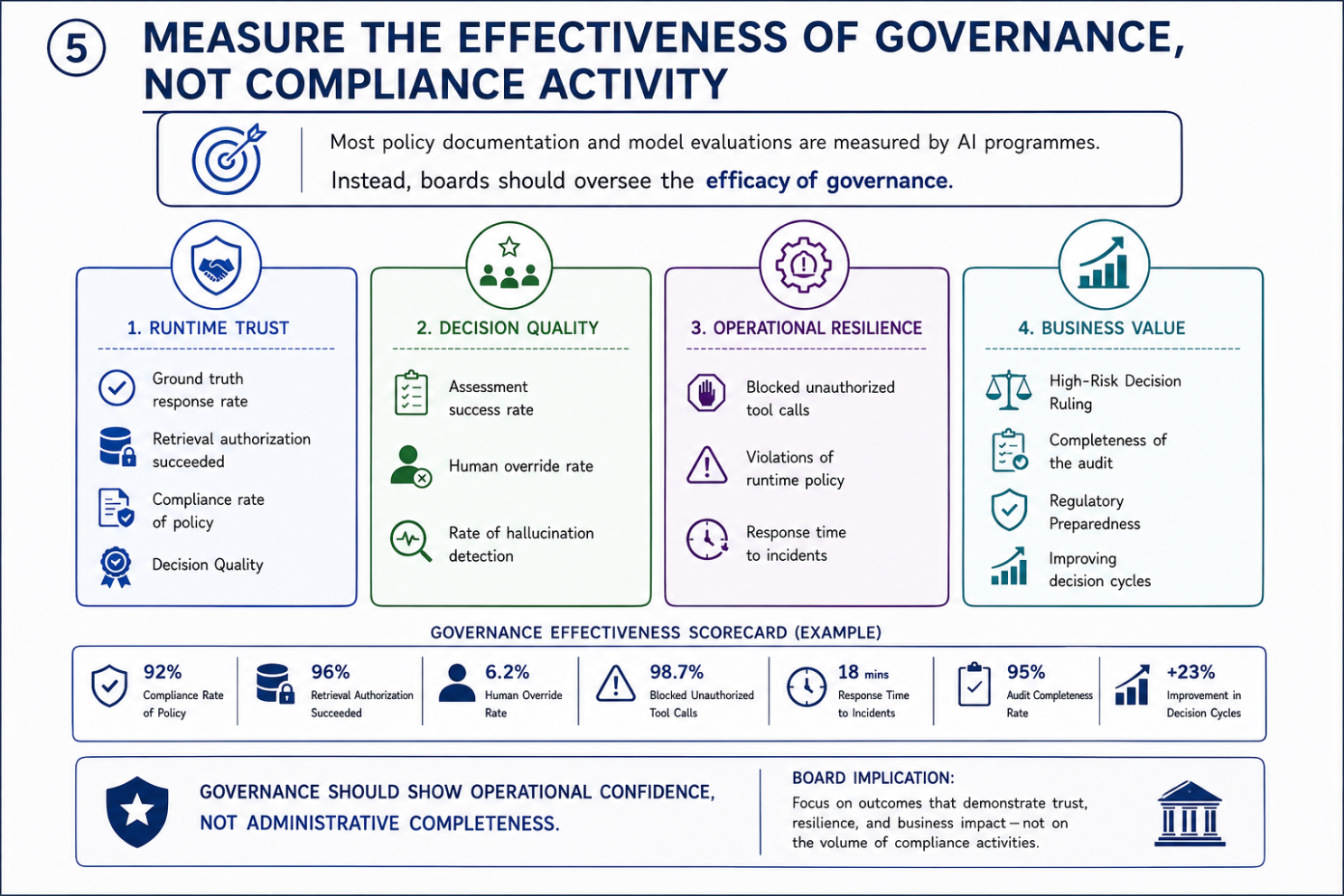
Most policy documentation and model evaluations are measured by AI programmes.
Instead, boards should oversee the efficacy of governance.
Runtime Trust
- Ground truth response rate
- Retrieval authorization succeeded
- Compliance rate of policy
Decision Quality
- Assessment success rate
- human override rate
- Rate for hallucination detection
Operational Resilience
- Blocked unauthorized tool calls
- Violations of runtime policy
- Response time to incidents
Business Value
- High-Risk Decision Ruling
- completeness of the audit
- Regulatory Preparedness
- Improving decision cycles
Governance should show operational confidence, not administrative completeness.
6) Enterprise SLOs for Runtime Governance
Practical run time commitments are
- Every AI transaction is directed to a governed gateway.
- Before reasoning, every retrieved document is authorised.
- All production responses are verified before delivery.
- You must specifically authorize each time you invoke a tool.
- All decisions made using AI are fully traceable and reproducible.
- A policy violation results in structured remediation.
These SLOs turn governance from documentation into measurable operational behaviour.
7) The control model is of a universal nature. The implementation isn’t.
The technologies mentioned in the article include AI gateways, policy engines, retrieval governance, evaluation frameworks and observability platforms.
Those technologies will keep on changing.
The operating model has been remarkably stable.
These are universal capabilities:
- Payment processing
- Policy-as-code
- Retrieval governance
- Output evaluation
- Tool permissions
- Authorizations by humans
- Observability:
- Incident management
Board Implication: Governance architecture standardization comes before governance tooling standardization.
8) The operating model changes the way the enterprise is governed
The most important implication is an organizational, not a technical, one.
Governance teams have more to do than just review models before deployment.
They are responsible for governing live AI decisions.
This calls for new skills in:
- policy engineering runtime risk management
- AI observability Decision tracking Ongoing review Incident management
Governance is an always on operational discipline not a periodic compliance exercise.
Perspective Closing
Each big enterprise technology shift created a new layer of control.
Networks brought in firewalls.
Cloud brought identity and access management.
Gateways got APIs.
Agentic AI brings runtime governance.
The organisations that will succeed in operationalizing AI will not be deploying more capable models alone. They will build runtime control planes that continuously monitor how AI reasons, retrieves, recommends and acts in enterprise workflows.
Board Question:
As artificial intelligence systems get more involved in enterprise decisions, are we still governing models before deployment or have we built a runtime control plane to govern every decision while it is actually being made?
Leave a Reply