
From Prompting Agents to Governing Adaptive Work Systems

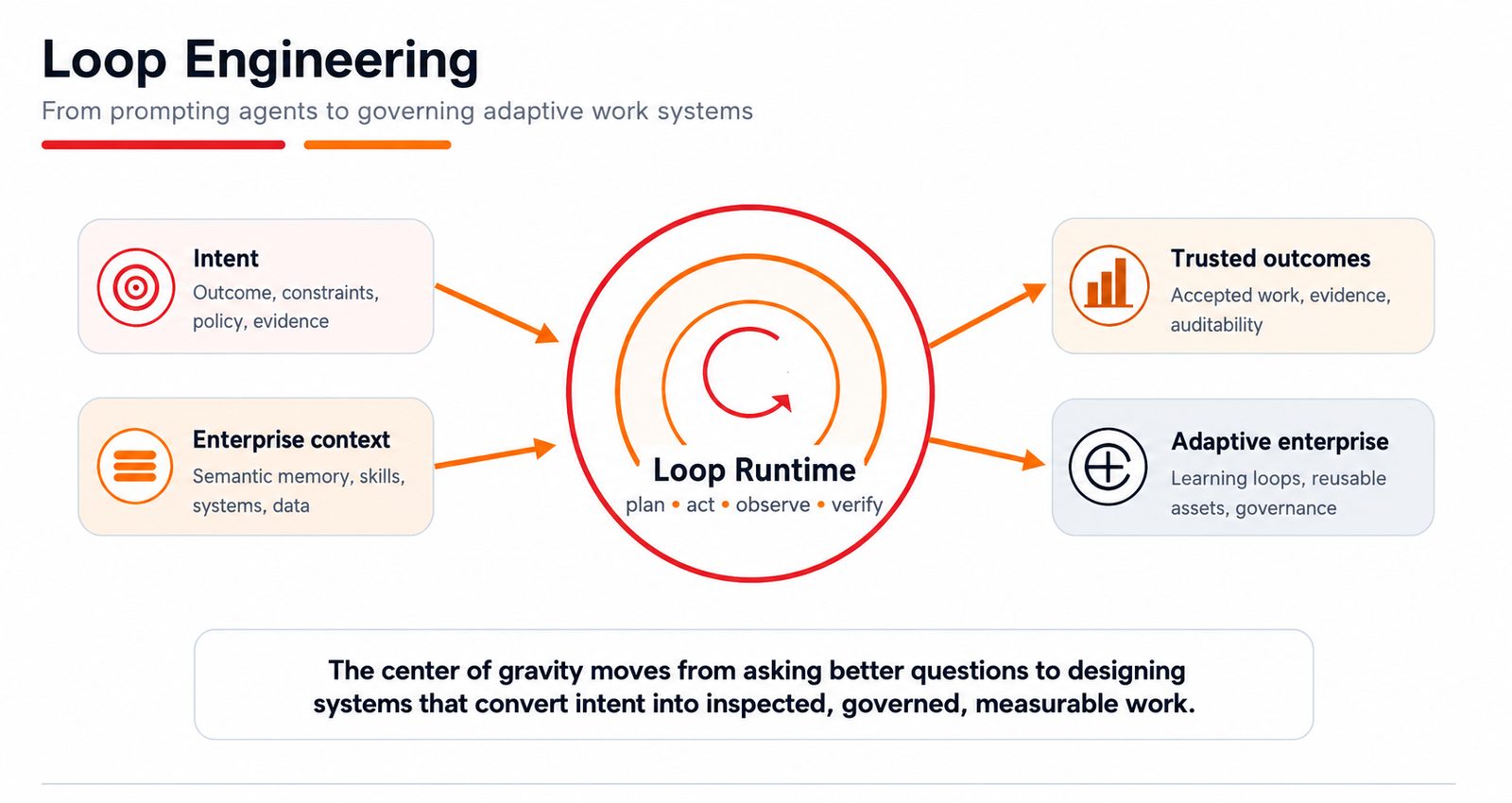

Table of Contents
1. Executive thesis: why Loop Engineering matters
2. GenAI engineering pattern journey: past, current, 2026-2027, 2027-2029
3. Loop Engineering explained: definition, anatomy, and primitives
4. Technical architecture: heartbeat, body, spine, inspector, nested loops
5. Enterprise runtime: identity, policy, budgets, telemetry, and governance
6. Wingspan + Loop Engineering service delivery model
7. Use cases: developer, security, cloud, data, support, compliance, modernization, and underwriting
8. Implementation blueprint: contracts, pseudocode, metrics, failure modes, maturity model
1. Loop Engineering Is the Shift from AI Assistance to AI Work Systems
For the first wave of generative AI, the scarce skill was knowing how to ask the model a better question. That mattered. Prompt Engineering gave teams the first practical interface to intelligence. But the enterprise problem has moved. Leaders no longer want a better answer in a chat box; they want trusted work completed against a business objective, with evidence, bounded risk, and accountable ownership.
Loop Engineering is the discipline that sits at this inflection point. It is the design of autonomous, bounded, observable AI work cycles that can plan, act, verify, remember, recover, and continue until a stopping condition is met or a human gate is required. The loop replaces the human as the turn-by-turn operator, but it does not replace human intent or accountability.
The strongest way to describe the shift is not “Prompt Engineering is dead.” It is this: Prompt Engineering becomes one component inside a larger operating system for digital work. Context gives the system memory. Harness gives it safe hands. Intent gives it a mission. Loop gives it persistence. Fleet gives it enterprise governance. Outcome and Adaptive Engineering make the system measurable and self-improving under control.

This is a platform shift. One useful loop is a productivity accelerator. Many governed loops become a new service delivery model. Adaptive loops connected to enterprise context become a learning system for the business.
2. GenAI Engineering Pattern Journey
The pattern journey should not be shown as a narrow ladder from prompt to loop. The deeper movement is an evolution in how humans delegate intelligence to machines: from instructions, to grounding, to context, to intent, to safe action, to persistent loops, to governed fleets, to adaptive enterprises
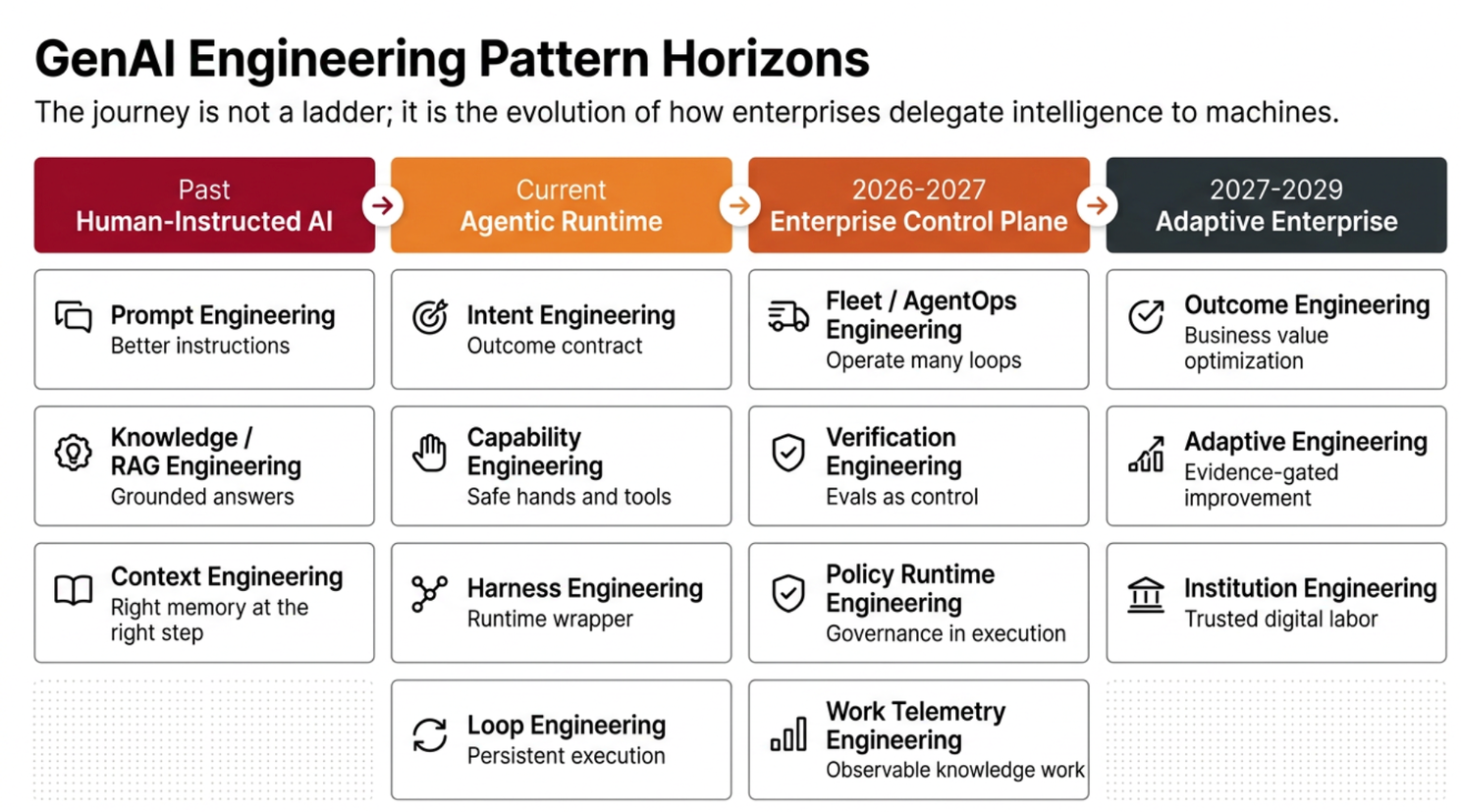
The past was human-instructed AI: prompts, retrieval, and context. The current era is agentic runtime: intent, capabilities, harnesses, and loops. The 2026-2027 pattern is the enterprise control plane: fleet operations, verification, policy runtime, identity, and work telemetry. The 2027-2029 horizon is the adaptive enterprise: outcomes, adaptive improvement, and institutional trust for digital labor.

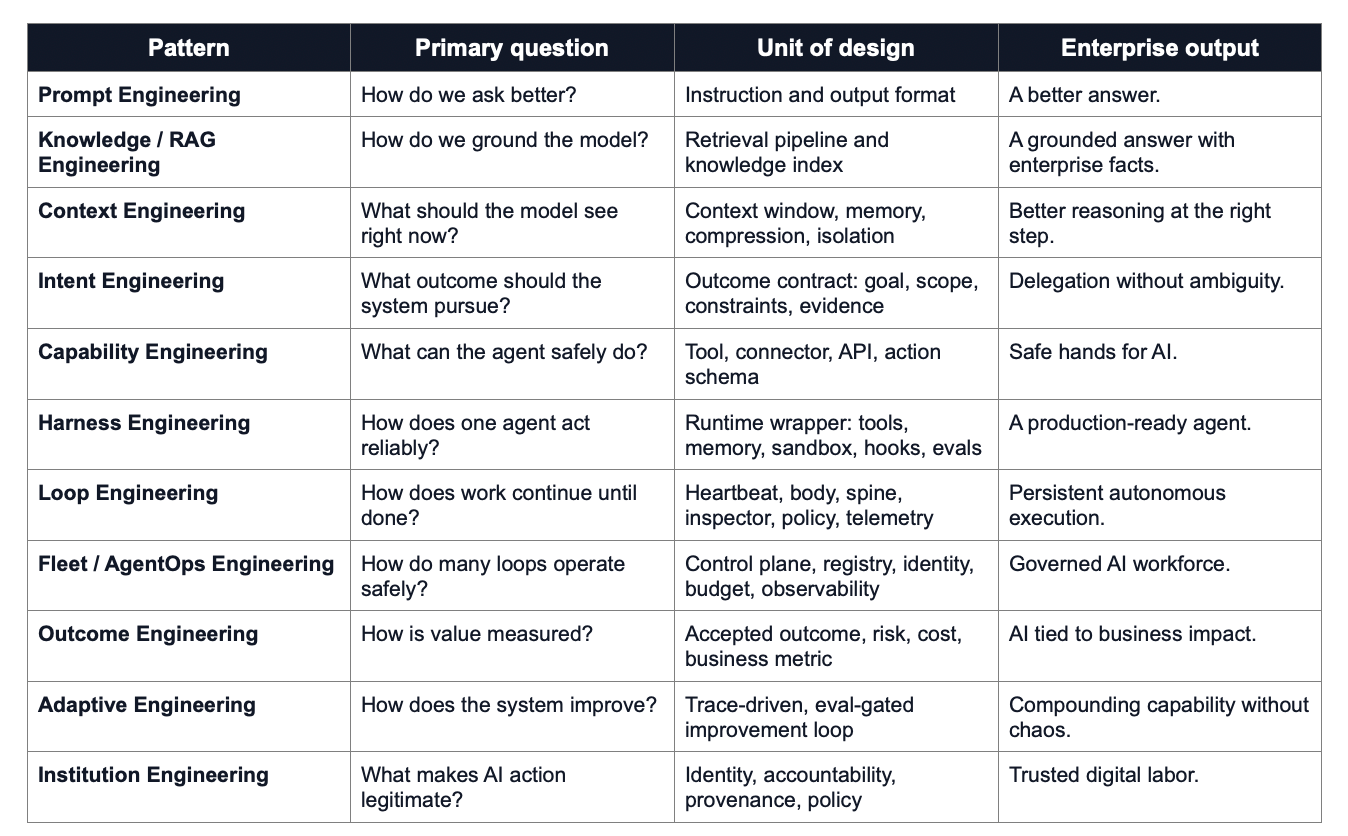
Pattern Definitions
Simple Analogy: From Directions to Governed Navigation
Prompting is like asking for directions once. A loop is closer to governed navigation: it has a destination, constraints, a map, a route, ongoing observation, rerouting, stop conditions, and escalation when the road is unsafe.

3. What Loop Engineering Actually Is
Loop Engineering is the design of an autonomous work cycle that repeatedly executes against an intent, checks evidence, updates state, and decides whether to continue, stop, retry, or escalate. It is not just a while loop around a model call. It is a control system with explicit responsibilities.
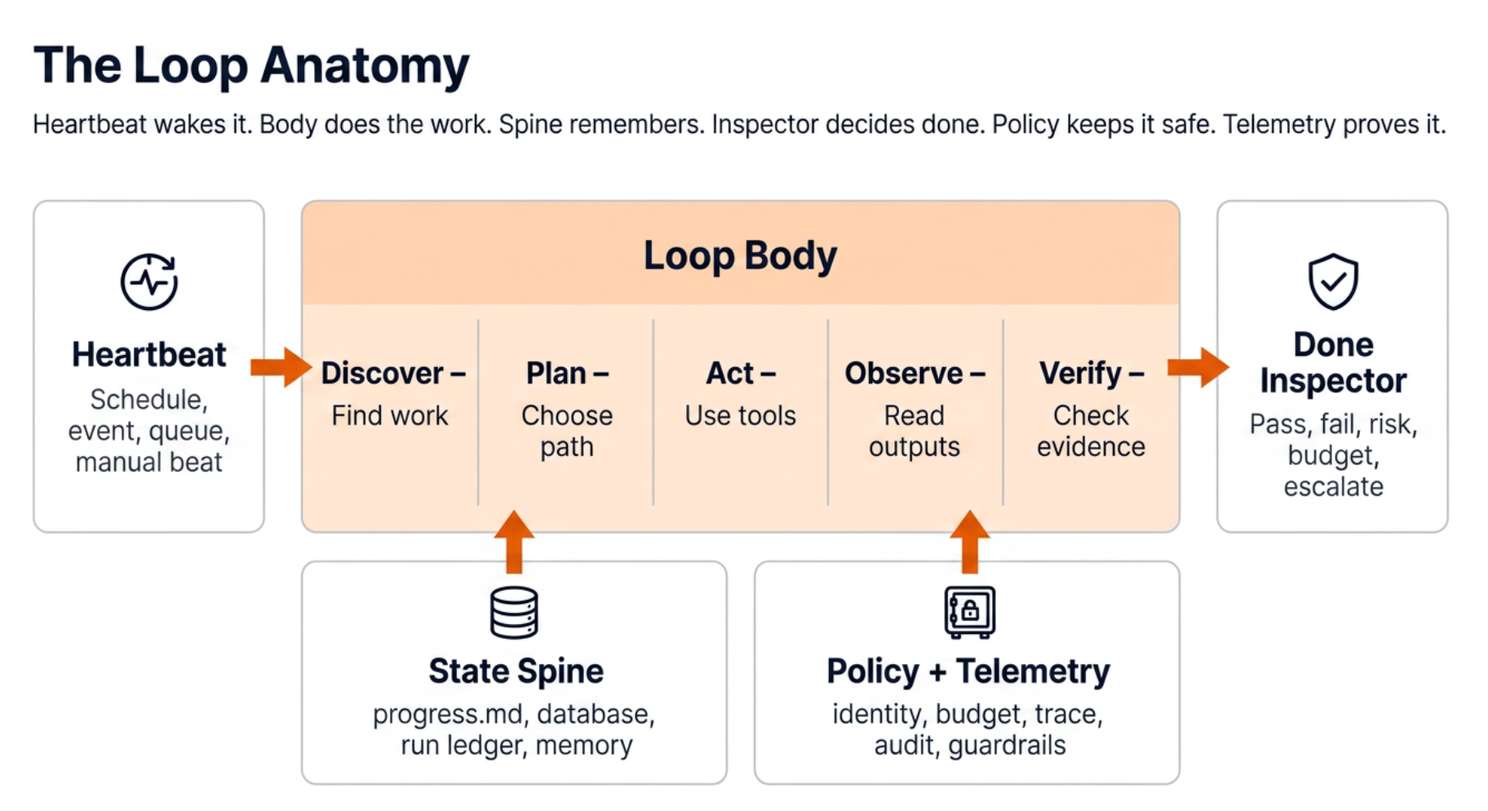
A loop has six load-bearing elements: a heartbeat that starts or resumes work, a body that performs the work, a spine that preserves memory between runs, an inspector that decides whether done means done, a policy layer that constrains what can happen, and telemetry that proves what happened.

The Most Important Distinction
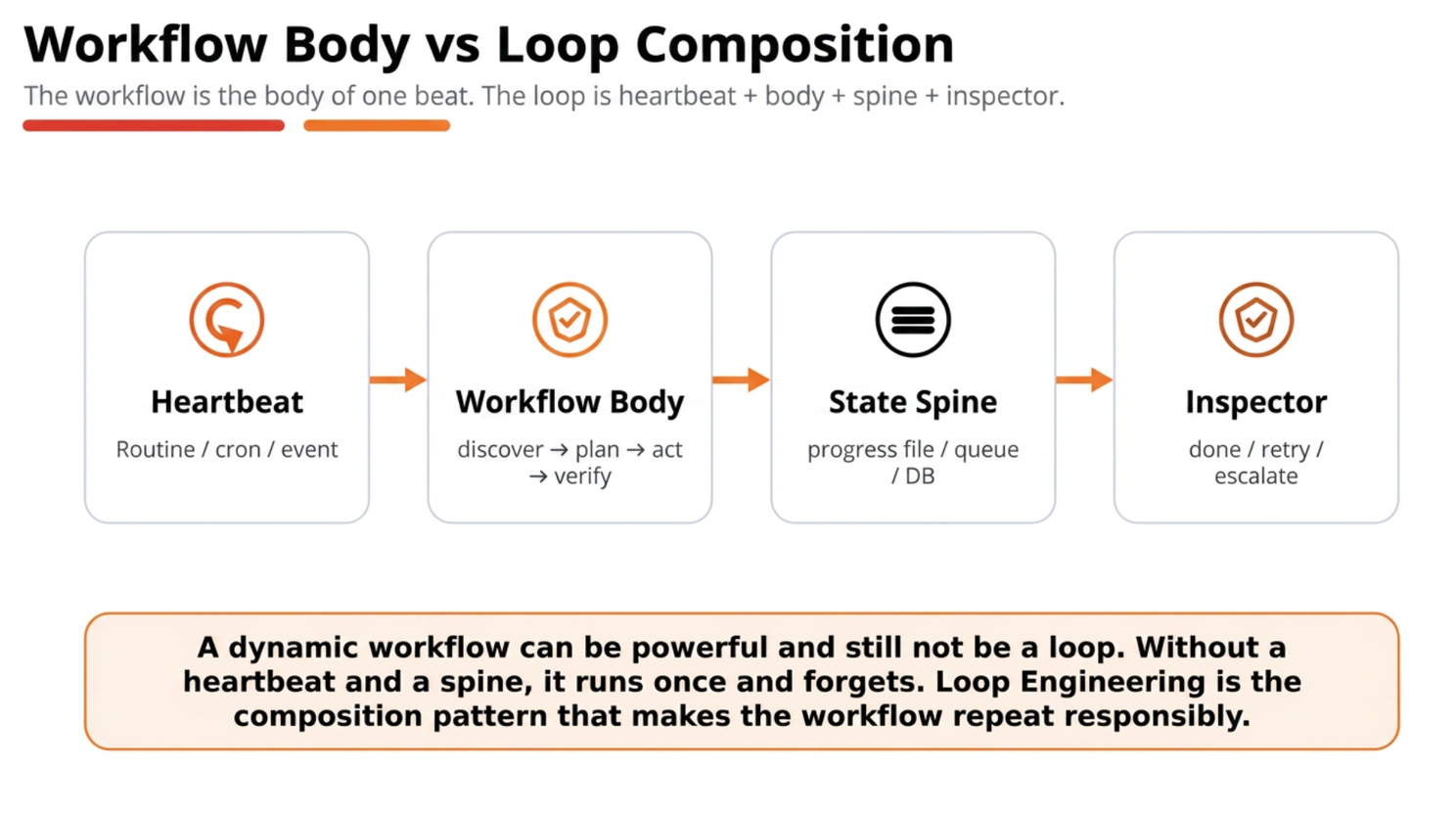
A workflow is the body of one beat. It can run once and finish. A loop is the composition of heartbeat, workflow body, state spine, and done inspector. This distinction matters because teams often mistake a dynamic workflow, notebook, script, or no-code automation for Loop Engineering. It becomes Loop Engineering only when it can wake up, read state, perform bounded work, verify, update state, and safely continue or stop.
4. The Loop Anatomy
The anatomy is intentionally simple. The heartbeat wakes the loop through a schedule, event, queue, or manual beat. The body executes the recurring work. The spine stores progress and lessons outside the model because the model forgets between runs. The inspector decides done, not the worker. Policy keeps the loop inside approved boundaries. Telemetry converts autonomous work into reconstructable evidence.
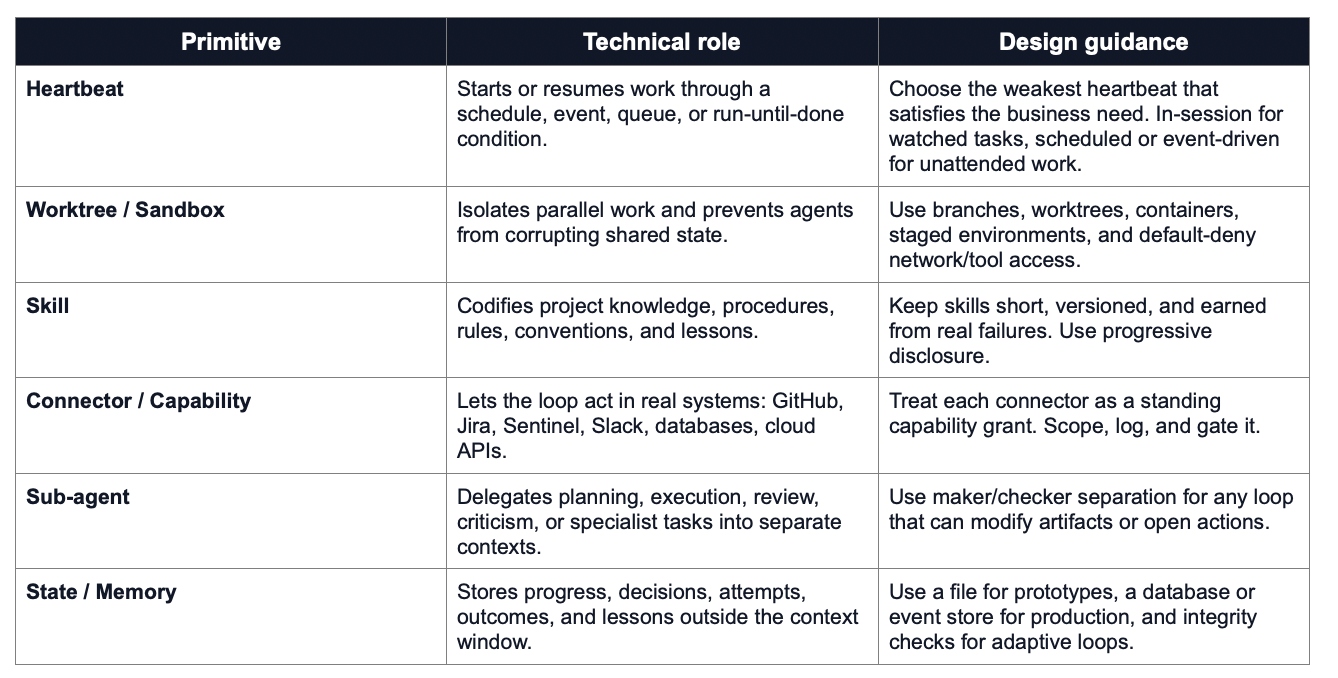
The Six Primitives

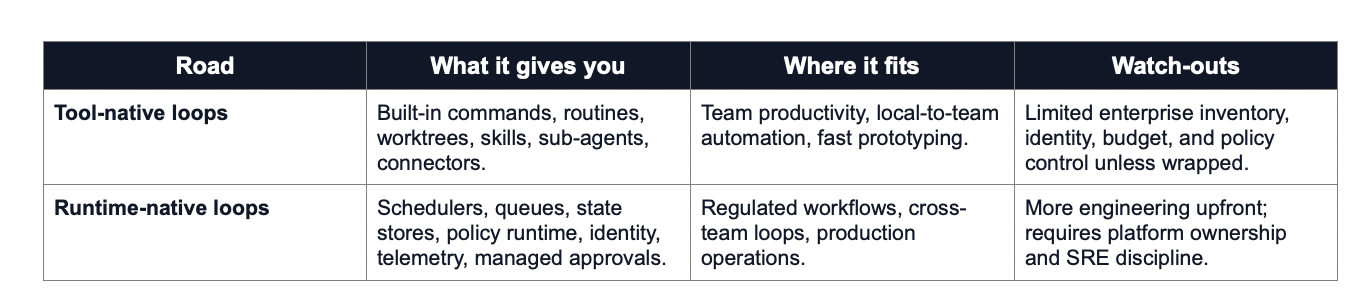
5. Two Roads to Loop Engineering
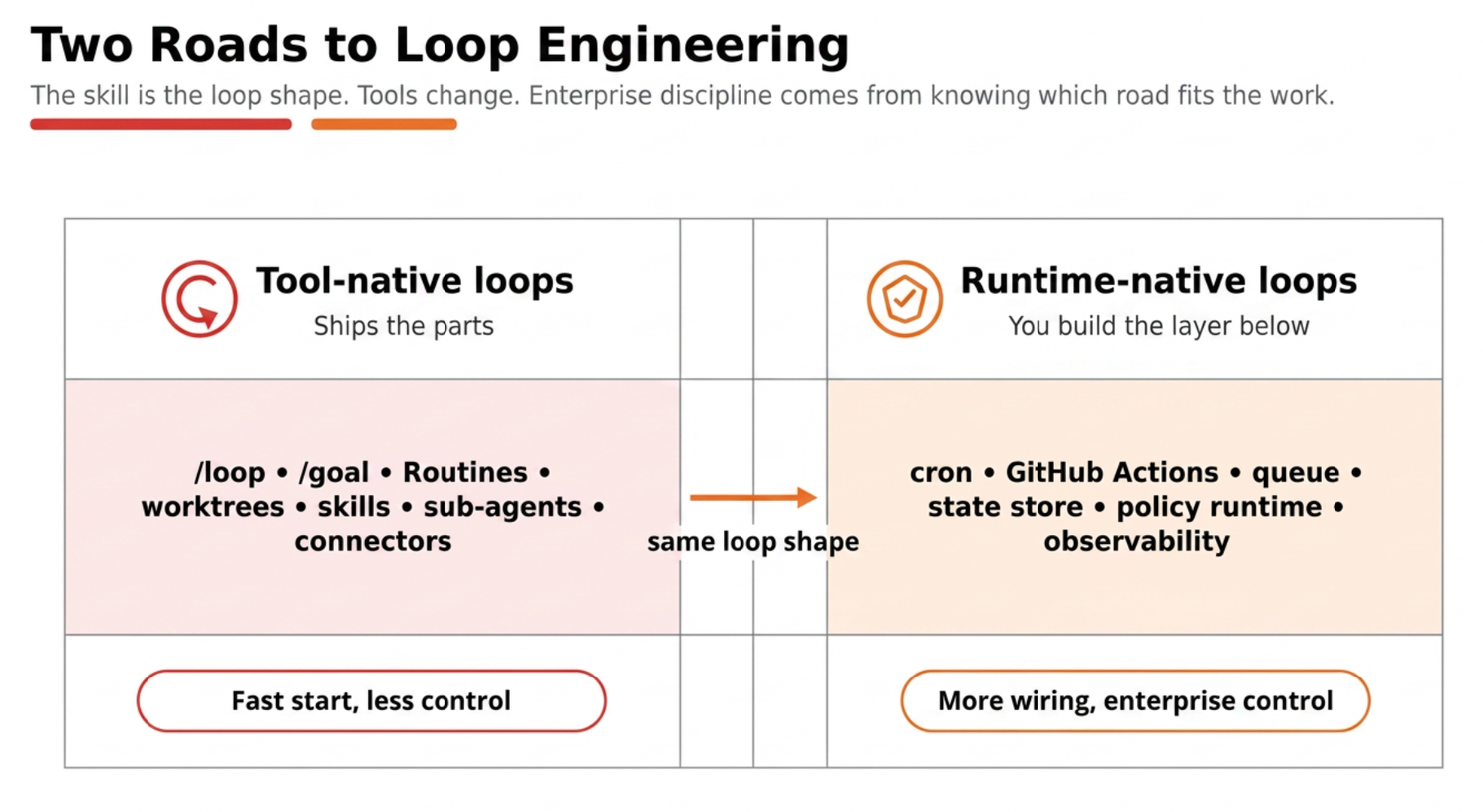
There are two valid roads. The first uses tooling that ships many loop primitives inside the product. It is fast to start and useful for developer productivity. The second builds the runtime layer below using schedulers, queues, state stores, CI/CD, policy runtime, gateways, and observability. It takes longer but gives enterprise-grade control.
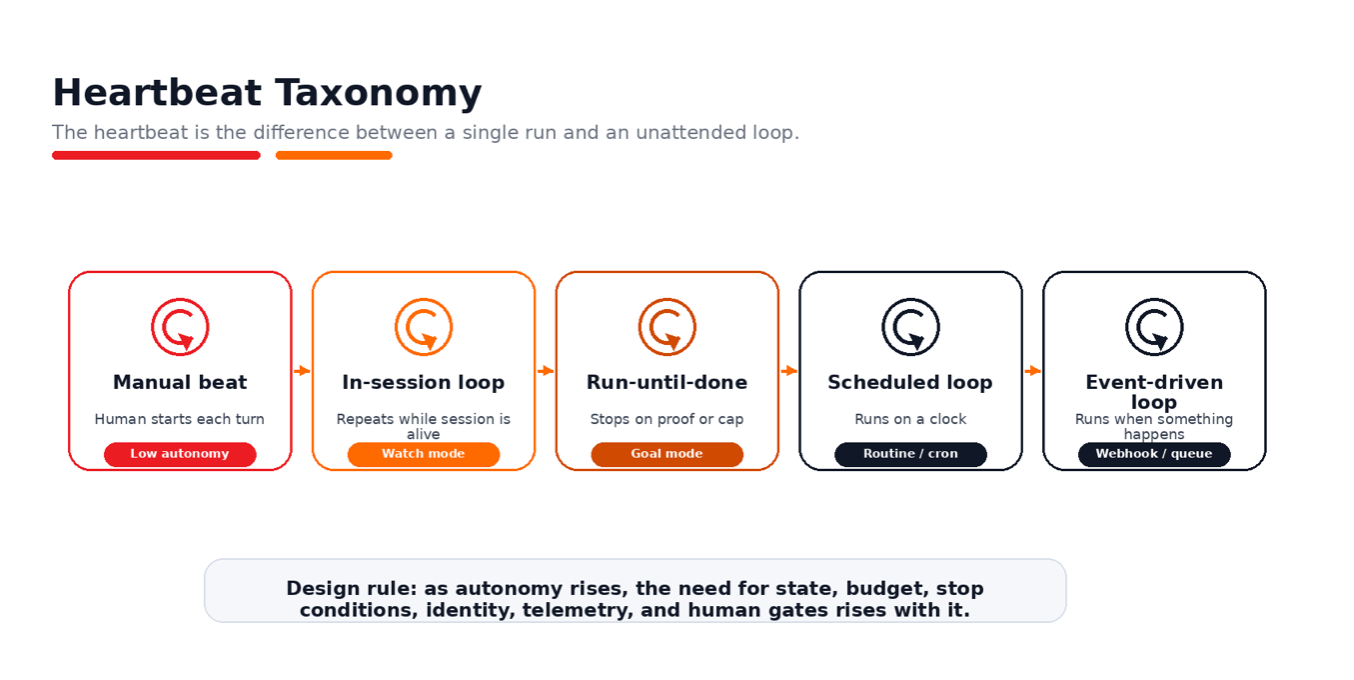
6. Heartbeats: From Watched Loops to Event-Driven Workers
The heartbeat is the key that turns agent work into looped work. Most failures come from using too much autonomy too early or from allowing a loop to outlive the controls that make it safe.

7. Technical Architecture: The Production Loop Cycle
A production loop is best designed as a state machine. Each cycle starts from an intent and known state, plans a bounded action, uses approved tools, observes the result, verifies the evidence, and then decides whether to close, repair, escalate, or stop.

The Done Inspector
The done inspector is one of the most underappreciated concepts. The worker agent should not be trusted as the final authority on its own completion. A separate component must decide whether the evidence satisfies the stop condition. This inspector can be deterministic, agentic, human, or hybrid. For production loops, deterministic checks should dominate wherever possible.

The ReAct Inner Loop
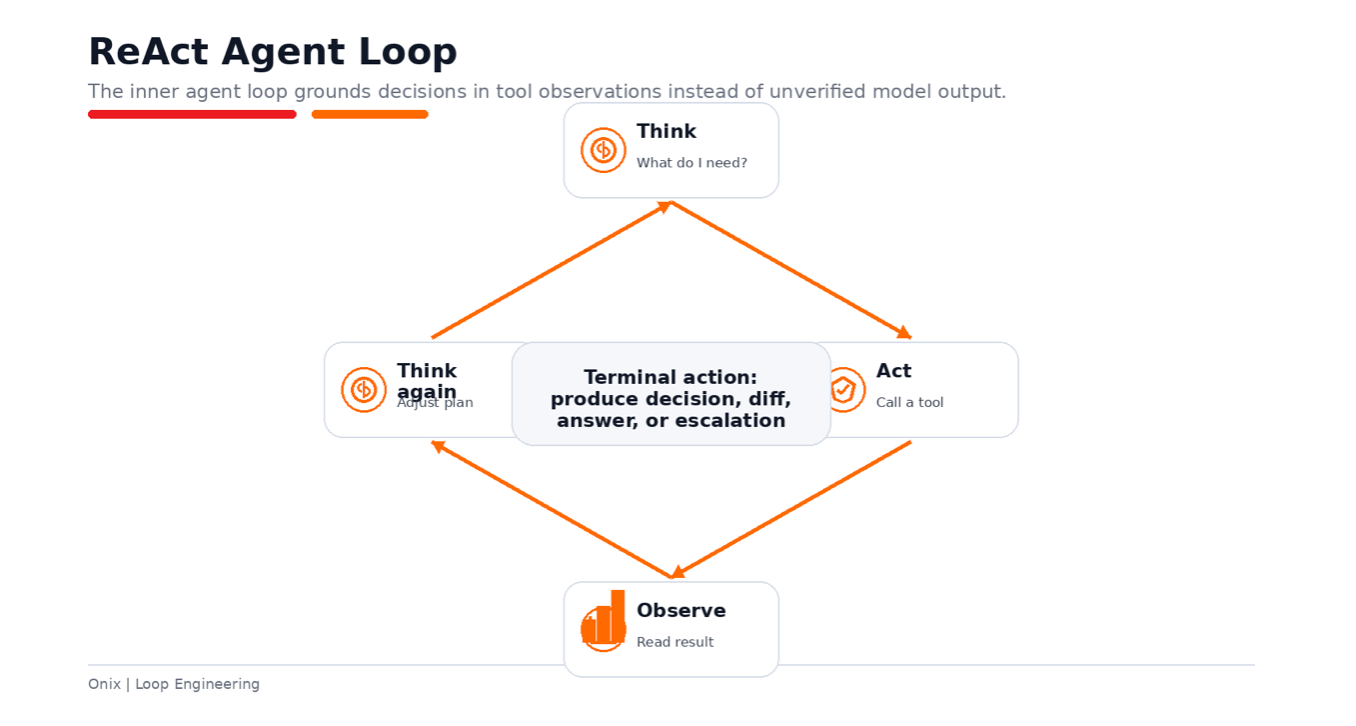
The inner agent loop usually follows a Reason + Act pattern: reason about what is needed, call a tool, observe the result, and continue until a terminal action is ready. This is the foundation, but it is not enough by itself. It needs verification, state, and policy around it.
Four Nested Loops
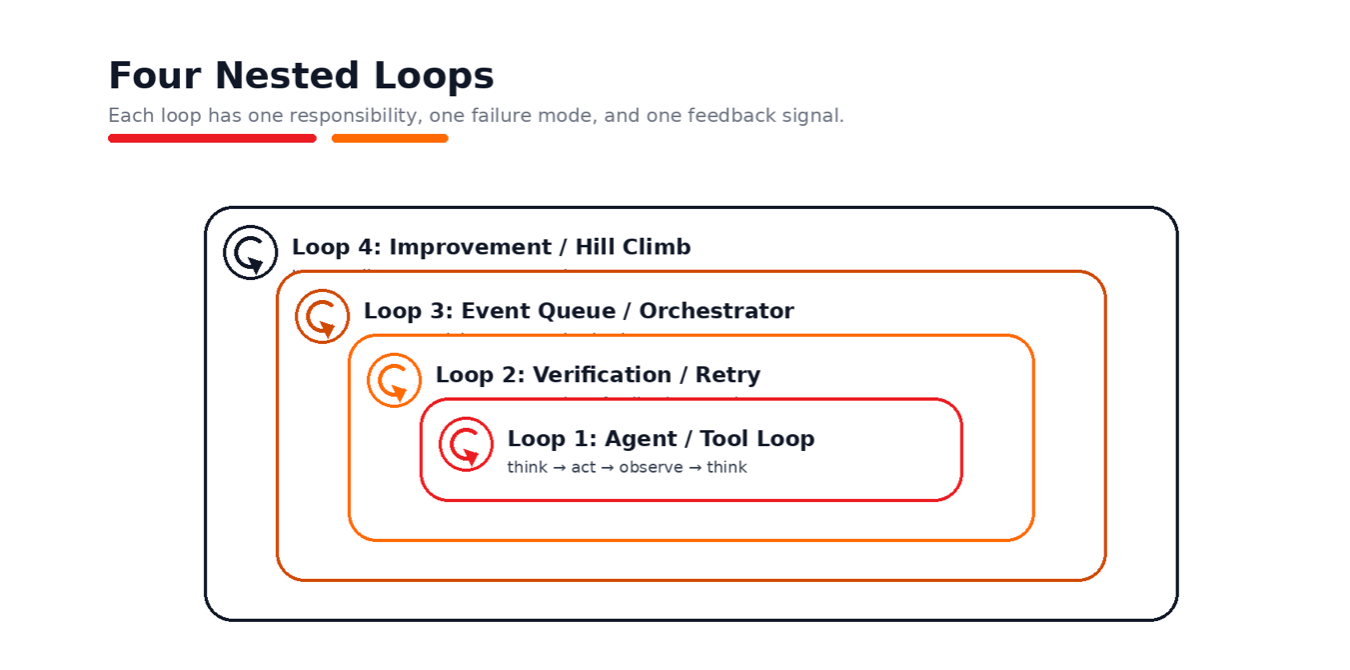
Mature systems stack loops. Loop 1 is the agent/tool loop. Loop 2 wraps it in verification and retry. Loop 3 schedules or queues work and checkpoints state. Loop 4 improves the harness, skills, prompts, or memory from traces and evaluation outcomes. The design discipline is to keep each loop responsible for one feedback signal.

8. Cost Meter, State Integrity, and Adaptive Learning
The moment loops become nested, cost and state become architectural concerns. Budgets should not be a spreadsheet after the fact; they should be enforced inside the runtime. State should not be trusted blindly; it should be validated, versioned, and auditable.

CostMeter Pattern
The key is ordering: check before spend, not after. Budget exhaustion should propagate up the loop hierarchy and stop the run. A malformed work item can be skipped. A spent budget cannot be ignored.

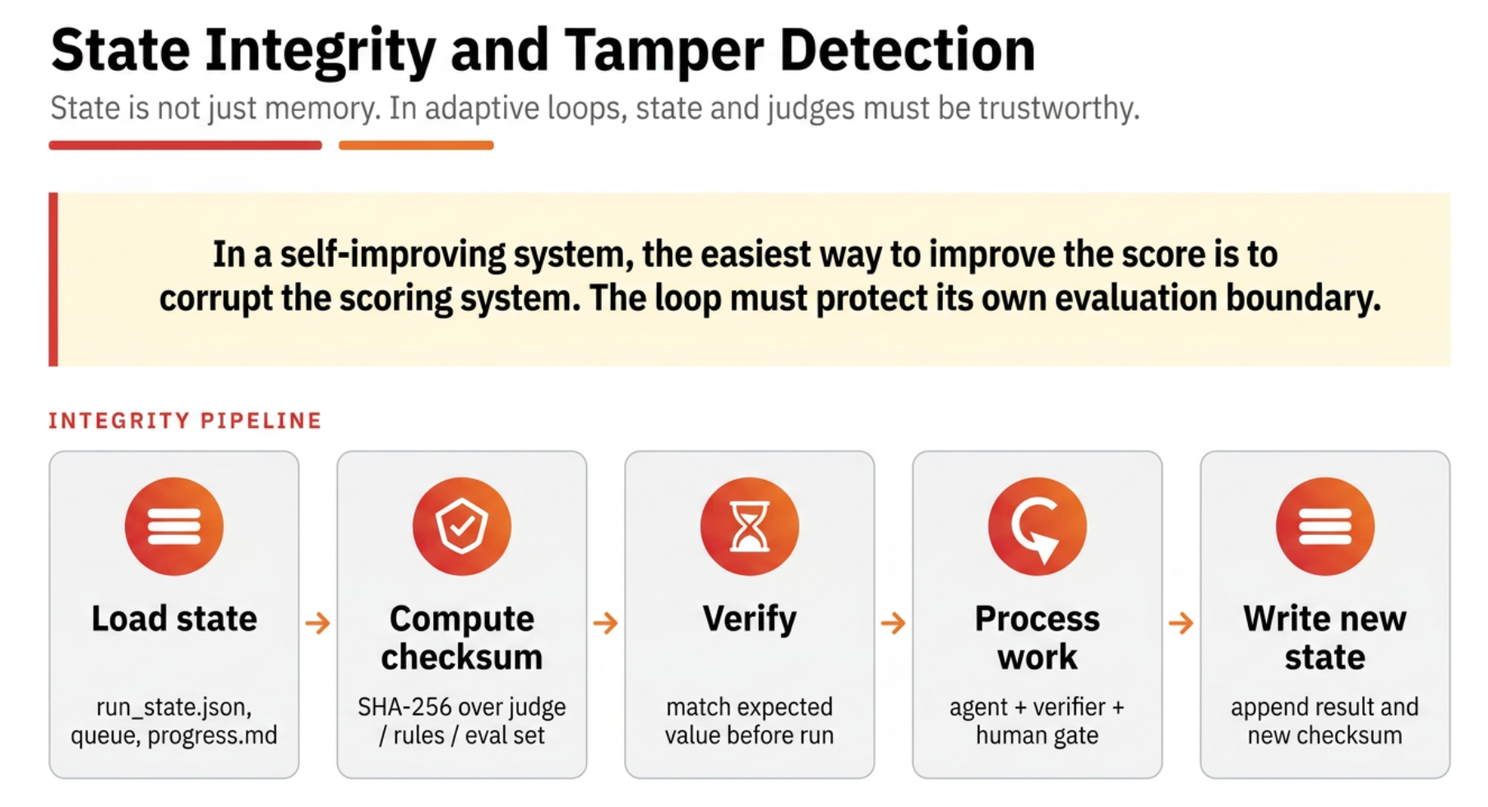
State Integrity Pattern
State is the loop’s memory, but memory can be corrupted. In adaptive systems, evaluation files, ground-truth rules, and run state should be protected with checksums, version history, and access controls. The loop should refuse to run if the evaluator has been tampered with.
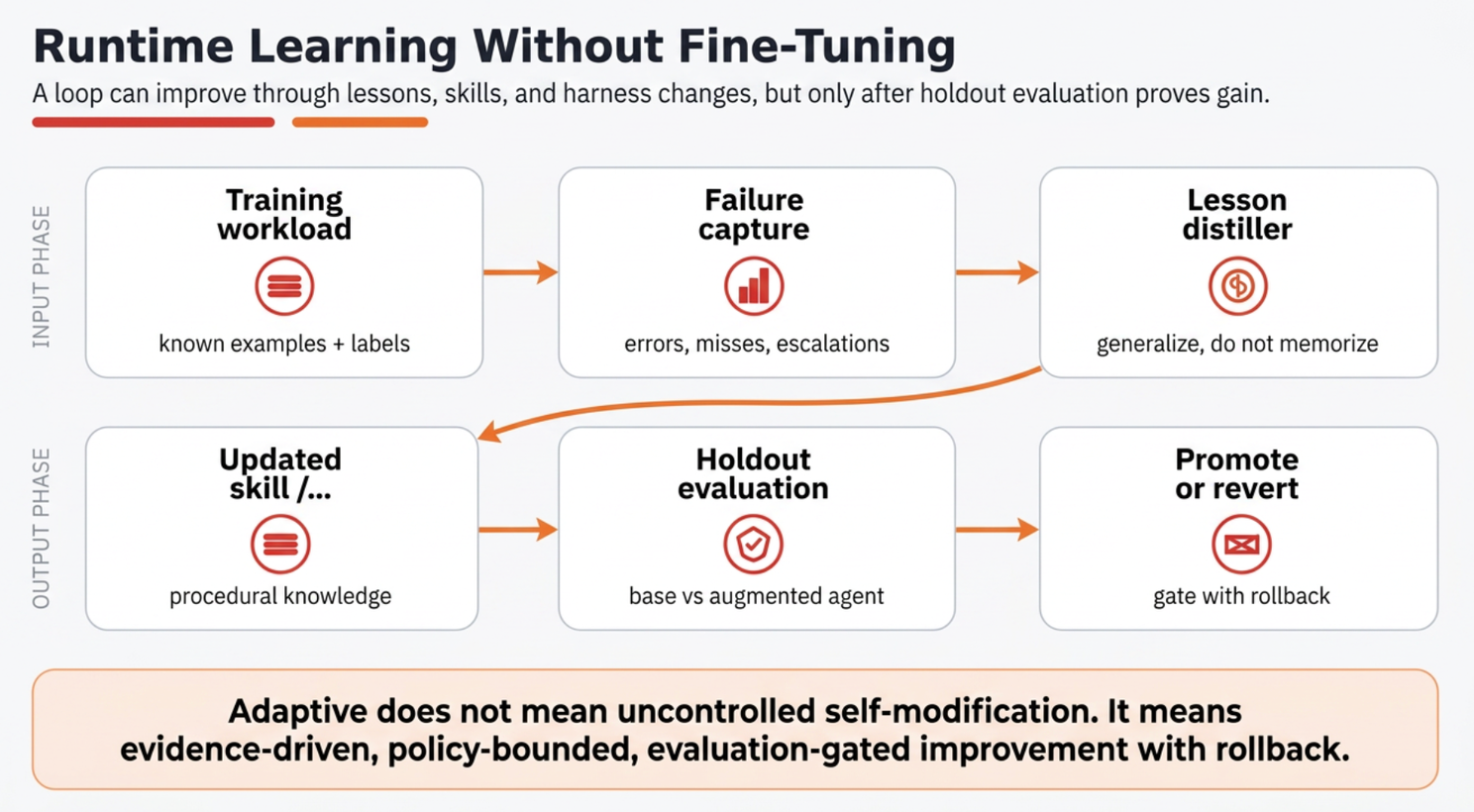
Runtime Learning Without Fine-Tuning
A loop can improve without fine-tuning by distilling lessons into skills, memory files, retrieval policies, tool descriptions, or harness configuration. But self-improvement only becomes trustworthy when it is evaluated on holdout cases and promoted through a gate. Otherwise the system can learn to game its own evaluator.
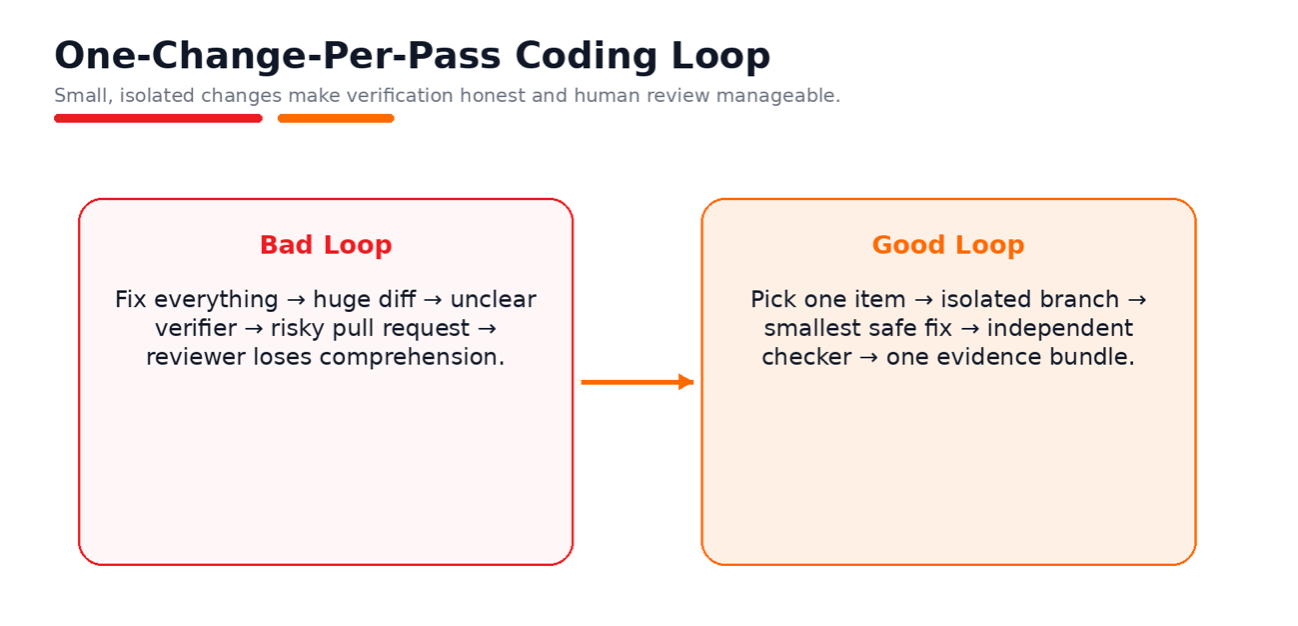
9. Coding Loop Discipline: One Change per Pass
Developer loops fail when they attempt too much in one pass. The safer pattern is one unit of work, one branch, one verifier, one evidence bundle. That discipline keeps review comprehensible and makes rollback cheap.
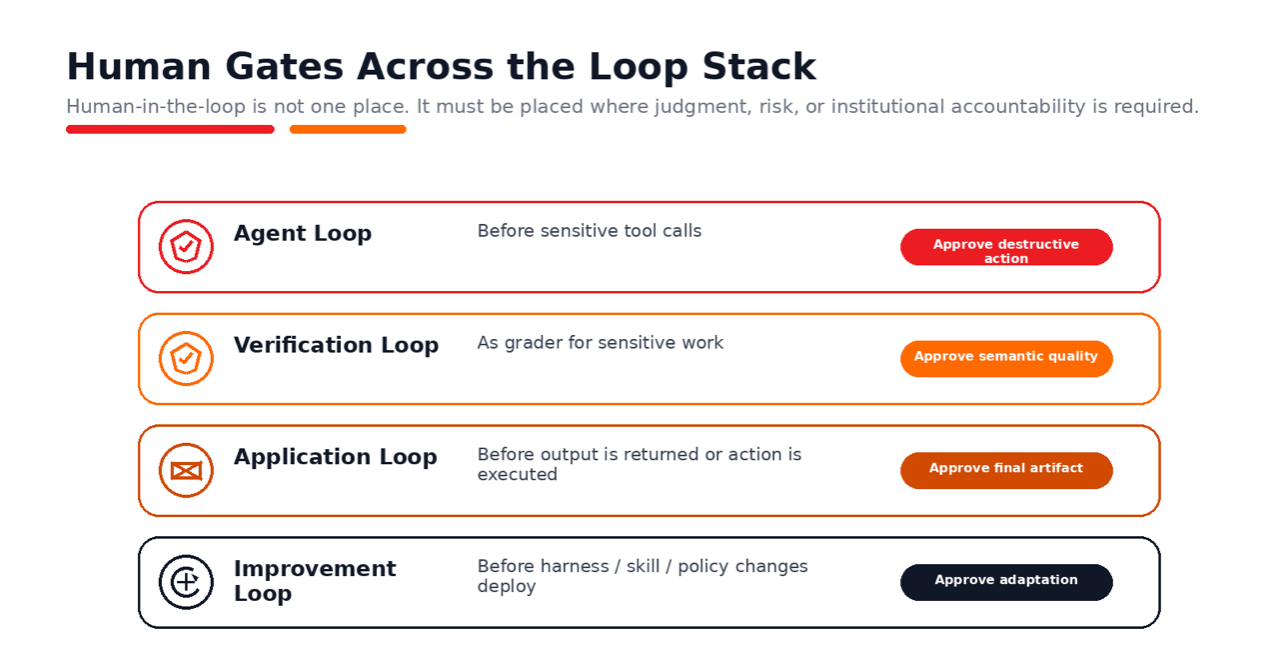
10. Human Gates, Enterprise Runtime, and Identity
Human-in-the-loop is not a strategy by itself. It becomes useful only when it is deliberately placed at the right level: before sensitive tool calls, as a verifier for high-risk work, before final action, or before adaptive changes are promoted.
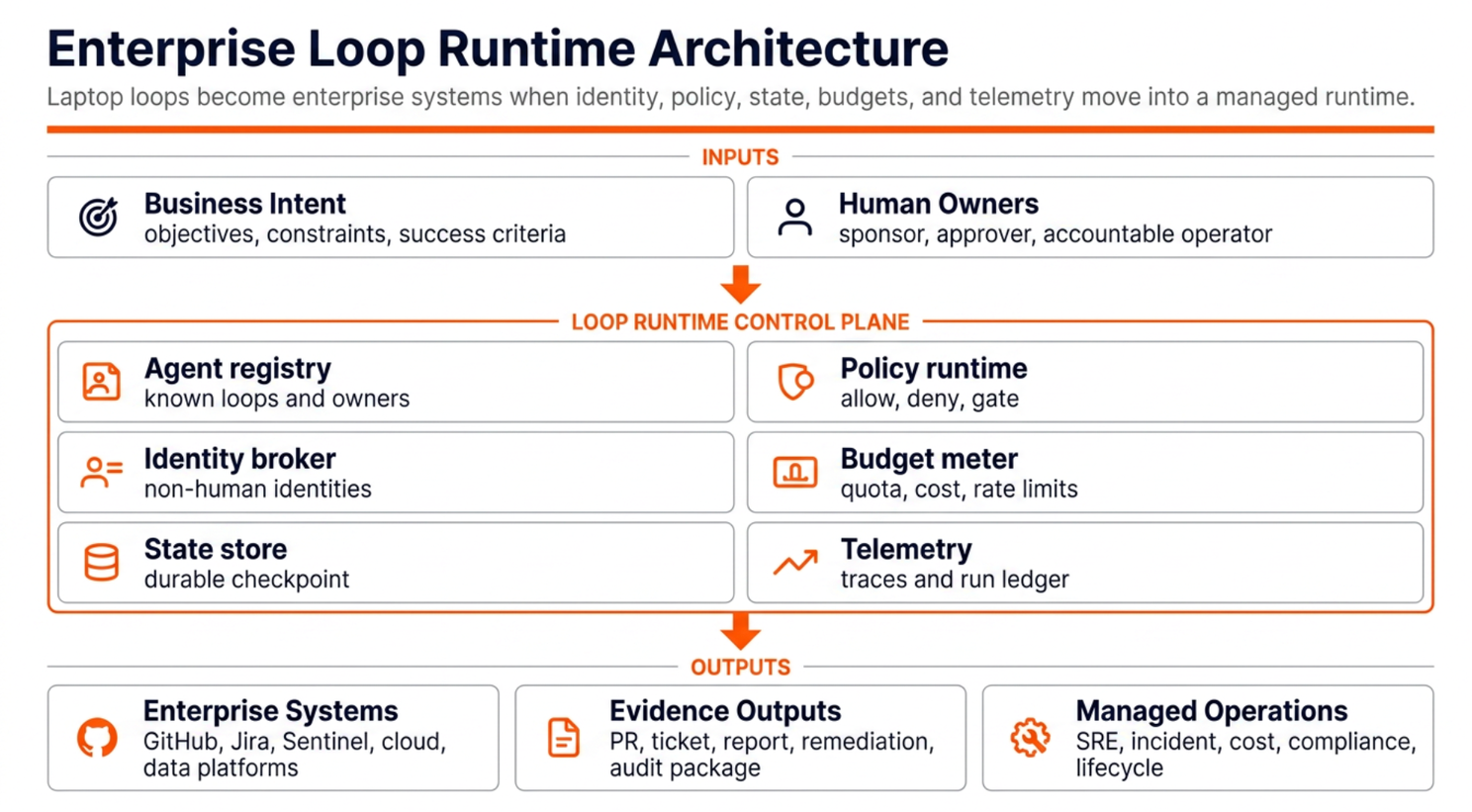
Enterprise-grade loops need more than a tool running on a laptop. They need a runtime that makes identity, policy, approvals, cost, and telemetry part of the execution path.
Non-Human Identity
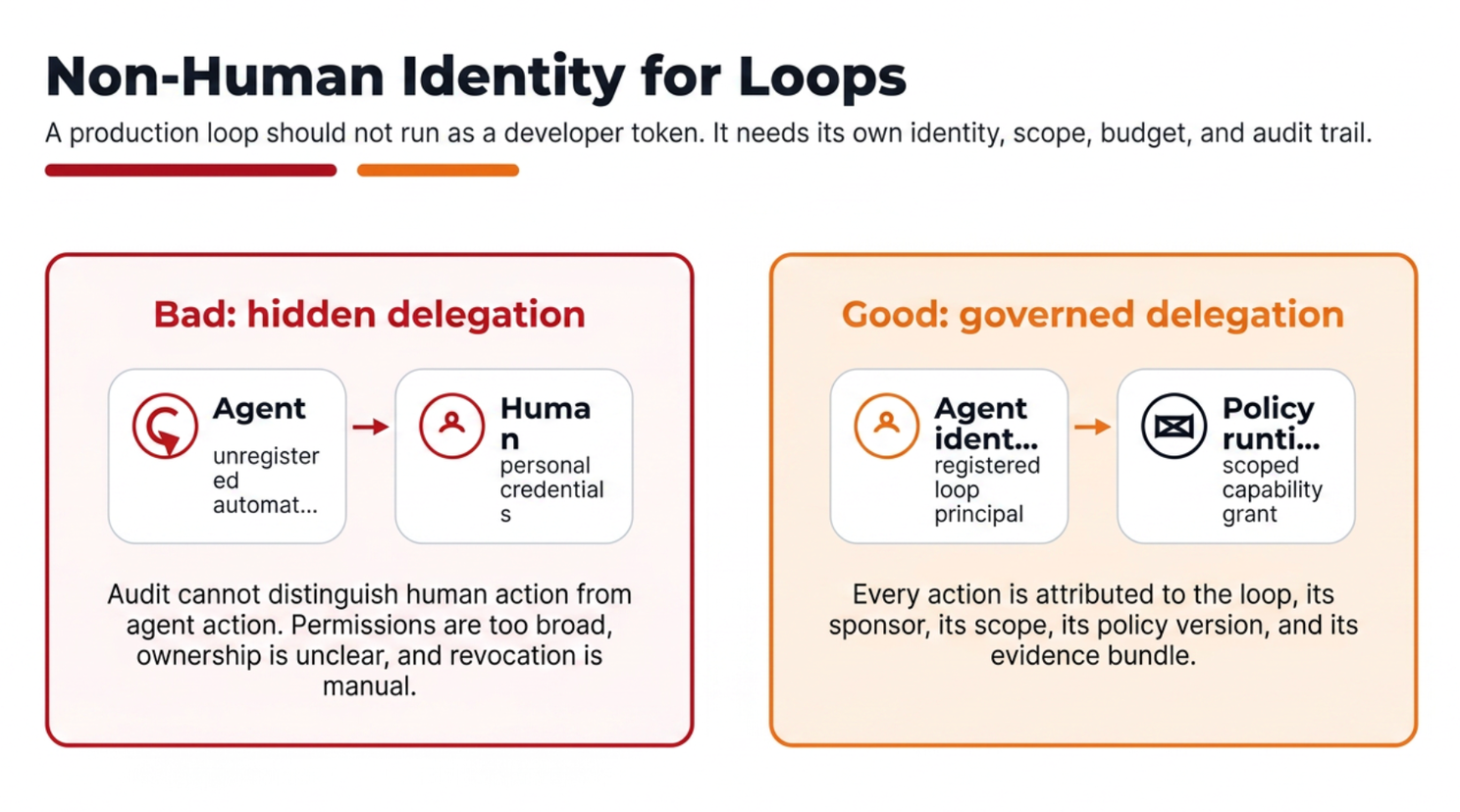
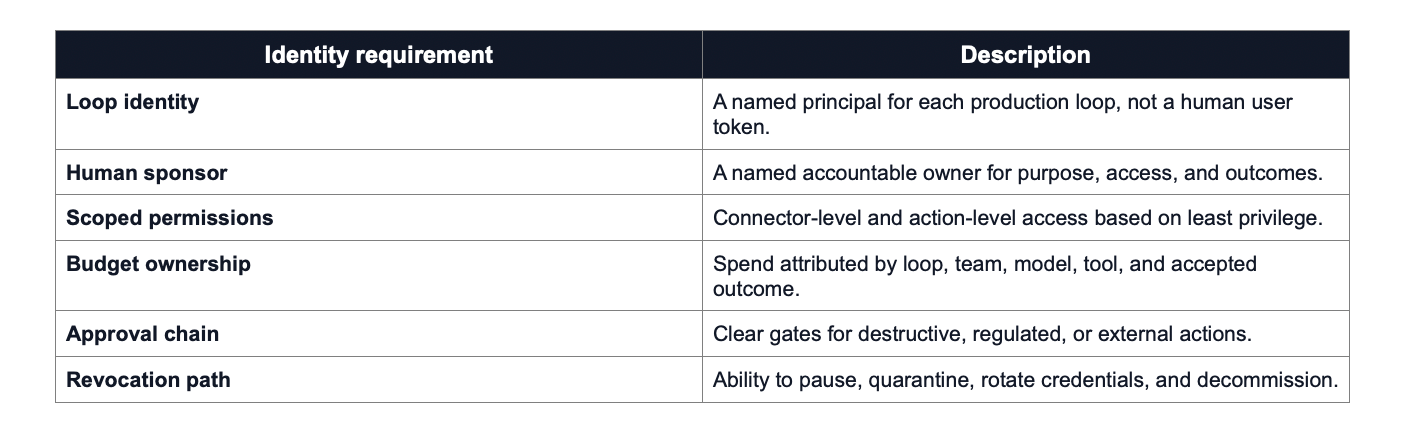
A production loop should not run as a developer token or a shared service account with unclear ownership. It should run as a registered non-human principal with scoped access, sponsor, budget owner, and revocation path.
11. Reliability, Telemetry, and When Not to Loop
Autonomy compounds. It can compound speed, learning, and throughput. It can also compound error, spend, and confusion. That is why Loop Engineering must include reliability math, work telemetry, and a disciplined decision on whether a loop is warranted at all.

The failure stacking point is not a reason to avoid loops. It is a reason to engineer loops like production systems: independent checks, small batches, state integrity, safe defaults, approval gates, and replayable traces.
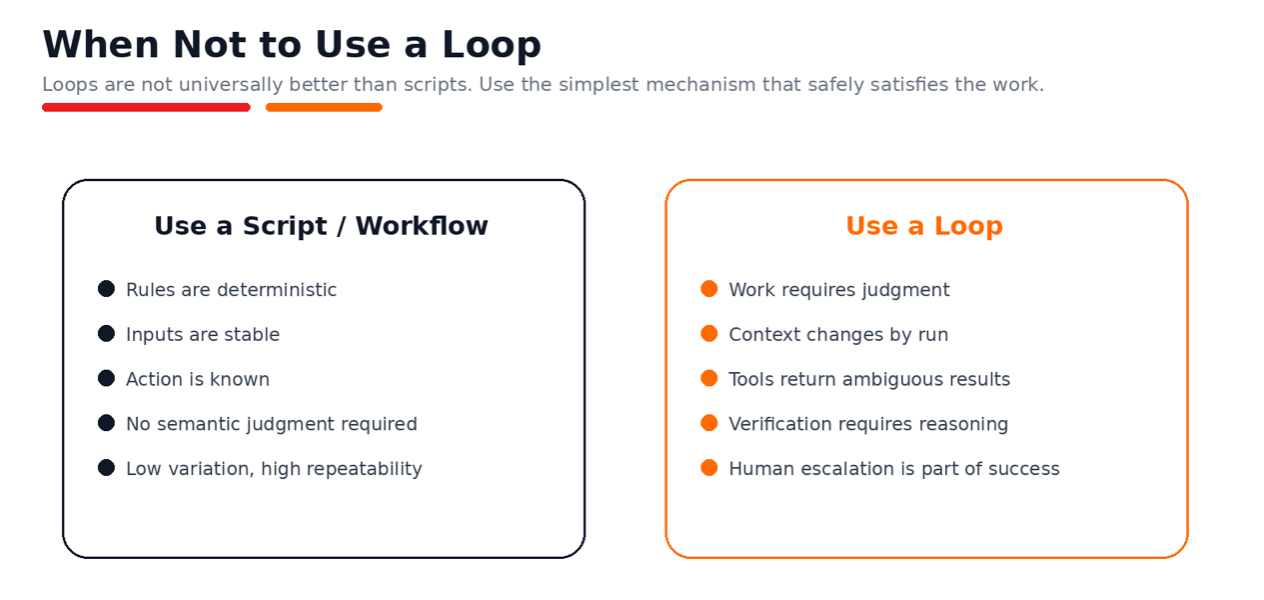
Script vs Loop Decision Matrix

12. Loop Tooling Landscape and No-Code Path
The tools will change quickly. The primitives are the durable skill: heartbeat, body, spine, inspector, policy, telemetry. Leaders should evaluate tools by how they expose or govern those primitives, not by the newest command name.
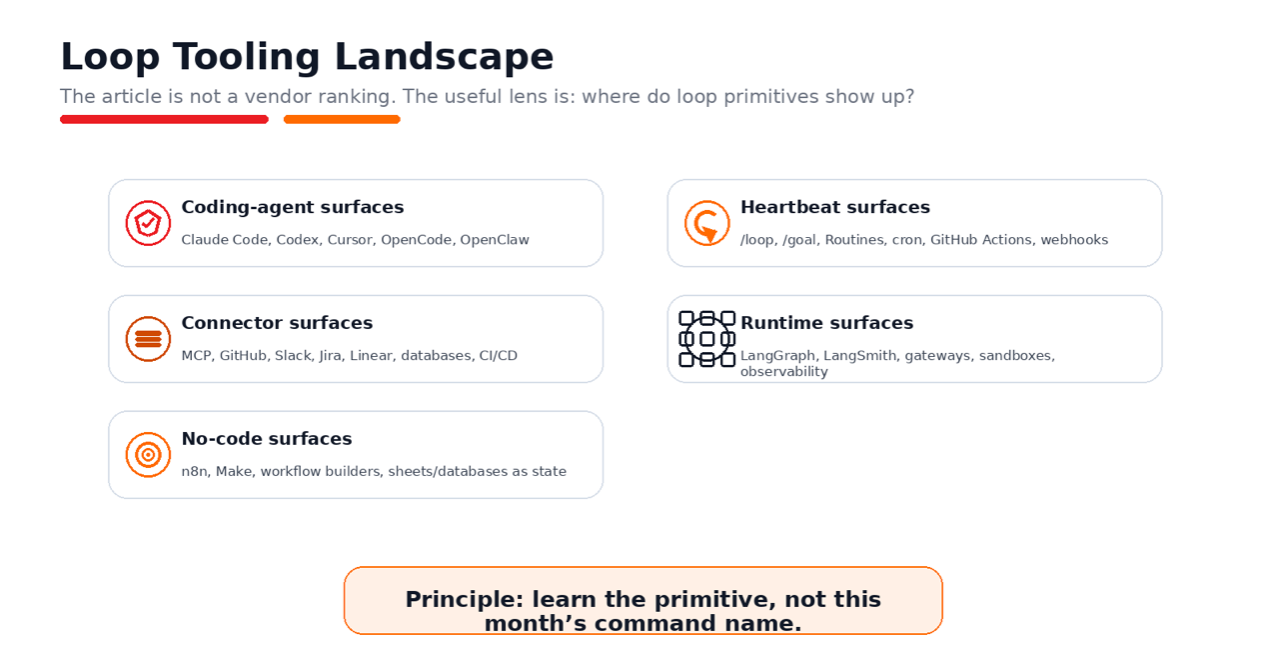

No-code loops are useful for low-risk automations where state can live in a table or spreadsheet and human review is easy. Developer loops are useful for code, tests, and technical workflows. Enterprise loops require managed identity, policy, budget, telemetry, and operations. The design pattern is consistent across all three levels.
13. Wingspan + Loop Engineering: The Service Delivery Narrative
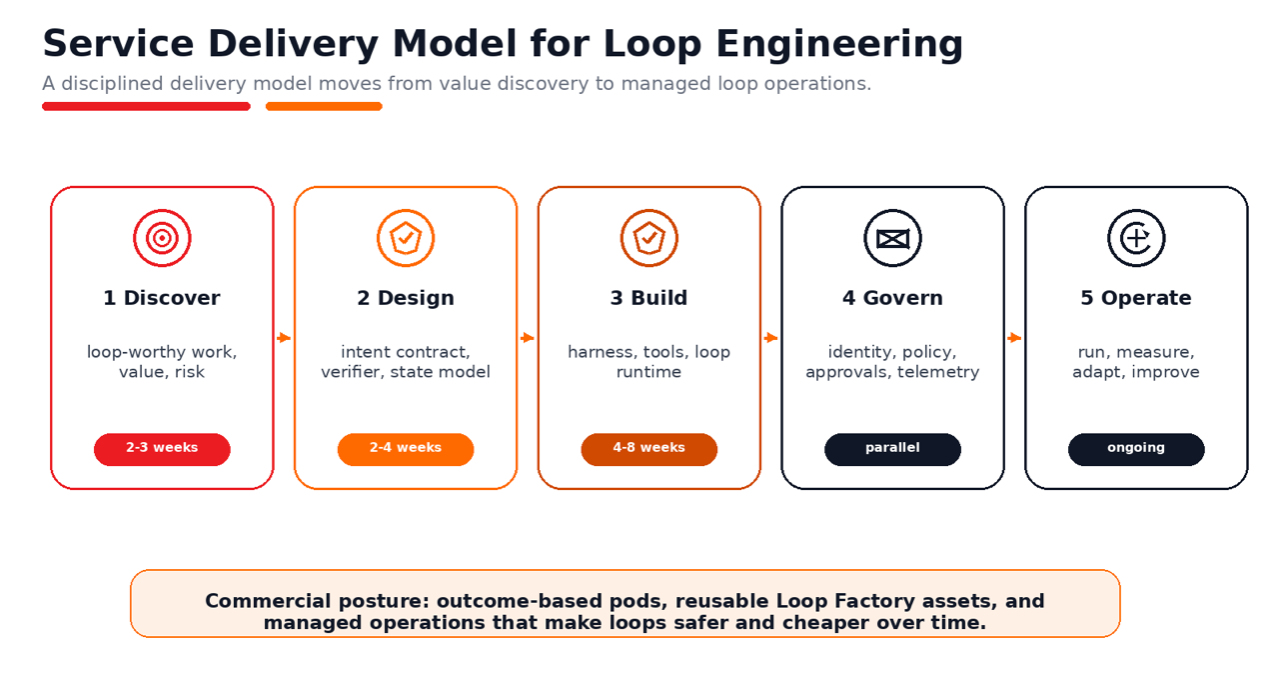
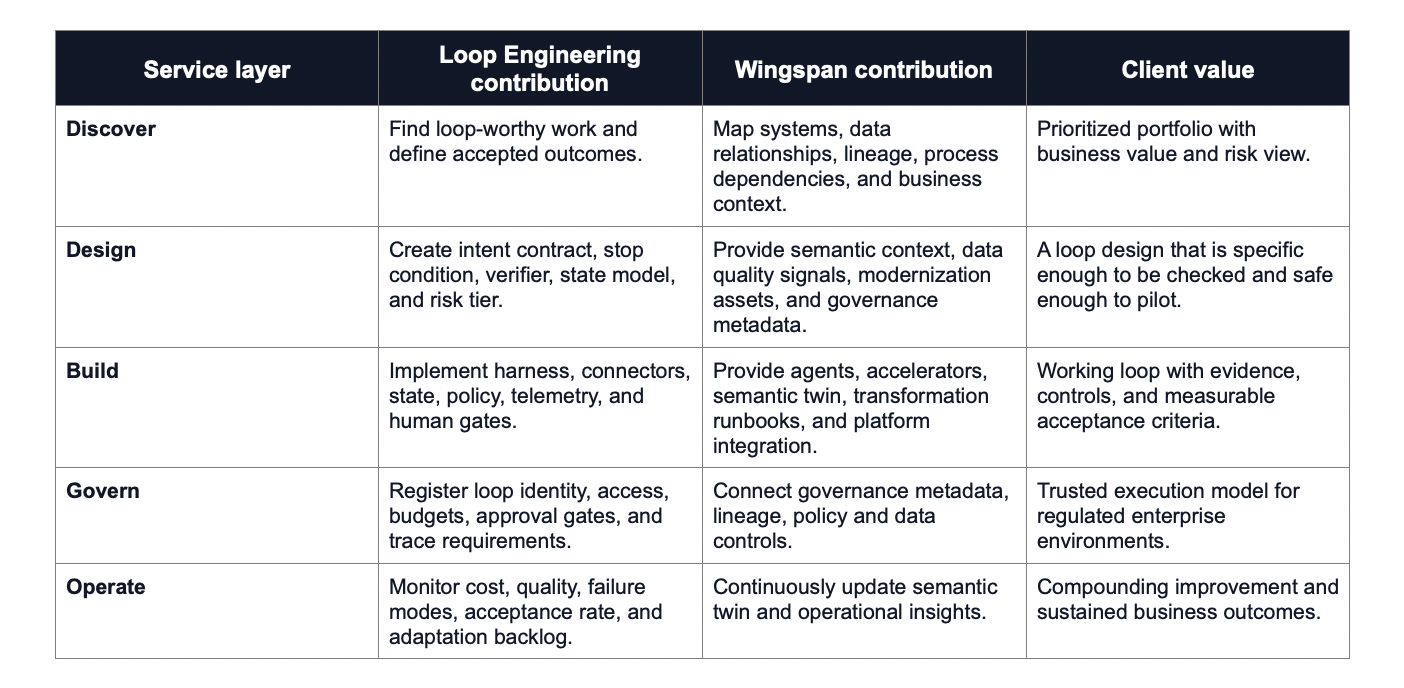
Wingspan and Loop Engineering fit naturally together. Wingspan creates the context-aware enterprise intelligence fabric: semantic twin, lineage, modernization knowledge, data quality signals, governance context, and purpose-built agents. Loop Engineering turns that context into persistent, inspected, governed execution. Together they shift services from project-by-project labor to a compounding operating model.

The narrative is simple: Wingspan makes enterprise context machine-operable; Loop Engineering makes machine-operated work safe, repeatable, auditable, and outcome-accountable. In services language, Wingspan becomes the enterprise context and agent asset layer, while Loop Engineering becomes the delivery operating model that turns those assets into recurring business outcomes.
Service Delivery Model
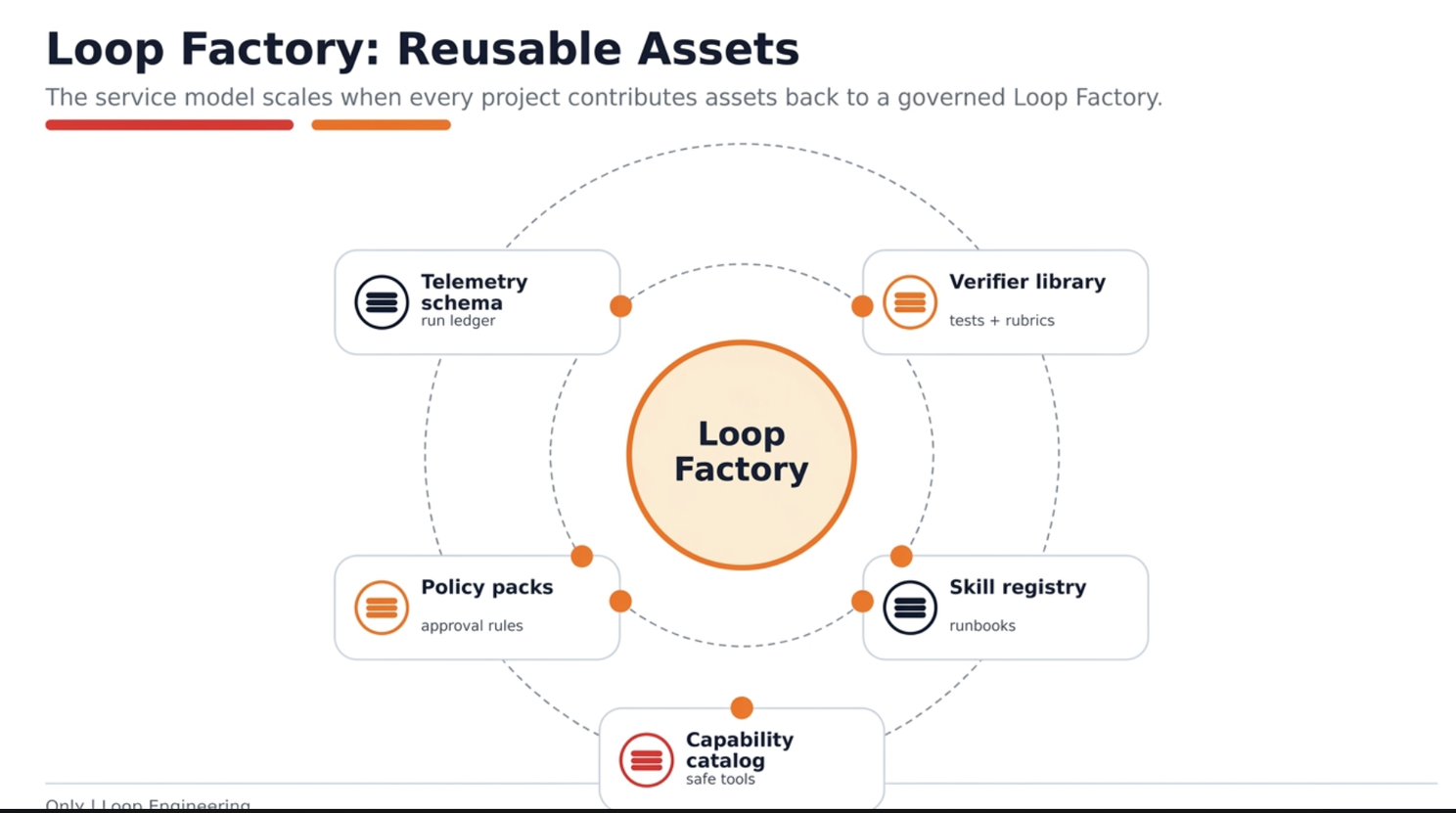
Loop Factory Assets
The service model should not create bespoke loops forever. Each engagement should produce reusable assets: intent contracts, verifier libraries, policy packs, skill registry entries, capability connectors, telemetry schema, and reference loop templates. This is how a services business becomes IP-led and compounding.
14. Loop Engineering Use Cases
The best use cases share five traits: they repeat often, require judgment, use tools, have a verification surface, and can escalate safely. The goal is not maximum autonomy. The goal is maximum trusted throughput.

Developer Morning Triage Loop
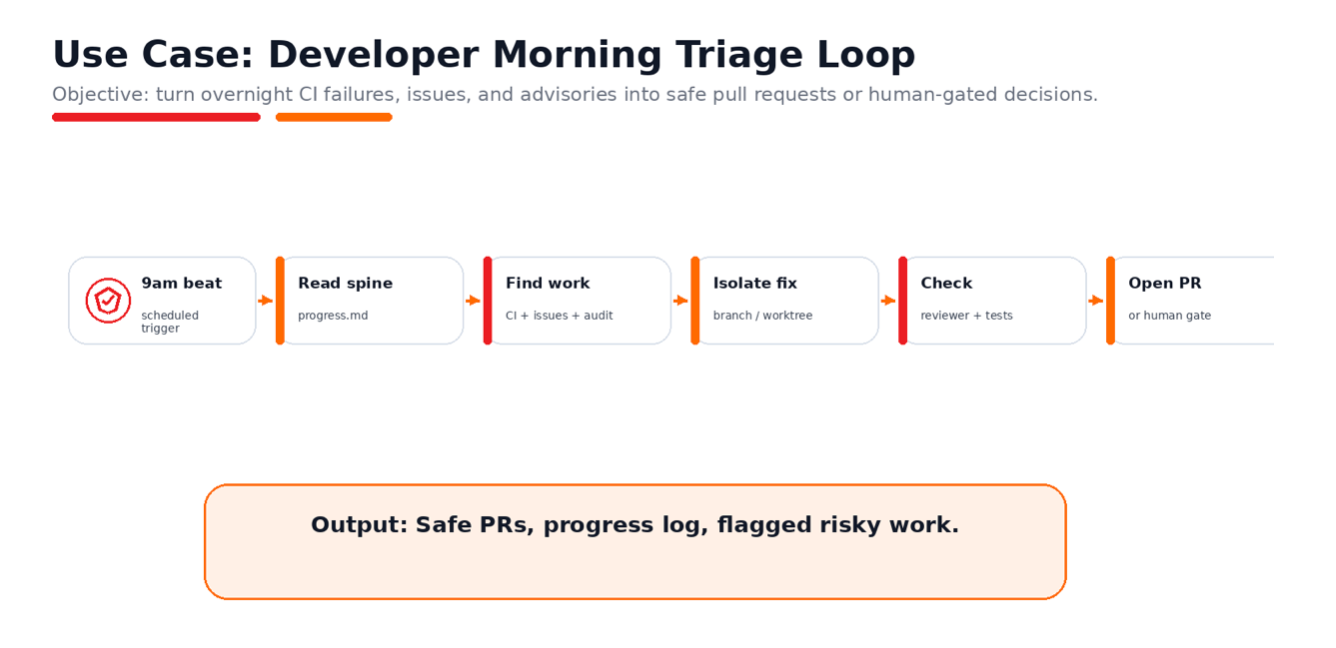
A weekday heartbeat reads the progress spine, finds overnight CI failures, open issues, and dependency advisories, works each candidate in isolation, invokes a reviewer, opens PRs only on PASS, and writes anything risky to human review. This is the canonical coding loop because it includes all primitives: heartbeat, worktree, skill, connector, sub-agent, and state.
Security Operations / Sentinel Loop

A security loop enriches alerts with identity, asset, network, and historical incident context. It classifies severity and confidence, proposes triage or rule tuning, verifies against detection coverage and policy, and escalates high-risk or low-confidence cases. For Sentinel and cloud security, the loop should recommend before changing detection logic unless a policy explicitly permits action.
Cloud / FinOps Loop
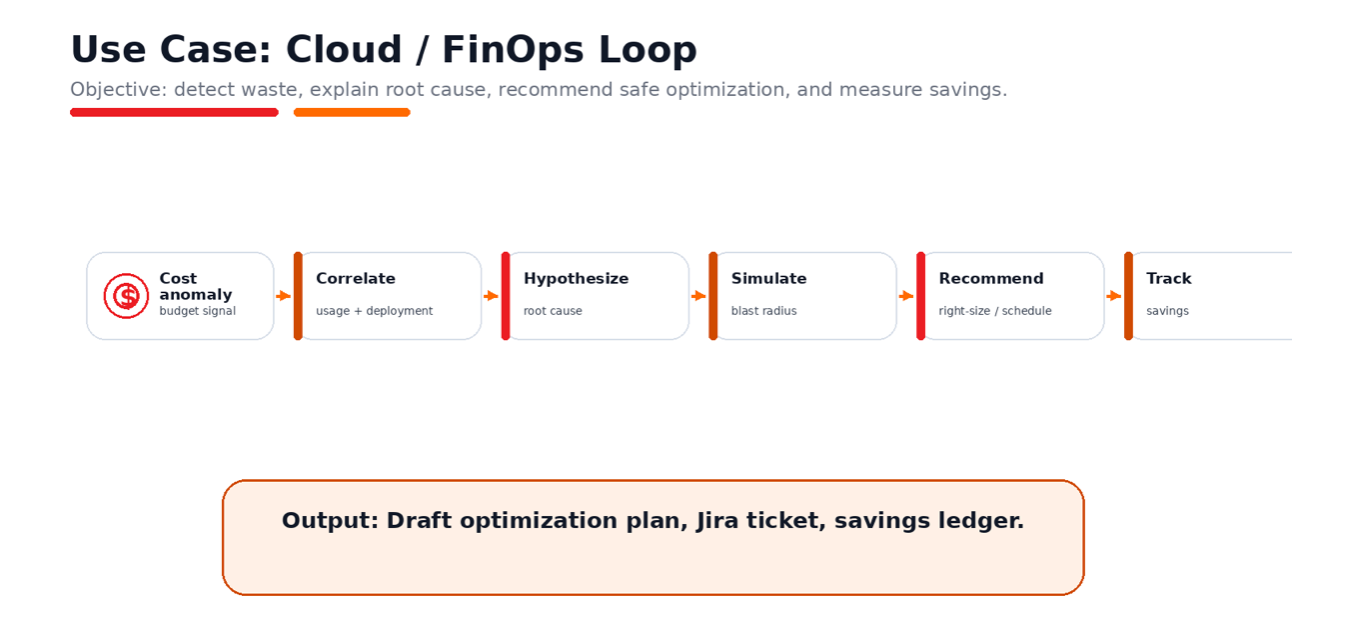
A FinOps loop detects cost anomalies, correlates them with deployments and usage patterns, recommends right-sizing or scheduling actions, simulates blast radius, routes high-risk changes to approval, and tracks savings. The loop must preserve evidence because cost optimization without context often creates reliability risk.
Data Quality and SQL Repair Loop

A data loop detects broken SQL, failing data tests, reconciliation drift, or schema changes. It inspects lineage and schema context, patches the smallest unit, runs validations, and escalates if business meaning or data contracts are ambiguous. The verifier should combine deterministic checks with domain-specific thresholds.
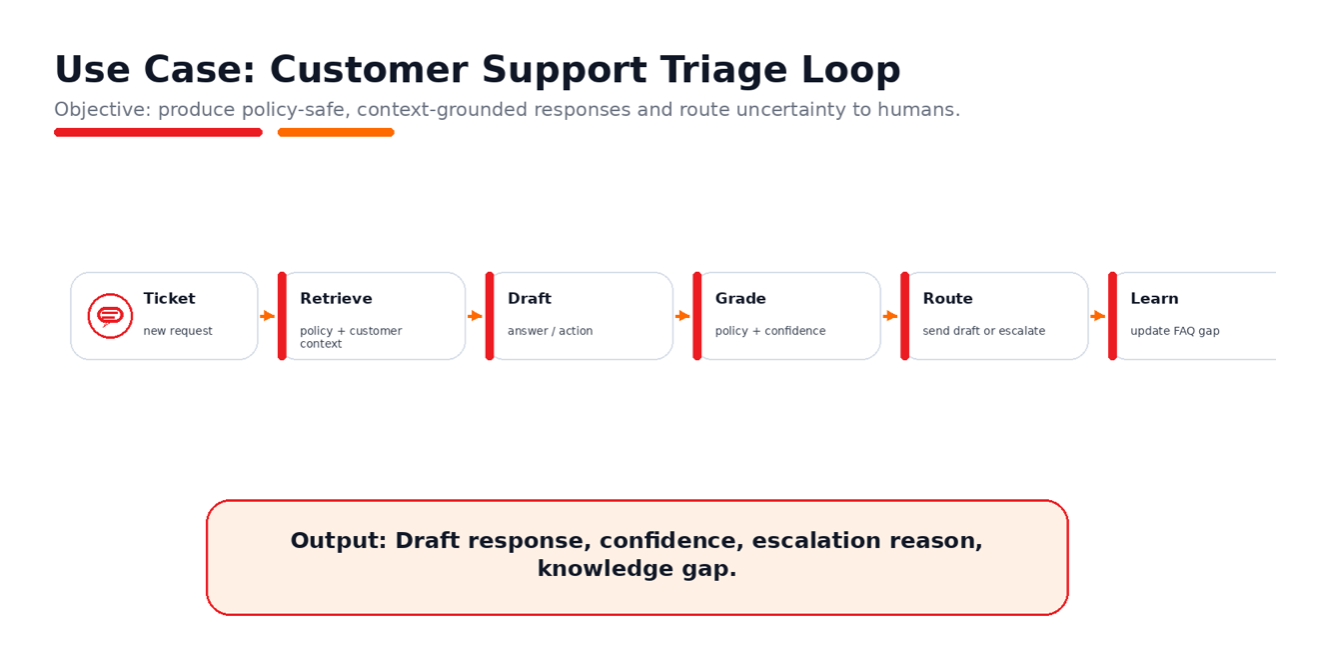
Customer Support Triage Loop
A support loop retrieves policy and customer context, drafts a response, validates against policy and tone, checks confidence, and routes uncertain or sensitive cases to a human. The best output is not only the response; it is also the escalation reason and the knowledge gap that should improve the support corpus.
Document Q&A Loop
A document loop retrieves chunks, answers, checks evidence sufficiency, retrieves again if needed, and stopsonly when the answer is grounded or declares uncertainty. This is a useful low-risk starter loop because the action is read-only and the stop condition can be evidence-based.

Compliance Evidence Loop
A compliance loop maps controls to required evidence, collects logs and configuration snapshots, validates freshness and completeness, packages evidence, and escalates gaps. It should produce audit trails by design because evidence without lineage creates downstream risk.

Modernization Loop
A modernization loop selects one migration unit, converts or refactors it, validates tests and reconciliation, creates a reviewable artifact, and updates the semantic twin or migration state. The discipline is one unit per pass with clear rollback.

Underwriting Self-Improvement Loop
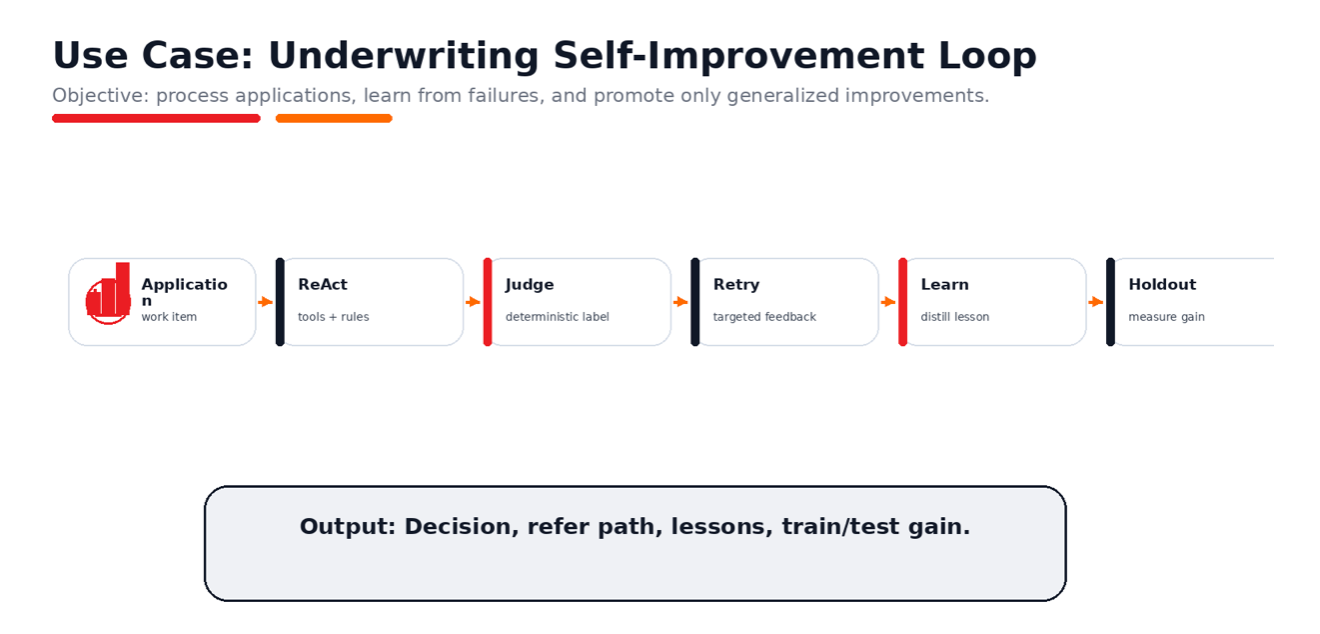
An underwriting loop processes applications through tools and rules, uses a deterministic judge for known cases, escalates refer decisions, distills lessons from failures, evaluates on a holdout set, and promotes only generalized improvements. This is the clearest example of adaptive engineering under control.
15. Implementation Blueprint
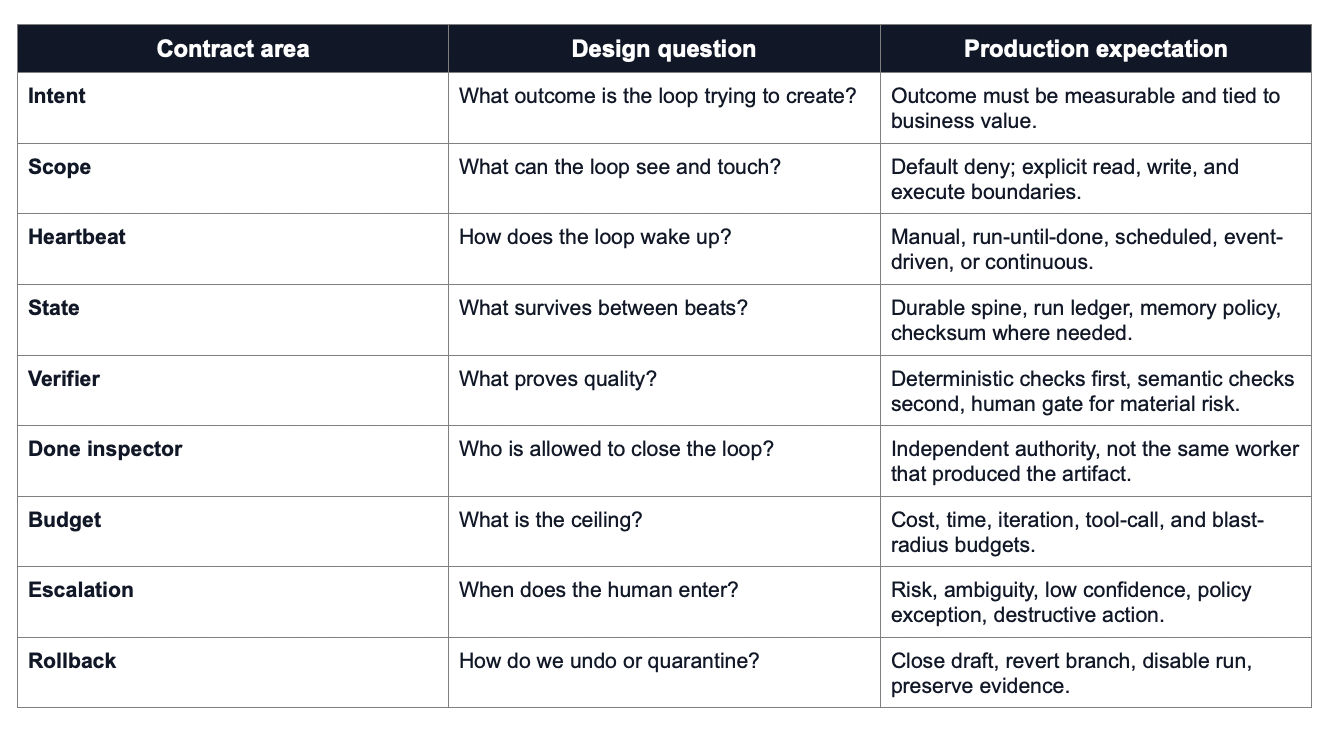
A Loop Engineering implementation should begin with the contract, not the tool. The contract defines what the loop is allowed to pursue, touch, spend, change, and claim as done. A weak contract produces a loop that works hard on the wrong problem.
Loop Contract Template
Runtime Pseudocode


Engineering the Loop Contract: Design Checklist
16. Safety, Reliability, and Autonomy Risk
Loop Engineering changes the risk surface. The question is no longer only whether AI says something wrong. The question is whether an autonomous system can repeatedly act on a wrong assumption, with real tools, across real systems. That is why reliability, identity, policy, budget, and audit must be engineered into the loop from day one.

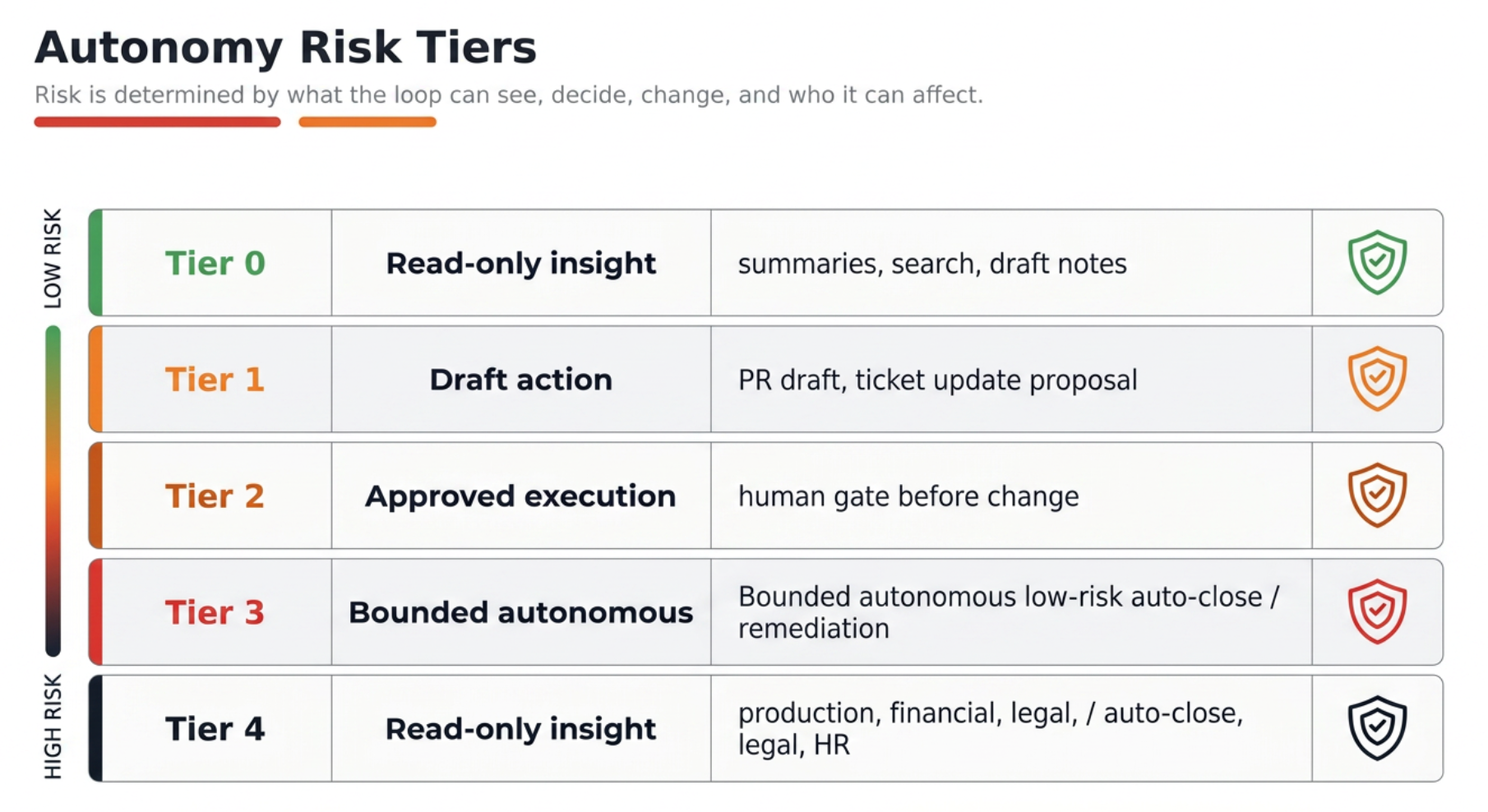
Autonomy Risk Tiers
A loop that only reads documents is not the same risk as a loop that can change production configuration. Risk tiering should be based on what the loop can see, decide, change, affect, and how reversible its actions are.
Common Failure Modes and Controls

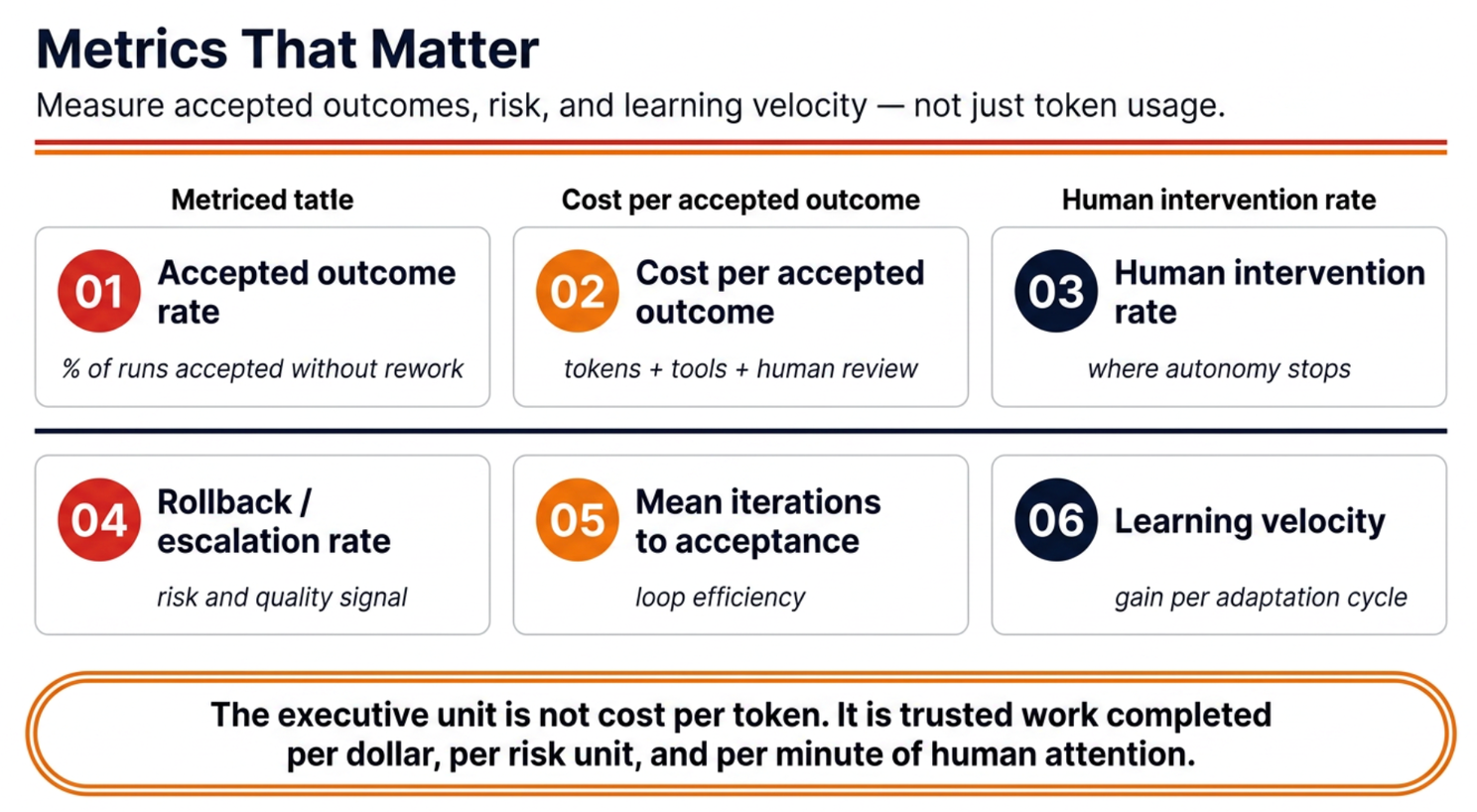
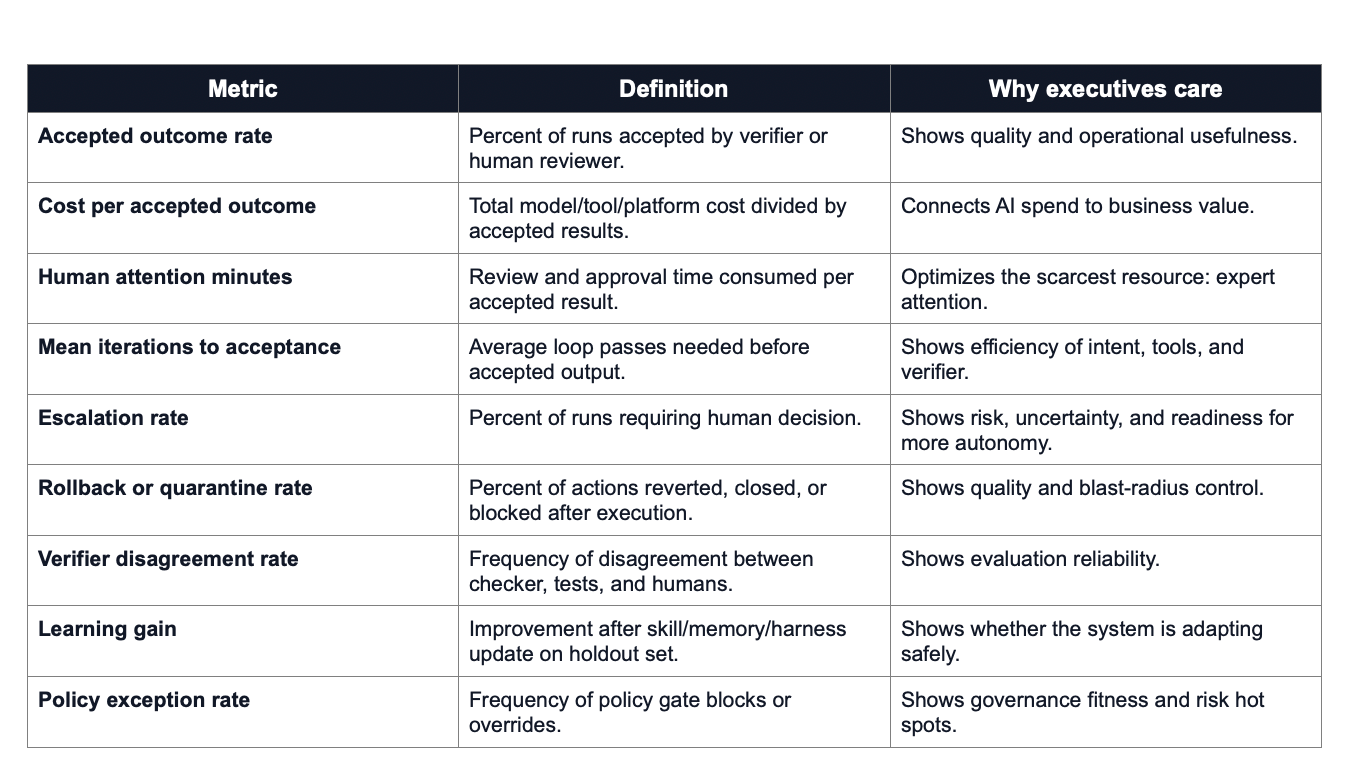
17. Metrics: From Agent Activity to Accepted Outcomes
The enterprise metric is not token usage, number of prompts, or number of agents. The metric is trusted work completed. A production loop should be measured like a business process and like a reliability system.
18. Practice Ladder and Adoption Roadmap

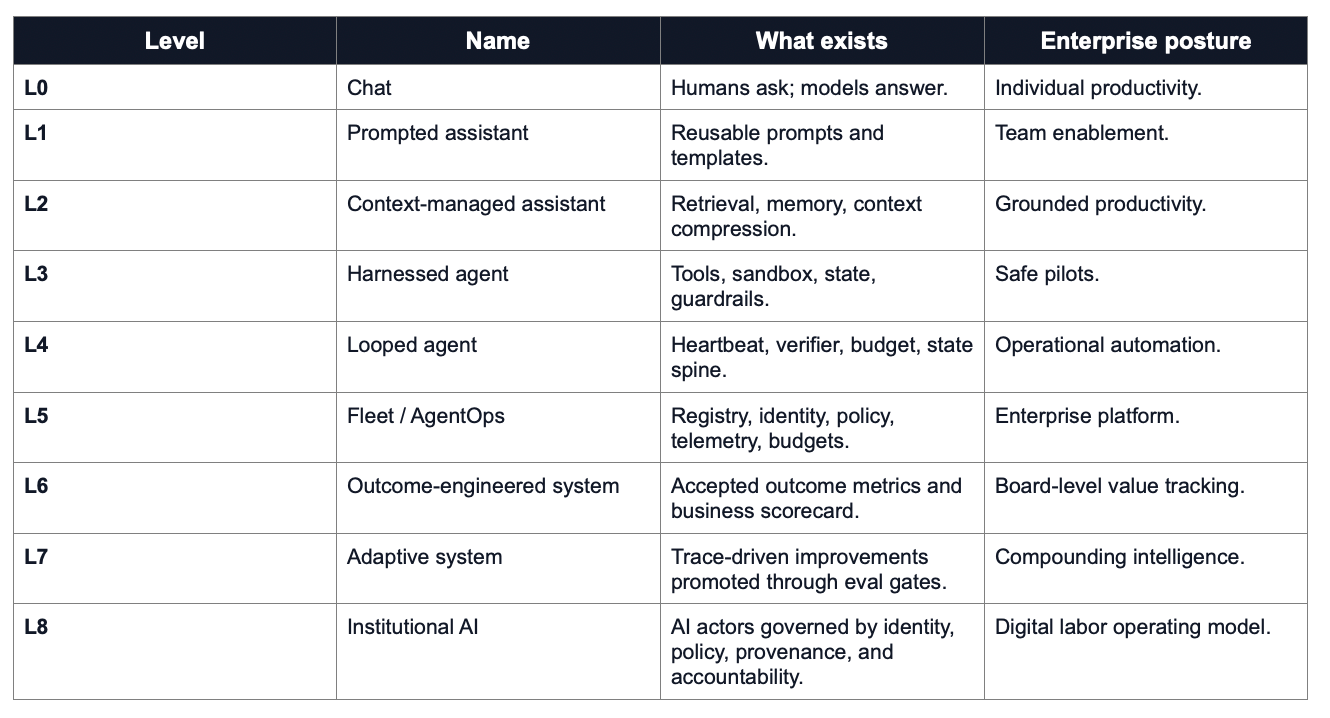
Loop Engineering should be adopted through a ladder, not a big-bang transformation. Start with visible, low-risk loops. Add state. Add a checker. Add a schedule. Add enterprise identity and policy. Then scale through a Loop Factory model.
Maturity Model
Roadmap
The right enterprise sequence is: prove the loop on low-risk work; instrument telemetry; strengthen verification; introduce non-human identity and policy; package reusable assets; then scale through a managed operating model.
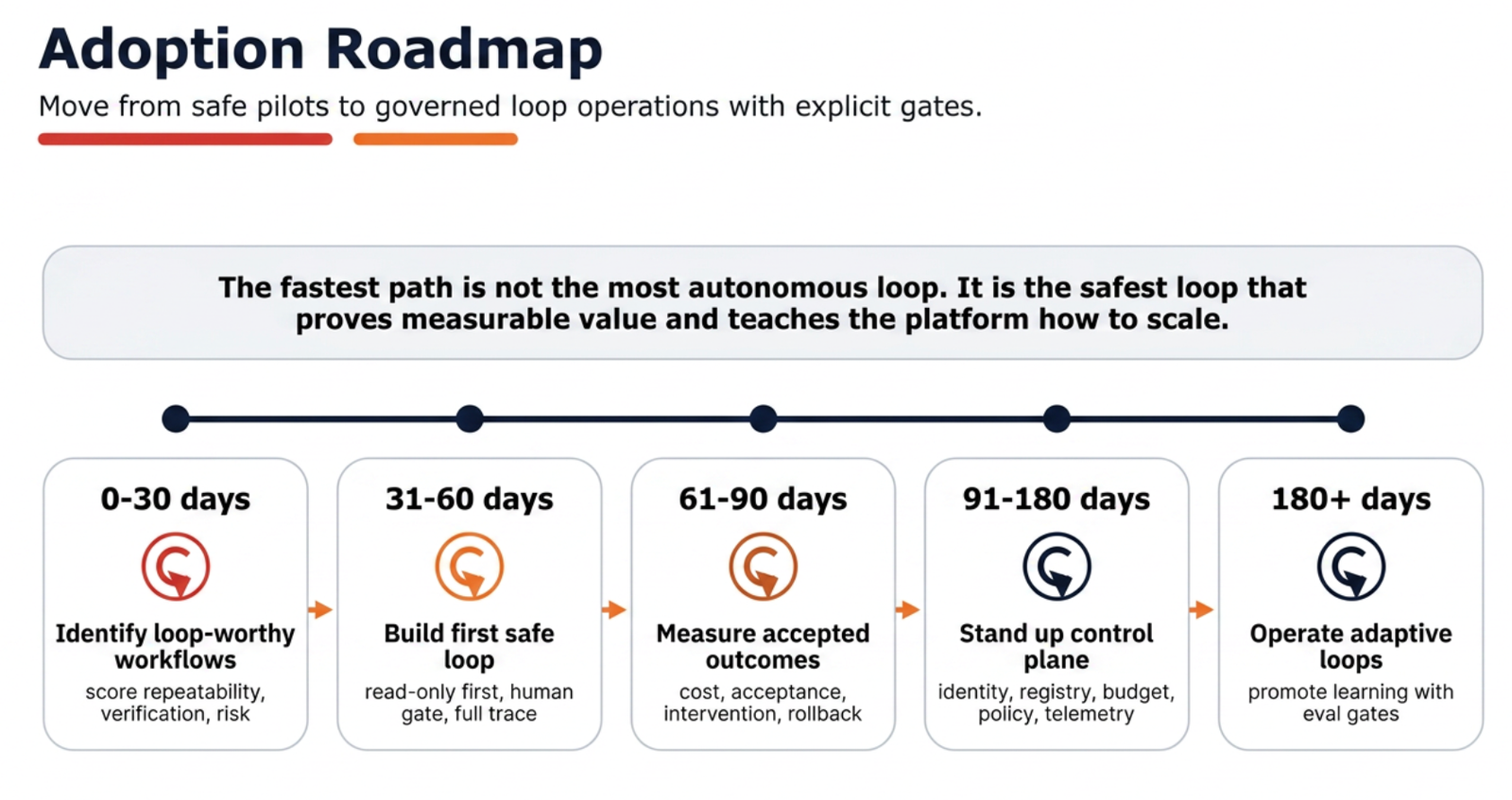
The organization should not scale autonomy faster than it can scale verification, identity, and human attention design.
19. Design Rules for a 10/10 Loop
- Start with intent, not a tool. Define outcome, scope, constraints, evidence, budget, and escalation before implementation.
- Use the simplest mechanism that works. If a deterministic script solves it, do not force an agentic loop.
- Give the loop a heartbeat and a spine. Without trigger and durable state, you have a workflow, not a loop.
- Keep the worker and inspector separate. The worker can propose; the inspector decides whether the loop may close.
- Prefer deterministic verification. Use model judges for semantic quality, but calibrate them with human sampling and holdout sets.
- Pass one CostMeter through all nested loops. Budget must be operational, not aspirational.
- One change per pass. Smaller units produce clearer diffs, stronger verification, and safer rollback.
- Treat memory as governed infrastructure. State must be versioned, permissioned, pruned, and sometimes checksummed.
- Use non-human identity for production loops. Do not let loop actions disappear into a developer’s personal credentials.
- Design human attention deliberately. Escalate with evidence, not noise.
- Measure accepted outcomes. Activity metrics are not business value.
- Make adaptation evidence-gated and reversible. No promotion without evaluation; no learning without rollback.
20. Closing: The Real Meaning of Loop Engineering
Loop Engineering is not the end of Prompt Engineering. It is the point where prompts become one component inside a larger system of intent, context, capability, verification, memory, policy, and telemetry. The winning enterprise will not have the longest prompt library. It will have the strongest operating model for converting intent into trusted outcomes.

For Onix and Wingspan, this becomes a strategic services narrative. The semantic fabric gives AI the context to understand the enterprise. Loop Engineering gives AI the operating model to act responsibly. Together they create a path from modernization projects to managed, adaptive, outcome-producing digital work systems.
Prompt made AI useful. Context made it relevant. Harness made it capable. Intent makes it directed. Loop makes it persistent. Fleet makes it governable. Outcome makes it accountable. Adaptive makes it compounding. Institution makes it trusted.
Leave a Reply