
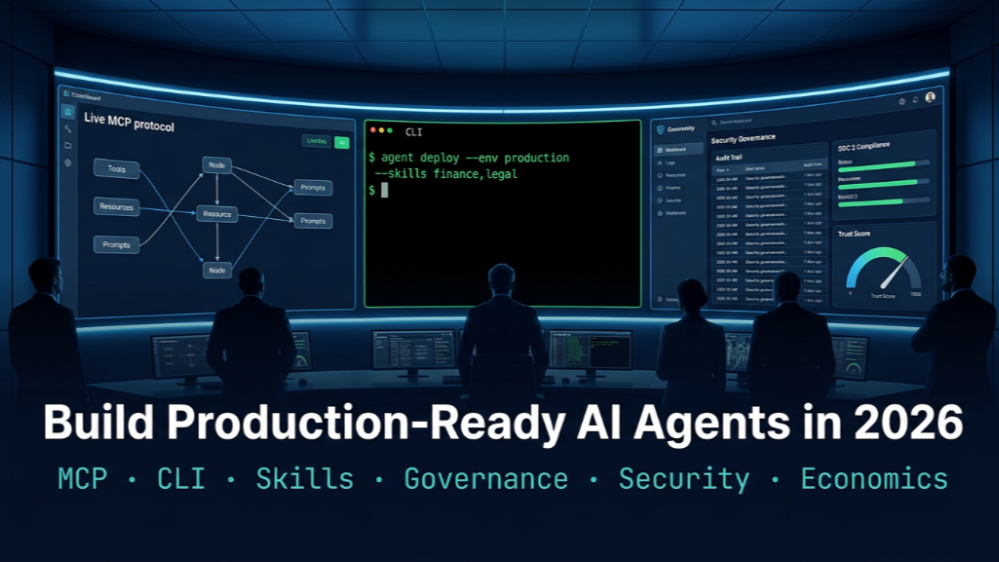
Build Production-Ready AI Agents in 2026: MCP, CLI, and Skills – With the Governance, Economics, and Security Boards Actually Want
Executive summary
Enterprise agents are no longer constrained primarily by model capability. They’re constrained by connectivity: how reliably, securely, and cost-effectively an agent can move across tools, data, and workflows at scale.
A practical way to frame the 2026 landscape is a connectivity stack with three complementary primitives:
- Skills: reusable domain capability + procedural know-how
- MCP: governed connectivity with rich semantics, authorization, and auditability
- CLI / local execution: token-efficient, composable execution for tool-heavy work
Leadership takeaway: there is no silver bullet. Production-grade systems blend all three—intentionally—under a standardized agent control plane.
1) Executive framing: Don’t argue tools. Standardize the control plane.
“MCP adoption” or “agent rollouts” shouldn’t be board-level approvals by themselves. Boards should approve an operating model for autonomous work, including:
- Which workflows can be made autonomous (and which cannot)
- What level of autonomy is permitted
- What controls are mandatory (before/after execution, approvals, audit evidence)
- What unit economics prove it scales (cost per success, exception costs, throughput)
- What audit evidence exists and how it’s retained
The “use the full stack (Skills + MCP + CLI)” idea only becomes valuable when it is tied to governance, evidence, and economics.
2) Risk tiering: the missing boundary (where MCP, CLI, and Skills fit)
The biggest gap in most agent strategies is the lack of a clear policy boundary. Here’s a board-grade tier model:
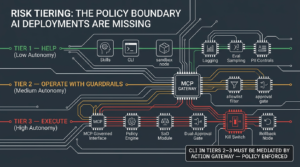
Tier 1 — Help (Low autonomy)
Scope: drafting, summarizing, analysis. No write-back to systems of record. Allowed: Skills + CLI in sandbox environments; MCP optional. Controls (minimum):
- Logging of prompts/tool calls (with redaction policies)
- Evaluation sampling (quality + safety)
- PII handling rules and data minimization
What success looks like: productivity gains without operational or regulatory blast radius.
Tier 2 — Operate with Guardrails (Medium autonomy)
Scope: limited actions (create ticket, pre-fill forms, propose changes). Preferred: governed connectivity (MCP). CLI only via managed gateway. Controls (required):
- Tool allowlists (approved systems/actions only)
- Approvals and checkpoints (human-in-the-loop where needed)
- Full audit trail (inputs, outputs, decisions, approvals)
- Deterministic workflow wrapper (bounded steps and validations)
What success looks like: measurable cycle-time reduction with controlled operational risk.
Tier 3 — Execute (High autonomy)
Scope: actions with financial, regulatory, or customer impact (payments, entitlements, production changes). Required: MCP-like governed interfaces + policy enforcement + segregation of duties + rollback. Controls (mandatory):
- Dual-approval (SoD) and high-trust identity controls
- Kill switch and incident response playbooks
- Continuous evaluation + drift monitoring
- Evidence retention suitable for audit and legal discovery
Board rule: CLI is not a “free for all.” Even if execution is local, Tier 2–3 CLI usage must be mediated through an action gateway with strict policy controls.
3) The connectivity stack, reimagined for enterprise scale
A) Skills = reusable domain capability (standardize what “good” looks like)
Skills aren’t a developer convenience; they’re a regulated enterprise asset:
- Curated procedures for repeatable work
- Portable across teams and workflows
- A direct mechanism to reduce variance, rework, and duplicated engineering
Board implication: treat Skills like products:
- Clear ownership and accountability
- Versioning, change control, and deprecation policies
- Quality gates (tests, evals, security review) Otherwise, Skills become another form of sprawl.
B) MCP = governed connectivity with semantics (standardize what’s “allowed”)
MCP is best understood as part of the agent control plane: it encodes and enforces:
- Who can access which tools/data
- What actions can be performed
- How actions are logged and audited
- How authorization and policy travel with the workflow
Board implication: MCP is not “a protocol choice.” It is a governance layer for tool access and auditability.
C) CLI = token-efficient execution (standardize cost and speed—within bounds)
CLI workflows can be highly composable and token-efficient: models are already familiar with CLI patterns and can generate compact, structured outputs.
But: CLI is a performance lever, not a governance mechanism. It must be wrapped:
- Sandboxed by default
- Least-privilege permissions
- Monitored execution with strong logging
- Policy-mediated access in Tier 2–3 via an action gateway
Board implication: CLI boosts throughput, but increases risk unless controlled.
4) The control plane architecture (what boards should actually fund)
Protocols are not governance. Enterprises need a control plane above MCP/CLI/Skills.
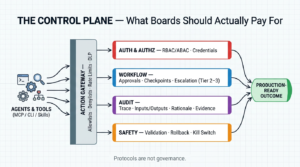
Core control plane capabilities
1) Identity, authentication, authorization
- Agent identity and workload identity
- RBAC/ABAC policies for tools, data, and agents
- Scoped credentials and automatic rotation
2) Action gateway (policy enforcement)
- All tool calls pass through a policy layer
- Allowlists/denylists for tools + operations
- Rate limits and anomaly detection
- Data loss prevention checks (inputs and outputs)
3) Workflow enforcement (Tier 2–3)
- Deterministic stages: validate → propose → approve → execute → verify
- Escalation paths for exceptions
- Guardrails for intent drift (what the agent is allowed to attempt next)
4) Audit + observability
- Traceability of tool calls, inputs/outputs, and decision rationale
- Approval evidence captured in audit-ready form
- Metrics by workflow: reliability, cost, exception rate, containment time
5) Safety + recovery
- Pre/post validations
- Retries/fallbacks and safe degradation modes
- Rollback mechanisms
- Kill switch and incident containment procedures
Result: the “connectivity stack” becomes production-ready.
5) Engineering patterns that translate into board-level value
Progressive discovery = cost + reliability management
Loading tools on demand (instead of dumping every tool into context) reduces:
- Context bloat and inference cost
- Error surface area (fewer tools = fewer wrong calls)
- Unpredictability in long-running tasks
Board metric: cost per successful completion, not raw token counts.
Programmatic tool calling (“code mode”) = latency + throughput gains
Scripting multiple operations in a sandbox reduces sequential round-trips.
Board metric: cycle-time reduction per workflow + throughput under peak load.
“Build for agents” = product discipline, not API wrapping
You can’t map REST APIs 1:1 and call it done. Agent-native tools require:
- Clear intent definition and predictable schemas
- Safe execution boundaries and idempotency where possible
- Governance hooks (authz, logging, approvals, rollback)
Board metric: exception rate + rework caused by ambiguous tool contracts.
6) Unit economics: the scorecard boards should demand
To avoid “adoption without impact,” require every production workflow to publish:
- Cost per success (all-in: inference, orchestration, monitoring, human exceptions)
- Completion rate without escalation
- Exception / escalation rate (and mean time to resolution)
- Correction / rework rate
- Latency and throughput time
- Audit exceptions (count, severity, root cause)
- Time-to-contain incidents and recovery performance
Funding gate: no dashboard, no scale.
7) Security threat model: what most “connectivity” discussions undersell
Production-grade agent connectivity must explicitly defend against:
- Tool/prompt injection via external content and tool responses
- Over-scoped permissions (agents accumulating privileges across systems)
- Data exfiltration through “helpful” logs and summaries
- Lateral movement when agents can chain tools across apps
- Write-back abuse from intent drift (destructive or unauthorized actions)
Board requirement: run privilege escalation tests and enforce least-privilege tool scopes before Tier 2/3 deployments.
8) Next steps: a practical 90-day plan
Week 1–3: Policy + scope
- Define risk tiers and map which of MCP/CLI/Skills are allowed per tier
- Identify 5–10 workflows with measurable outcomes and controlled blast radius
Week 4–8: Build the control plane baseline
- Implement identity + policy enforcement (RBAC/ABAC)
- Stand up an action gateway for tool calls
- Implement audit traces and evidence retention
Week 6–10: Skills governance
- Establish Skills ownership, versioning, review gates
- Create a Skills catalog with lifecycle management (promote/deprecate)
Week 8–12: Orchestration patterns + economics
- Standardize progressive discovery and sandboxed “code mode”
- Launch unit-economics dashboard per workflow and make it the scale gate
Closing perspective
“The right tool for the right job” is directionally correct. The enterprise reality is sharper:
You can’t have a production-ready agent strategy without a control plane, risk tiering, and unit economics. MCP and CLI are execution primitives; Skills are reusable capability. Leadership’s job is to make them a governed system that can scale without blowing up risk, cost, or audit exposure.
Leave a Reply