
LangChain’s Deep Agents: A Useful Change in the Way Businesses Make Agentic Systems
Most teams that make agents follow the same path.
They begin with simple chains. It works until work stops being linear, like when there are tool calls, retries, branching logic, long-running sessions, and outputs of different lengths. At that point, teams move on to LangGraph and start doing infrastructure work right away, such as state schemas, routing, persistence, compilation, and execution plumbing.
None of this is “wrong.” LangGraph is very useful. The real problem is with the organization: you end up wasting valuable engineering time on runtime mechanics before you can deliver business capability.
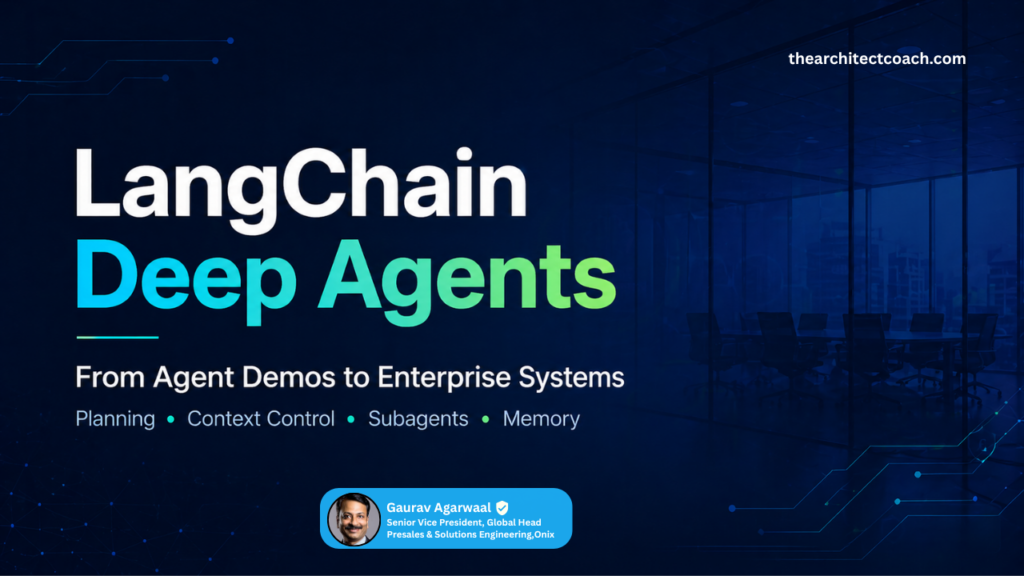
LangChain’s answer to that trade-off is Deep Agents. It’s not just another “agent framework.” It’s an agent harness, which is a higher-level interface that makes the infrastructure patterns that most enterprise teams use over and over again the same. These patterns include planning, context control, file-backed state, subagent delegation, and memory.
The win isn’t new. The win is maturity in business.
Without the marketing, what Deep Agents really is
Deep Agents is a separate Python library that works with LangChain and LangGraph. In terms of ideas:
- LangChain gives you the models, tools, prompts, and chains you need to build things.
- LangGraph gives you the runtime engine for long-lasting, stateful execution.
- Deep Agents gives you a harness that packages the hard, repeatable parts of making agents run reliably.
In other words, LangGraph is the engine and Deep Agents is the car.
Getting Started (Install and Keys)
It’s easy to use Deep Agents, which is the whole point: you should be able to test it out in an afternoon.

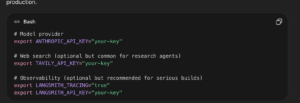
Here is where you can find the full documentation, which includes backends, subagents, sandboxes, human-in-the-loop patterns, and the CLI:
docs.langchain.com/oss/python/deepagents
It’s worth knowing where this harness fits into your stack if you’re working on something serious with agents right now, even if you don’t use it right away.
Why This Release Is Important: The Industry Has Moved On From “Tool Calling”
Over the past 24 to 36 months, people have felt like things were getting better. Many companies saw demos and decided that agents are “basically solved.”
No, they aren’t.
Tool calling is a must. Long-horizon work is the real problem for businesses. These are tasks that take a long time, create a lot of intermediate artifacts, need to be traceable, and must stay reliable even when there are rules in place.
That is the case with Deep Agents. Its worth comes from what it ships by default: capabilities teams usually build late, under pressure, and after the first problems.
The Five Skills That Change the Build
1) Planning that is built in and lasts (not just a prompt trick)
Deep Agents has a planning tool (often called a “to-do list”) that the agent can use to organize tasks that take more than one step and keep track of how far they’ve come.
The main difference is that the plan is part of the agent’s state, not a “think step-by-step” prompt pattern that goes away when the context changes.
Enterprise implication: planning becomes an observable artifact—something you can look at, test, and make standard as part of an operating model.
2) A Virtual Filesystem for Managing Context
The number of context windows is limited. Work for businesses isn’t.
Deep Agents fixes the problem by treating big intermediate outputs as files instead of conversations. The harness can write content into a filesystem abstraction instead of forcing everything into the model context. This keeps the active context clean and lets you use file paths and previews when you need them.
This is what makes them different:
- an agent that slowly breaks down as the context changes, and
- an agent that handles information in a planned way, like a system.
Enterprise implication: you stop relying on context-window luck to make your production reliable.
3) Delegation of subagents that keeps the main thread clean
“One agent does everything” is one of the most common ways that agents fail. At first, it seems like it works well. Then long sessions get messy because of partial results, repeated tool outputs, dead ends, and rework that mess up the context.
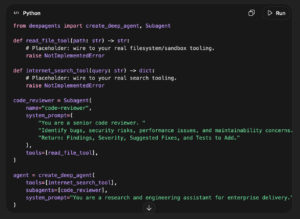
Deep Agents makes delegation a top-notch pattern. The main agent can create subagents to do separate tasks. Subagents work in clean environments and send a short result back to the main thread.
Enterprise implication: better separation of concerns, behavior that is easier to predict, and easier to check how conclusions were reached.
4) Automatic Context Compression When It Really Counts
You will eventually run out of space, especially when it comes to research, troubleshooting, code analysis, and operational workflows.
Deep Agents has a way to summarize and compress context when it gets close to its limits. This keeps the session’s intent, key decisions, and next steps while moving raw history into stored artifacts.
Long-term work becomes more sustainable for businesses. You can make agents that work across long workflows without “context collapse” being a hidden problem.
5) Long-Term Memory Across Conversations (Not Magical, but Governable)
It’s easy to understand short-term agent state. Enterprise memory is difficult.
When set up with the right backend store, Deep Agents can keep memory across sessions and threads. The most important thing is the architecture: persistence is no longer implied by what the model remembers; it is now clear and configurable.
Enterprise implication: you can set up memory boundaries that are in line with governance:
- what stays the same,
- where it is kept,
- how to get to it,
- how it is kept or let go,
- and how it is checked.
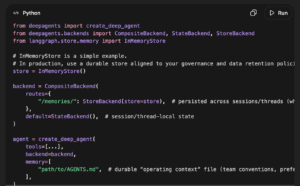
How Deep Agents Works with LangChain
This is where teams get mixed up, so it’s important to be clear.
- When you need composable primitives and light orchestration, use LangChain.
- When you need to have a lot of control over durable execution flows, use LangGraph.
- When you want the benefits of LangGraph but don’t want to have to build the same “agent infrastructure layer” over and over again, use Deep Agents.
LangGraph is not the same as Deep Agents. It makes it work.
The Real Quickstart for Building a Research Agent (Business-Friendly)
A research workflow is a practical enterprise test: search the web, put together your findings, write structured output, and keep intermediate artifacts for auditing.
A good harness should make this process easy to follow without getting you lost in all the details.
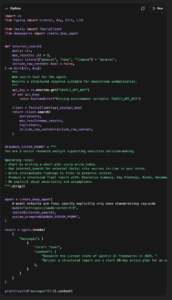
What a good harness should do:
- It makes plans for the work.
- It uses tools to get things back
- It saves intermediate results to files to keep the context.
- It gives out subtasks when they are useful.
- It gives back a structured output that is easy for executives to understand.
- It doesn’t die when the session gets bigger.
That is the standard for enterprise-level agentic systems.
The Deep Agents CLI: Why It’s More Important Than It Seems
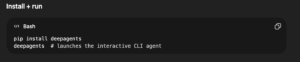
Deep Agents has a command-line interface (CLI) agent that is based on the same SDK. This seems small. No, it isn’t.
When the same primitives power:
- a developer’s terminal workflow and
- a system for production agents,
You make things run more smoothly in your organization. Teams can try things out in their own area and keep patterns going without having to rewrite everything for a different runtime later.
When You Should and Shouldn’t Use Deep Agents
When to Use Deep Agents:
- You need to plan and carry out your tasks in several steps.
- The outputs of the tool are big or many.
- You need to give tasks to specialists without making subagent plumbing.
- You want to have more control over how context grows and how long sessions last.
- You are moving from demos to real work processes.
When you need to, use simpler methods:
- Your agent is small, with only one or two tool calls.
- You need a custom graph topology and full control over the runtime.
- You already have a mature LangGraph build and don’t want defaults that are set in stone.
The goal is not to use the heaviest tool. The goal is to not have to rebuild infrastructure that you didn’t want to become an expert in.
Things to Avoid (Because They Seem Efficient)
Anti-pattern 1:”We’ll just build the loop ourselves” is an example of an anti-pattern.
This seems like a good idea until you have to rewrite context management, file offloading, and reliability controls three times. Most teams don’t realize how much of an agent’s success is based on infrastructure.
Anti-pattern 2: “We’ll add observability later.”
Agents fail in ways that are hard to repeat. If you don’t trace early, you waste time and trust. “Later” turns into “after an incident that could have been avoided.”
Anti-pattern 3: “One big agent for everything.”
It works well in demos but not so well when it ships. Set limits on your contexts. Give people specific tasks. Make sure the main thread is clear and easy to read.
The Bigger Point: The Plumbing Industry Is Making Things More Standard
Agentic AI has gone from being new to being used in business.
People in the market are starting to agree on what matters:
- long-lasting execution,
- context control,
- artifact management,
- delegation,
- memory with governance,
- and keeping track of things.
LangChain’s bet with Deep Agents is that these patterns are now common enough to make them standard.
The direction is clear: the teams that win won’t have the most clever prompts, whether you use them right away or not. They will be the ones who treat agents like systems that are built to be reliable, easy to audit, and able to change.
Takeaway for Executives
Stop optimizing demos and start standardizing the harness if your business wants agentic AI to give it real operational leverage.
Make a 90-day plan that makes things clear about:
- your agent’s way of doing things (planning and delegating),
- the limits of your state and memory,
- your artifact plan (files, logs, outputs),
- your baseline for observability,
- and the controls you have in place for governance.
Not from another round of “agent loop” reinvention, but from that
Leave a Reply