
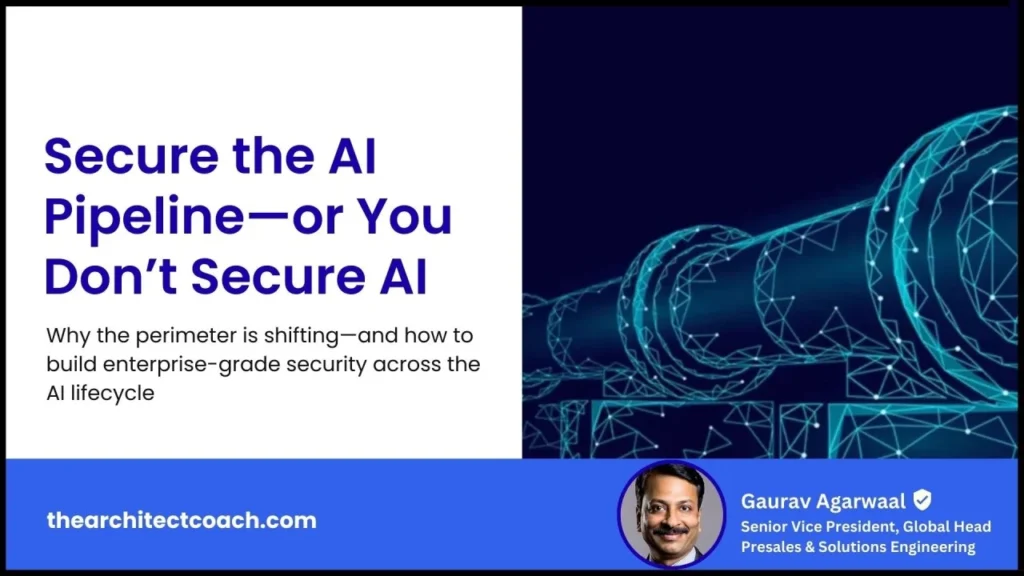
Secure the AI Pipeline—or You Don’t Secure AI
When enterprises talk about “AI security,” the focus often narrows to jailbreaks, prompt injection, and hallucinations. The model is seen as the battleground.
That’s understandable—and dangerously incomplete.
In reality, most AI breaches don’t start with the model. They begin earlier: a poisoned dataset, a tampered training job, a compromised feature pipeline, or an inference endpoint that leaks data under pressure. The model isn’t the perimeter. The pipeline is.

And if we’re serious about secure, trustworthy AI, we need to treat the entire pipeline—from raw data to live deployment—as an attack surface, not just a workflow.
Why the AI Pipeline Is the New Security Perimeter
Modern AI systems aren’t isolated models. They’re interconnected pipelines of services, tools, models, APIs, and data flows that turn inputs into decisions—at scale.
That means: poison one link, and the outcome degrades. Exploit a single stage, and the damage cascades. Whether it’s data leakage, compliance failure, or exfiltration, the root cause is often upstream.

Security, then, must move from reaction to architecture. Microsoft’s reference blueprint aligns with emerging best practices from:
- NIST AI RMF: Lifecycle-based risk governance
- MITRE ATLAS: AI-specific threat modeling
- OWASP Top 10 for LLMs: Real-world failure patterns in genAI systems
Together, they call for defense-in-depth across every pipeline stage—not just filters on the final output.
The Six-Stage AI Pipeline—and Where the Risks Actually Lie
Microsoft’s breakdown offers a clean, actionable structure for securing the pipeline. Here’s how I’d brief any security leader or platform team:

1. Data Collection & Ingestion: Your First—and Often Weakest—Link
Risks: Data poisoning, PII/PHI leakage, shadow datasets, poor lineage.
Key advice:
- Only train on approved, classified datasets. Unregistered = untrusted.
- Enforce data provenance and labeling early. No visibility = no security.
- Don’t treat differential privacy as a shield—it reduces risk but doesn’t detect intent.
- Pipe DLP, labeling, and ingestion alerts directly into SOC workflows.
2. Data Prep & Feature Engineering: The Quiet Backdoor
Risks: Backdoored features, tampered transformations, unvalidated logic.
Key advice:
- Treat feature pipelines as production code: peer reviews, signed commits.
- Version all artifacts: raw data, transforms, features, labels.
- Add integrity checks between stages—don’t wait for outcomes to fail.
3. Model Training & Fine-Tuning: Where Sensitive Data Meets Expensive Compute
Risks: Model theft, inversion, training-time poisoning, compromised GPUs.
Key advice:
- Isolate training networks—no open internet, strict egress controls.
- Use confidential computing or secure enclaves for sensitive workloads.
- Lock down identities and secrets—training jobs are often over-privileged
4. Validation & Red-Teaming: Shift from Unit Tests to Adversarial Tests
Risks: Prompt injection, unrestricted generation, bias/fairness drift.
Key advice:
- Build test suites for direct and indirect attacks: prompt chaining, tool abuse, policy evasion.
- Evaluate agent behavior, not just text output.
- Gate releases on objective checks (e.g., “Does the model attempt restricted actions?”).
- Use the OWASP LLM Top 10 as a test plan, not just a readout.
5. Registry & Release Management: Your AI Supply Chain Has Real Dependencies
Risks: Unsigned models, dependency confusion, malicious artifacts.
Key advice:
- Sign every model, prompt, pipeline, and container—and verify before deployment.
- Maintain an AI Bill of Materials (AIBOM): know what’s in your stack.
- Restrict model registry access—treat it like prod deployment control.
6. Deployment & Inference: The New Frontline for Abuse
Risks: Prompt injection, API misuse, cost abuse, data exfiltration.
Key advice:
- Rate limit, authenticate, and segment agent access (no Swiss army knife setups).
- Apply least privilege to tools and connectors.
- Treat runtime monitoring as non-negotiable—watch for leakage, abuse, drift, and theft.
What “Zero Trust for AI” Actually Means
This isn’t just a buzzword. It’s a real operating model embedded into Microsoft’s architecture:
- Governance: Use Microsoft Purview or similar to track data lineage and enforce classification.
- Isolation: Secure training networks via Azure ML or your cloud equivalent.
- Signing: Treat models and artifacts like code—verify signatures before release.
- Monitoring: Use Model Monitoring + Defender-style tools to detect threats in production.
- Learning Loop: Feed failures back into training, tuning, and detection.
Even if you’re not using Microsoft’s stack, the sequence applies universally: govern → isolate → sign → monitor → respond → improve.
Anti-Patterns to Avoid—Because They Sound Smart, But Fail Fast
❌ “Security reviews happen before launch.” Post-launch drift, retraining, and prompt updates make static reviews obsolete.
❌ “We’re safe—we have a model filter.” Filters don’t detect poisoned data, backdoored features, or unsigned artifacts.
❌ “We’ll catch it at runtime.” That’s containment, not prevention. If the model is compromised upstream, you’re already behind.
A Boardroom Checklist: What I’d Ask Before an AI Release
- Can we trace and classify every dataset used in training?
- Are features reproducible, versioned, and code-reviewed?
- Is training isolated, access-controlled, and auditable?
- Do we run genAI-focused red teaming aligned to OWASP LLM Top 10?
- Are models signed and deployed through controlled registries?
- Do we have runtime detection for AI-specific threats—leakage, abuse, drift?
- Is there a response playbook for AI incidents?
If the answers aren’t crisp, you’re not alone—but you are carrying hidden risk.
Final Word: The Pipeline Is the Perimeter
The fastest way to lose trust in AI isn’t a hallucination—it’s a silent pipeline flaw that exposes data, enables tampering, or fails quietly in production.
So if there’s one action to take now, it’s this: map your AI pipeline like an attack surface. Assign ownership. Measure controls. Monitor continuously.
Because in the age of intelligent systems, security isn’t what you bolt on—it’s what you build in.
Leave a Reply