
Not every obstacle needs a solution.
Some need a new lens.
A while back, we were preparing to launch a hashtagGenAI-powered solution for a client.
The tech was solid. The use case was clear.
But adoption stalled. Teams weren’t engaging. Leaders were skeptical.
We tried enablement sessions, demos, success metrics—nothing landed.
It was frustrating. On paper, everything should’ve worked.
So we paused. Reframed.
Instead of asking “How do we drive adoption?”
We asked “What’s stopping trust?”
That’s when it clicked:
This wasn’t a product issue. It was an experience issue.
People didn’t fear the tool. They feared what it meant for their roles, their value, their voice.
We shifted focus—from rollout to reassurance.
We invited users into the design loop, clarified how hashtagAI would augment—not replace—their work.
Adoption followed.
The strategy didn’t change.
But the framing did.
And that made all the difference.
Because strategy isn’t built in the calm.
It’s forged in friction.
Every obstacle is feedback.
Sometimes it’s not telling you what to fix—but what to see differently.
It reveals assumptions. Unspoken fears. Unexamined mental models.
To every leader:
When momentum slows, don’t just push harder.
Step back. Challenge your framing.
That’s where better strategy lives.
💬 What’s one time an unexpected roadblock changed how you lead?
I’d love to hear your story. We grow when we reflect together.
hashtagLeadership hashtagStrategyInAction hashtagExecutiveClarity hashtagFramingMatters hashtagAdoptionMindset
During the beginning of my career, for a long time, I thought quiet meetings were a sign that things were working. Prework done to drive consensus worked. Decisions went through without much discussion, and progress looked smooth.
In hindsight, it was not alignment. It was a restraint.
The moments that actually shaped me came later.
From feedback I did not ask for. From someone choosing to speak up, knowing it might be uncomfortable.
From perspectives that forced me to pause and reconsider what I thought was obvious.
It was not easy to hear. But it pushed me to practice active listening — to pause, absorb context, and respond with intent rather than instinct.
That single change improved my conversations and strengthened my leadership far more than any technique I had learned.
I now believe this: a leader’s real job is not to be right, but to make truth feel safe.
Over time, I have seen this pattern repeat far beyond my own experience: - Teams do not stop learning because they lack talent — they stop learning when honesty feels risky.
That is when I internalised something essential but straightforward:
Feedback was not a distraction from progress. It was what made progress possible.
Today, the teams I value most are not the quiet ones.
Those who know it’s a psychologically safe environment. Honesty will not risk their safety.
They are the ones who challenge me with respect and the right intent.The ones that ask questions.That is where learning actually happens.
Not in perfectly run meetings, but in environments where people feel safe enough to tell the truth.
💬 CTA:
Think about one piece of feedback/advice that stayed with you longer than you expected. What did it teach you?
And if you are leading a team this week, try this once:
Leave space for a dissenting view — and do not rush to fill the silence.
hashtagSaturdayMantra hashtagLeadership hashtagLearningCulture
\\\"Don’t react. Respond.\\\"
A tense meeting.
A deadline slipping.
An executive raising their voice, demanding answers.
I\\\'ve been in that room — too many times.
And every time, I’ve learned: your first move defines the room’s direction.
Do you react from urgency?
Or respond from clarity?
Last year, I was tested again.
A last-minute ask. High stakes. All eyes on me.
I took a breath. I didn’t jump in.
I asked a question instead of giving a directive.
And the dynamic shifted — fast.
Not because I had the answer, but because I chose the space to find one.
That’s the lesson this image brought home for me.
In high-velocity environments, leadership is not about speed. It’s about the strength to pause, then move with intent.
Remember !
Reactions are reflexes.
Responses are choices.
Which one are you bringing into your decisions?
hashtagSaturdayMantra hashtagExecutivePresence hashtagLeadershipUnderPressure hashtagBoardroomBehavior hashtagLeadWithIntent
Most of us think reinvention happens when life “forces” it — a setback, a deadline, a job change, a crisis. Pressure becomes the spark.
But if I look back at the biggest upgrades I’ve made (personally and professionally), they didn’t come from pressure. They came from a choice.
A choice to step into discomfort on purpose.
Because pressure-driven change is reactive. It’s survival mode. You do what you must, and you move.
Purpose-driven discomfort is different. It’s intentional. It’s you deciding, “I’m not waiting for circumstances to push me. I’m going to pull myself forward.”
And the truth is: reinvention rarely looks glamorous in real time.
It looks like:
1. Doing the boring reps when nobody is watching
2. Being a beginner again after you were “good” at something
3. Having a hard conversation you’ve been avoiding
4. Shipping something imperfect instead of polishing forever
5. Saying no to what’s easy so you can say yes to what matters
I used to chase comfort thinking it would give me clarity.
But clarity usually came after I moved — not before.
So here’s what I’m doing this week: choosing one uncomfortable thing with purpose. Not ten. Just one. Something small, but real.
Maybe it’s:
1. Reaching out to someone I’ve been delaying
2. Starting the fitness routine I keep “planning”
3. Publishing the work I keep refining
4. Finally learning that skill I keep bookmarking
Reinvention doesn’t need pressure.
It needs commitment.
What’s one discomfort you’re choosing this week — with purpose?
hashtagLeadership hashtagMantra hashtagReinvention hashtagDiscomfort

Legacy is shaped by how we lead when no one\\\'s watching.
Years ago, I worked with a leader who had a habit I’ll never forget. After every big meeting, while most of us rushed off to our next task, he’d linger behind. Not to talk hashtagstrategy or hashtagpolitics. But to check in—genuinely—with the most silent person in the room.
I once asked him why.
He said, “Sometimes the people who say the least are carrying the most.”
That stayed with me.
It reminded me that leadership isn\\\'t always about making big, visible moves. It’s in those small choices—pausing to listen, staying back to notice, offering space rather than solutions.
No headlines, no recognition. Just presence. And that presence changes things.
Over the years, I’ve seen this again and again: The moments that shape a person’s confidence, clarity, or courage rarely happen on stage. They happen in the margins—in a 1:1 check-in, an unasked-for word of support, a quiet vote of trust.
And over time, these moments compound. They become your culture. They become your hashtaglegacy.
So here’s a question I come back to often:
How am I showing up when no one’s keeping score?
Because that’s where real hashtagleadership takes root.
🌱 What quiet moment this week offered you a chance to lead?
hashtagLeadership hashtagLegacy hashtagTransformation hashtagStrategy
Chanakya once said: “He who is prepared during ease, stands firm in hardship.”
hashtagDiscipline doesn’t shout. It carves strength in hashtagsilence.
I set a goal that looked ordinary — until I met the quiet days.
No urgency. No recognition. Just the question: Will I honor my word when no one’s watching?
Some days I showed up with hashtagclarity.
Other days, all I had was hashtagcommitment.
But I kept showing up.
And when I reached the milestone, it wasn’t joy that hit me.
It was a calm knowing — that I could trust myself when it counts.
hashtagEarnedConfidence doesn’t come from grand gestures.
It’s built in the invisible moments, one deliberate act at a time.
So I ask you —
What are you building now that your future self will thank you for?
hashtagChanakyaWisdom hashtagLeadership hashtagDiscipline hashtagConsistency hashtagGrowth hashtagSelfMastery
The best strategy is the one you can sustain.
If it burns you out, it won’t scale.
1️⃣ Early in any serious project, there’s a phase where effort hides flaws.
You can brute-force progress with late nights, urgency, and sheer will.
2️⃣ It feels hashtagproductive… until the bill arrives.
Quality slips. Decisions get worse. The team slows down. You start “catching up” every week.
3️⃣ I’ve learned to treat burnout like a system bug, not a personality flaw.
When a plan depends on heroics, it’s already failing—just quietly.
4️⃣ The most important question isn’t “Can we do this once?”
It’s “Can we do this every week… without breaking people or standards?”
5️⃣ Sustainable strategy has a different signature:
fewer priorities, clearer metrics, tighter feedback loops, and enough slack to handle reality.
6️⃣ Because scale doesn’t come from intensity.
It comes from repeatability.
If your current plan needs constant willpower to survive—what would you change so it can run like a system?
hashtagSaturdayMantra hashtagStrategy hashtagExecution hashtagConsistency hashtagLeadership hashtagProductivity
🏆 Talent may open the match… but only teamwork finishes the season.
In every high-stakes transformation I’ve led — from cloud migrations to AI-native platform builds — I\\\'ve seen a pattern repeat:
The most talented individual can spark momentum.
But only a cohesive, intelligent team can sustain it through complexity.
True digital champions:
✅ Share context, not just tasks.
✅ Solve for the system, not personal KPIs.
✅ Know when to lead — and when to elevate others.
It’s easy to applaud the star coder, the visionary architect, the bold strategist.
But the silent alignment, the cross-functional trust, and the shared resilience — that’s what wins the championship.
🔁 As leaders, are we over-indexing on talent… and under-investing in team intelligence?
👉 “Talent wins games, but teamwork and intelligence win championships.”
— Let’s build teams that play the long game.
hashtagLeadership hashtagSaturdayMantra hashtagTeamwork hashtagEnterpriseGrowth hashtagDigitalTransformation hashtagArchitectMindset
“The mindset of a winner is to always find a way.”
A winner doesn’t magically avoid problems.
A winner simply refuses to be stuck.
“Finding a way” is not a motivational line — it’s a repeatable method.
Here are practical ways to build that winner mindset (and use it this week):
1) Start with control, not chaos
When things go wrong, ask:
What is 100% in my control right now?
Your effort. Your next step. Your attitude. Your output quality.
Winners don’t waste energy on what they can’t control.
2) Shrink the problem to the next action
Big problems feel heavy because they’re undefined.
Define the next move:
✅ “What is the smallest step I can take in the next 30 minutes?”
Momentum beats overthinking.
3) Shift from “Why me?” to “What now?”
Losing time in emotion is normal. Staying there is optional.
The winner question is always:
“Okay. What’s the best move from here?”
4) Create 3 options — always
If there’s one path and it fails, you stop.
If you have 3 paths, you adapt.
Try this:
Plan A: ideal route
Plan B: practical route
Plan C: messy but moves you forward
Winners don’t need perfect plans — they need options.
5) Replace excuses with constraints
Excuses sound like: “I can’t because…”
Winners reframe it as:
“Given this constraint, what’s still possible?”
Constraints don’t block winners — they force creativity.
6) Use rejection as feedback, not identity
Rejection isn’t “I’m not good enough.”
It’s usually: wrong timing, wrong fit, wrong packaging, or incomplete skill.
Winners ask:
What did this rejection teach me? What should I refine?
7) Protect your consistency
Winners aren’t always intense — they’re consistent.
Simple rule:
Show up even on low-energy days, just with a smaller goal.
Small effort daily beats big effort sometimes.
8) Stay close to people who move
When you’re stuck, don’t isolate.
Borrow energy from builders:
talk to someone who has done it
ask for a 10-minute clarity call
get feedback early
Winners don’t do everything alone — they move with the right people.
This week, don’t wait for the “perfect time.”
Don’t wait for confidence.
Find a way — then confidence follows.
Question for you:
What’s one challenge you’re determined to “find a way” through this week?
hashtagMindset hashtagDiscipline hashtagResilience hashtagLeadership hashtagSuccess hashtagExecution
We all like the idea of quick success.
But most success is slow. It comes from what you do again and again.
Success doesn’t come from what you do occasionally.
It comes from what you do consistently.
There is a phase nobody talks about.
You are doing the work.
But nothing seems to change.
Results feel slow. Progress feels invisible. This is where many people stop.
There is a simple line many of us grew up hearing:
करत करत अभ्यास के जड़मति होत सुजान।
रसरी आवत जात ते सिल पर पड़त निशान।
(With repeated practice, even the dull become wise.
A rope moving again and again leaves marks on stone.)
The Bhagavad Gita says it clearly:
कर्मण्येवाधिकारस्ते मा फलेषु कदाचन। (2:47)
Karmanye vadhikaraste, Ma phaleshu kadachana
\\\"You have a right to perform your prescribed duty, but you are not entitled to the fruits of action.\\\"
When we detach from the immediate reward, we unlock true consistency.
Because consistency is powerful precisely because it works when the world is silent.
🔹 It builds the muscle.
🔹 It builds the identity.
🔹 It builds the trust.
And one day it becomes obvious to everyone — but only after it compounds. 📈
My action right now:
Showing up every day to do the work, even when progress feels slow.
If you’re in that quiet phase right now, keep going.
❌ Don’t wait for the perfect mood.
❌ Don’t wait for the perfect plan.
✅ Just stay consistent with the next right action.
Success isn’t a spark you catch.
It’s a flame you protect every day. 🔥
👇 What is the one thing you are staying consistent with right now?
hashtagSaturdayMantra hashtagConsistencyWins hashtagBhagavadGita hashtagLeadership hashtagKeepGoing
The next decade won’t be shaped by people who only use technology.
It will be shaped by people who build it with conviction.
Innovation today is not just about launching features faster.
It is about making better decisions on what to build, why it matters, and what impact it creates at scale.
As founders, leaders, and builders, we’re not just writing code.
We’re designing experiences.
We’re shaping behavior.
We’re influencing trust.
We’re defining how teams, customers, and industries operate tomorrow.
That’s why “fearless innovation” is not reckless speed.
It is the courage to:
1. challenge outdated systems,
2. solve real problems,and build with long-term responsibility.
A better future is not created in one breakthrough moment.
It is built through consistent choices — one product decision, one release, one improvement at a time.
Innovate fearlessly. Code with purpose. Build the future intentionally.
The future is calling.
Are you ready to answer?
hashtagLeadership hashtagInnovation hashtagFounderMindset hashtagProductStrategy hashtagDigitalTransformation hashtagBuildInPublic hashtagFutureOfWork


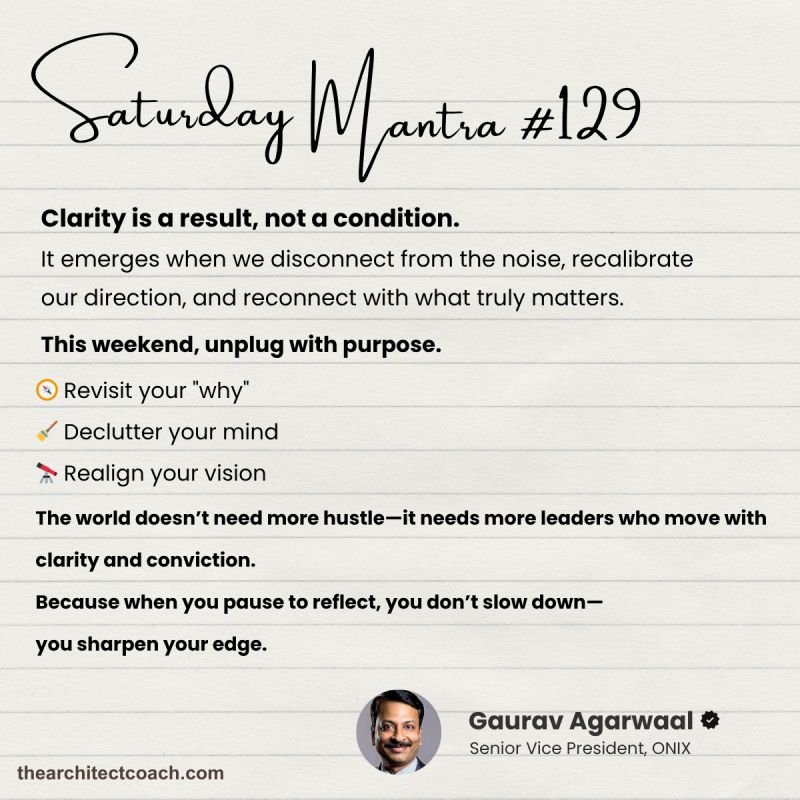
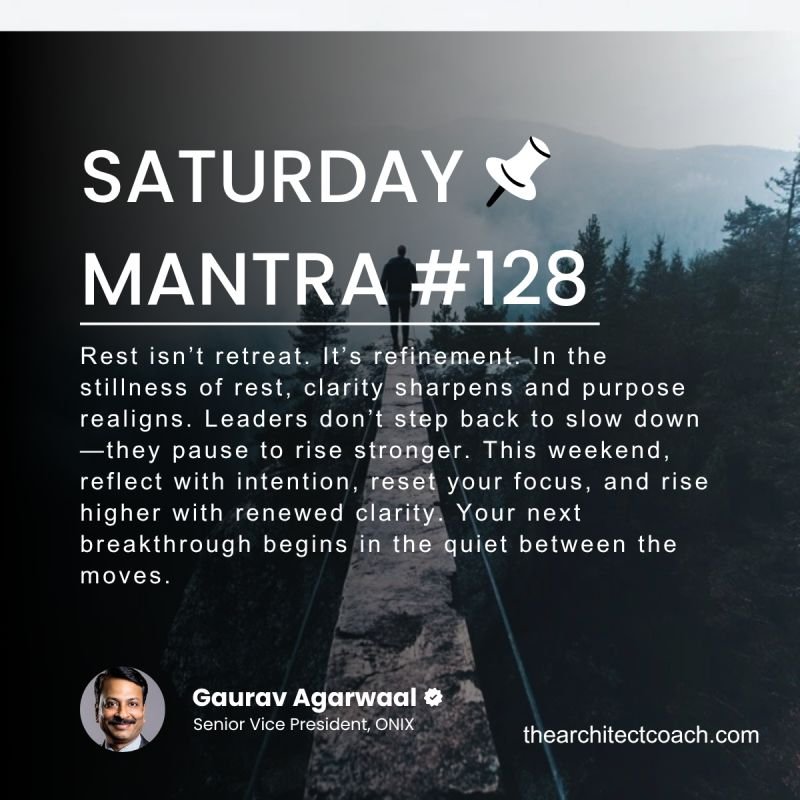
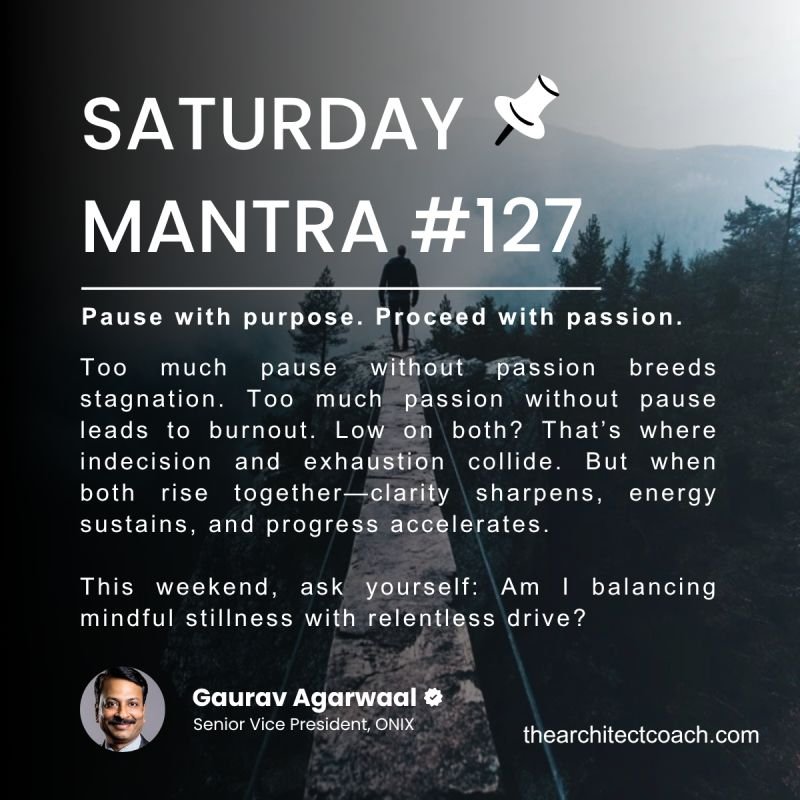
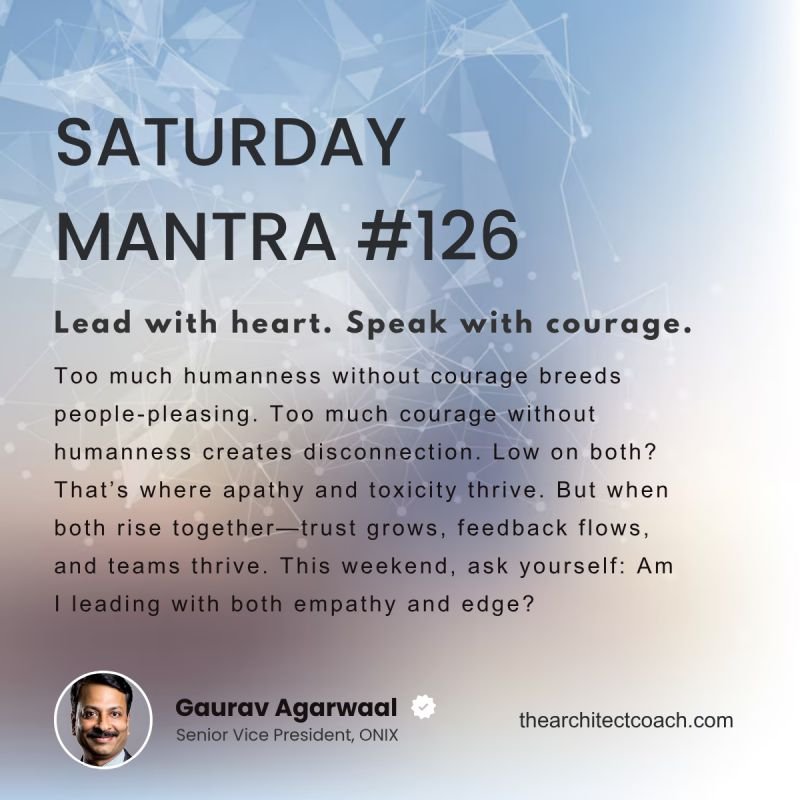











- Your edge isn’t urgency. It’s clarity.
- The courage to pause. The patience to reflect.
- The wisdom to reframe.
- Transformation doesn’t begin with knee jerk reaction.
- Action without clarity creates noise.
- Precision questioning creates momentum.
Think better. Act slower. Lead deeper. 💬 CTA: What is one question you could ask today that would change how your team understands the problem? When did slowing down help you see something others missed? Let’s build a habit of reflection—together. hashtag#ExecutiveClarity hashtag#SaturdayMantra hashtag#TheArchitectCoach hashtag#GrowthMindset