
Building Leaders for the Age of AI: When Execution Gets Cheap, Leadership Gets Priceless


AI has made execution faster, cheaper, and easier.
Draft the strategy. Summarize the market. Produce the first version of a plan. Generate code, messaging, customer responses. In minutes. Sometimes in seconds.
That reality triggers an uncomfortable question in every organization right now:
If so much work can be automated, does leadership still matter?
It does—more than ever.
Because AI raises the productivity floor, but it also raises the cost of weak leadership. When velocity increases, misalignment multiplies. Small misunderstandings become expensive. Conflicting priorities spread faster. And cultures drift without anyone noticing—until trust breaks, customers feel it, and teams lose momentum.
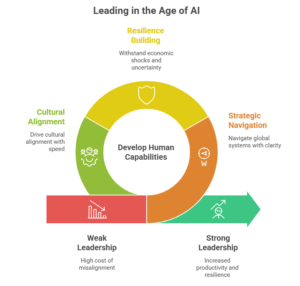
The opportunity is real. But so is the risk. The organizations that win won’t be the ones that simply “use AI.” They’ll be the ones that build leaders who can keep people aligned, decisions coherent, and systems resilient as everything speeds up.
(Based on McKinsey’s “Building leaders in the age of AI.”) https://www.mckinsey.com/capabilities/strategy-and-corporate-finance/our-insights/building-leaders-in-the-age-of-ai?cid=soc-app
The first mistake: thinking AI is the leader
AI can advise. It can suggest. It can simulate scenarios and generate options. It can even take actions inside defined boundaries.
But it cannot own the consequences.
It doesn’t carry accountability when a customer is harmed, when a model is wrong, when a trade-off costs jobs, when a decision invites regulatory scrutiny, or when a crisis tests your reputation. It doesn’t stand in front of a team and say, “This is the path we’re choosing—and here’s why.”
That is leadership.
So the right frame isn’t “AI replaces leaders.” The right frame is:
AI compresses execution. Leadership becomes the differentiator that prevents speed from becoming chaos.
In practice, this means leadership is shifting in three big ways:
- From having answers to framing the right context
- From driving execution to designing systems that move fast safely
- From control to clarity and coherence under pressure
AI makes it possible to do more. Leadership ensures you do the right more—consistently.
What’s changing in the real world of work
In the past, execution was scarce. Information moved slowly. Decisions took time. Leaders could rely on stable plans and incremental improvement.
Now, the opposite is true. Information moves instantly. AI can produce “good enough” work at scale. The bottleneck has moved upstream:
- Are we solving the right problem?
- Are we aligned on what matters?
- Do we trust the data, the assumptions, and the decision-making process?
- Can we adapt without fragmenting?
In an AI-saturated environment, you don’t need leaders who personally generate more outputs. You need leaders who can build an organization that learns faster than it fragments.
Three leadership muscles that become more valuable with AI
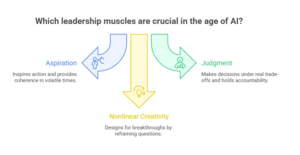
1) Aspiration: direction that creates belief
AI can propose ten plausible strategies. It can write a vision statement that sounds polished.
But people don’t move because the words are polished. People move because the direction feels real—because they believe it matters and that it’s achievable.
Aspiration is not motivational fluff. It’s a stabilizing force. It cuts through noise. It answers:
- What are we doing now that we weren’t doing before?
- What are we not doing anymore, even if it’s tempting?
- What does “good” look like when conditions change?
In fast-moving environments, aspiration prevents teams from becoming a collection of local optimizations. It keeps the organization coherent when the ground shifts.
2) Judgment: decisions under real trade-offs
AI is good at options. It’s not good at owning trade-offs.
Judgment is the ability to decide with incomplete information, to name the trade-offs honestly, and to take accountability when the outcome isn’t perfect. It’s also the ability to decide when not to decide—when the right move is to gather one more critical input or run a controlled experiment rather than forcing certainty.
The hard truth is that AI will increase the number of “reasonable paths.” That doesn’t make leadership easier. It makes it harder, because teams can now argue from endless alternatives.
In this world, judgment isn’t having the smartest answer. It’s choosing a direction people can execute against—and revisiting it quickly when the evidence changes.
3) Nonlinear creativity: designing for 10x, not 10%
AI optimizes from patterns. It tends toward what is probable, familiar, and statistically coherent.
Breakthroughs often come from a different move: reframing the problem, changing the constraints, questioning what everyone assumes must be true.
Nonlinear creativity isn’t “more ideas.” It’s the courage to ask better questions:
- What if we changed the business model, not the feature set?
- What if we redesigned the operating system of the org, not the org chart?
- What if we treated trust, safety, and verification as product features, not overhead?
AI can help you explore the space. Leaders decide which space is worth exploring—and commit resources with conviction.
How to identify and build future-ready leaders
Many leadership systems still overweight signals that mattered in a slower world: pedigree, past titles, polished communication, and linear career progression.
Those are not useless signals—but they’re incomplete.
The leaders you need now show three “intrinsics” in practice:
Resilience — not endurance, but the ability to stay clear, steady, and decisive under pressure. Learnability — speed of updating beliefs based on new evidence. Collaborative intelligence — the ability to align humans and AI systems toward outcomes, without losing trust or accountability.
How do you spot those reliably?
You don’t find them in resumes. You find them in real situations.
Give people scenario-based challenges where information is incomplete and pressure is real. Watch how they:
- ask clarifying questions,
- separate signal from noise,
- communicate trade-offs,
- include stakeholders,
- and decide without pretending certainty.
Then look for a specific behavior: do they learn in public? Do they adapt their view without defensiveness? Do they invite dissent? Do they turn mistakes into system upgrades rather than personal shame?
That is what scales.
The leadership system that makes this real (not a poster)
If you want this to be more than a speech, you need leadership infrastructure—habits and mechanisms that shape behavior consistently.
Start with four moves:
1) Codify what “great leadership” looks like now. Not aspirational values on a wall—operating standards. What do you expect when stakes are high? What gets rewarded under pressure? What decisions require escalation? What does “responsible speed” mean here?
2) Build learning loops, not review rituals. Traditional performance reviews don’t create adaptability. Learning loops do. Make it normal for leaders to share: one decision that didn’t work, one signal they missed, and one change they made to a system—not just to themselves.
3) Invest in trust like it’s infrastructure. Trust is not soft. It’s throughput. It determines whether teams surface risks early, whether people tell the truth, and whether your organization can coordinate at speed. If psychological safety is low, AI will accelerate fear, politics, and silence.
4) Protect energy for inflection points. Busyness is not readiness. Reflection, recovery, and focus are not luxuries—they are capacity. In discontinuous environments, the organizations that think clearly under stress will outperform the ones that merely move faster.
The traps that will quietly derail you
A few patterns look attractive and fail repeatedly:
- Turning “AI leadership” into tool training, instead of decision quality and system design
- Hiring for credentials and hoping character appears later
- Designing for a “normal” world in a post-normal environment
- Celebrating speed without upgrading verification, governance, and accountability
If AI increases velocity, your job is to increase coherence. If you don’t, the organization doesn’t fail loudly at first—it fractures quietly.
Closing thought: the standard is rising, not falling
Leadership starts where control ends.
In a world shaped by AI acceleration, your edge is increasingly human. Not in a sentimental way—in a competitive way.
The winners won’t be the ones who deploy the most models. They’ll be the ones who build leaders who can:
- set aspiration that creates belief,
- exercise judgment under pressure,
- think creatively beyond the obvious,
- and design human–AI systems that move fast without losing trust.
AI will make execution cheaper.
Leadership is what makes the execution worth something.
Leave a Reply