In enterprise technology, the headlines are rarely the real story. The real story is what changes when the ecosystem moves.
Microsoft donating DocumentDB to the Linux Foundation isn’t just about adding another MongoDB alternative to the market. It’s a signal that the industry is finally pushing toward something NoSQL has historically lacked: a vendor-neutral standard for document databases—at a time when modern applications are increasingly document-first and AI-driven.
The timing matters. Since the project’s August 2025 announcement, it has drawn support from an unusually broad coalition: Amazon Web Services, Google, and Microsoft. That kind of multi-cloud alignment doesn’t happen for charity. It happens when customer demand—especially enterprise demand—starts forcing the market toward portability, governance, and reduced lock-in.
There’s also a workload shift embedded in the move. DocumentDB integrates Microsoft Research’s DiskANN vector indexing, making it relevant for enterprise AI patterns like similarity search and retrieval-augmented generation (RAG). This is where the next wave of systems is headed: data platforms that can handle documents and vectors without turning architecture into a patchwork.
In short: this isn’t merely a database announcement. It’s an infrastructure response to how applications—and AI—are evolving.
PostgreSQL Foundation Enables MongoDB Compatibility
The architectural choice behind DocumentDB is pragmatic, and that’s why it has a chance.
Instead of building a new engine from scratch, DocumentDB is implemented as two PostgreSQL extensions that bring document capabilities into PostgreSQL:
- pg_documentdb_core: optimizes BSON parsing and handling for document workloads.
- pg_documentdb_api: implements MongoDB-compatible CRUD, index operations, and query behavior
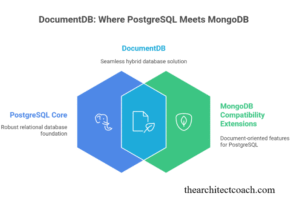
This matters because compatibility isn’t a marketing line—it’s the adoption gateway. If developers can use existing MongoDB drivers and tools, the conversation shifts from “rewrite the application” to “evaluate the platform.”
And PostgreSQL is not a small foundation to build on. It brings decades of operational maturity, reliability, and ecosystem depth. In enterprise terms: a familiar operating model, proven tooling, and a strong talent pool.
DocumentDB also leans into what the market is asking for now: AI-ready retrieval. Through pg_vector, the platform enables vector search inside the same PostgreSQL base—supporting large-scale embedding workloads and enabling semantic retrieval patterns that are becoming core to modern products.
Indexing support is positioned to match real production needs: single-field, compound, multi-key, geospatial, and text indexes. The integration with PostGIS strengthens geospatial use cases, and Decimal128 support addresses precision-sensitive applications where accuracy isn’t optional.
Cloud Provider Convergence Signals Market Shift
If you want to understand the strategic weight of this move, look at who showed up.
AWS already offers Amazon DocumentDB, a managed MongoDB-compatible service. Supporting a Linux Foundation–governed DocumentDB project could look counterintuitive—unless you view it through an enterprise lens: buyers are increasingly pushing back on lock-in, and vendor-neutral standards reduce switching risk.
Google Cloud joining reinforces the same reality. When multiple hyperscalers align behind a governance model, it typically reflects customer pressure: portability and interoperability are becoming expectations, not “nice-to-haves.”
For enterprise leaders, this changes the negotiation posture. Standards shift power. And power shifts matter in multi-year platform decisions.
The Prompt: Get the week’s biggest AI news on the buzziest companies and boldest breakthroughs, in your inbox.
Enterprise AI Applications Drive Adoption Requirements
The enterprise adoption story here isn’t “NoSQL versus SQL.” It’s about what AI applications demand from data infrastructure.
AI workloads are forcing systems to handle:
- unstructured records (conversations, knowledge artifacts, profiles, content), and
- vector retrieval (embeddings, similarity search, semantic context injection),
…often within the same application flow.
DocumentDB’s positioning acknowledges this directly. With pg_vector, the platform is designed to support large-scale vector storage and retrieval with low-latency search—capabilities that matter for production-grade RAG systems, copilots, and knowledge-driven assistants.
The other enterprise-grade differentiator is the PostgreSQL foundation itself. PostgreSQL’s ACID compliance brings transactional guarantees that many teams still need—especially when AI features sit inside business-critical workflows. As organizations build more agentic systems (where software takes action, not just suggests), consistency, auditability, and reliability become non-negotiable.
Standardization Challenges And Implementation Realities
Standards are easy to announce and hard to earn.
MongoDB has a deep feature surface area—especially in enterprise-grade capabilities such as aggregation pipelines, change streams, and sharding. DocumentDB today is focused on core compatibility and foundational operations. For some organizations, that will be enough. For others—particularly those running complex MongoDB-native patterns—it may delay adoption until parity matures.
There’s also an inevitable product-positioning question: how does open-source DocumentDB relate to Microsoft’s managed database portfolio, especially Azure Cosmos DB? Enterprises will want clarity on where each fits, and how innovation and support paths evolve across the open-source project and commercial services.
And then there’s performance—where migrations succeed or fail. DocumentDB and MongoDB sit on different engines and optimization models. Compatibility doesn’t automatically equal identical behavior under load. Serious evaluation must include workload-specific testing: query patterns, indexing behavior, throughput, latency, and operational characteristics.
Strategic Implications For Technology Decision Makers
The most important takeaway isn’t “a new database exists.” It’s what this could unlock if the ecosystem follows through.
A Linux Foundation–governed DocumentDB can reduce lock-in risk while still allowing cloud providers to offer managed services. In practical enterprise terms, it expands choices: deploy across clouds, hybrid environments, or on-premises without being trapped in a single proprietary layer.
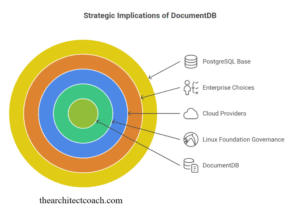
The PostgreSQL base changes the operating model as well:
- a mature ecosystem of extensions and tooling,
- a larger availability of talent, and
- a potentially lower cost of ownership compared to niche stacks.
The near-term move for most enterprises is clear: treat DocumentDB as a serious option for new initiatives that require document and vector capabilities—especially where portability matters—while watching maturity for advanced MongoDB feature parity before attempting large-scale migrations.
In the boardroom, this is what leaders should ask: Are we choosing a database—or are we choosing a dependency model for the next decade?
Views: 1.3K