
From FDE to FDIE — The Real-World Backbone of Enterprise AI


A CIO asked me recently: “Why is everyone suddenly talking about Forward Deployed Engineers? We already have Cloud Solution Architects, Customer Success teams, and AI Architects… what’s missing?”
To answer that, I had to go back to 2008.
When Cloud Needed a New Kind of Role
In 2008, I was part of the early team that helped define what eventually became the Cloud Solution Architect (CSA) role. Back then, cloud felt risky, misunderstood, and a bit intimidating. CSA changed that. It became the foundation for how enterprises adopted cloud for more than a decade.
We’re at a similar moment again — except this time the transition is bigger, faster, and more unforgiving.
The reality is this:
We design systems one way, but they behave very differently in the wild.
Palantir recognized this long before the rest of the industry caught up. Their answer: the Forward Deployed Engineer (FDE) — someone who doesn’t just understand the system, but steps inside the actual workflow, the actual constraints, the actual business environment.
FDEs don’t deal with possibilities. They deal with truth.
And that’s what enterprises suddenly realize they’ve been missing.
Why FDE Is Not Just “Another Role”
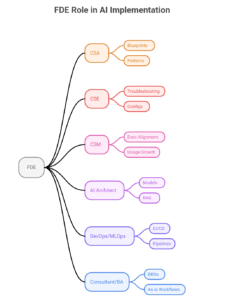
Here’s the richer, more honest version of the comparison:
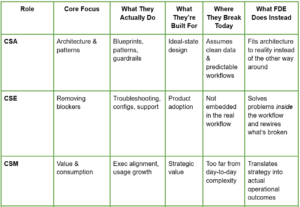
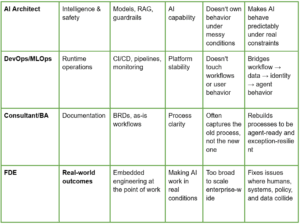
Most roles operate in the designed world. The FDE operates in the real world.
And enterprises are realizing very quickly that real-world is where impact happens.
If I Had to Explain FDE to a 10-Year-Old
If cloud was about design, AI is about survival in real conditions.
- A CSA writes the script.
- The AI Architect creates the special effects.
- The CSM gets the audience into the theater.
- The CSE fixes the projector when it blinks.
But the FDE? They’re on the movie set — adjusting for weather, fixing lighting, rewriting lines when the story doesn’t fit the scene. They deal with whatever the real world throws at the production.
That’s FDE. They make sure the story can actually be filmed.
Why FDE Matters So Much in the AI Era
AI doesn’t break in code. AI breaks in:
- messy exception paths
- human judgement calls
- identity rules
- policy boundaries
- legacy systems
- inconsistent data
- agent drift
- trust gaps
- unpredictable real-world environments
FDEs work directly inside that complexity. They make AI survive reality.
But here’s the shift: As AI evolves, the demands on the FDE role are starting to outgrow what one person can reasonably own.
The Next 3 Years Will Demand More Than FDE
We’re moving into a world of:
- agentic workflows
- autonomous processes
- human + AI co-working
- continuous orchestration
- identity-driven execution
- dynamic safety boundaries
- telemetry-driven learning loops
A single FDE cannot carry all of that.
We need a discipline, not a hero. A system, not a skillset.
That’s where the next chapter begins.
FDIE — Forward Deployed Intelligence Engineering
My proposed discipline for the AI decade
If CSA defined the cloud era, FDIE will define the AI era.
FDIE is the evolution of FDE — a formal discipline designed for a world where intelligence isn’t a feature… it’s a living part of the workflow.
FDIE is built on one belief:
AI doesn’t fail in theory. AI fails in the field. So engineering has to start in the field.
FDIE is not something that exists widely today. This is my view of what enterprises must build next.
Why We Need FDIE (The Gaps We Must Solve Next)
Here’s what AI is exposing inside every enterprise:
1 | Most workflows aren’t ready for agents
Lots of ambiguity, Tribal knowledge. Hidden exceptions.
2 | Agents drift
Their behavior changes with context, data, or time.
3 | Identity and policy often block automation
Systems were designed for human access, not agent access.
4 | People and AI don’t yet co-work smoothly
Trust and predictability are missing.
5 | Legacy coexistence is harder than it looks
AI doesn’t replace systems — it weaves through them.
6 | Reliability breaks under stress
Spiky demand, edge cases, and unexpected inputs reveal cracks.
7 | Adoption is emotional
People hesitate when systems feel unpredictable.
8 | The field rarely informs the platform
The feedback loop is slow or nonexistent.
FDIE is my proposed model for closing these gaps in a structured, sustainable way.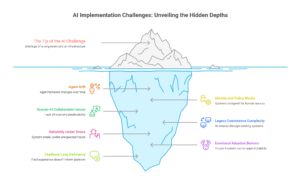
The Full FDIE Model — The Four Personas
FDIE brings four specialized personas together to create a real execution backbone:
1. FDIE–W — Workflow Intelligence Engineer
Redesigns workflows to be agent-ready, measurable, safe, and resilient.
2. FDIE–A — Agent Orchestration Engineer
Manages agent behavior, drift, escalation, conflict resolution, and reliability.
3. FDIE–X — Human–AI Experience Engineer
Designs clear, trustworthy, predictable interactions between humans and AI.
4. FDIE–R — Integration & Reliability Engineer
Owns the hard reality: identity, infra, data pipelines, integration, and production reliability.
Together, these four personas form the Forward Deployed Intelligence Engineering Unit — the discipline that can carry enterprise AI from “prototype” to “institutional capability.”
FDE → FDIE Is the Natural Evolution
Here’s the simplest way to describe the transition:
FDE makes AI work today. FDIE will make AI scale tomorrow.
FDE solved the last mile. FDIE will scale the enterprise.
This isn’t a new title. It’s a new way of organizing work for the AI era.
By 2027, CIOs won’t ask: “How many AI projects do we have?”
They’ll ask:
“Where is FDIE embedded in our core workflows, and what outcomes is it driving?”
That’s the real shift.
My Final View
FDE is essential for today. FDIE is essential for where we’re going.
If CSA defined the cloud decade, FDIE will define the AI decade.
This is the operating system for modern, agentic enterprises — built on real-world truth, grounded in human behavior, and designed for scale.
From FDE to FDIE — The Backbone of Enterprise AI
A CIO recently asked me: “Why is everyone talking about Forward Deployed Engineers? We already have CSAs, CSMs, and AI Architects—what’s missing?”
The answer is simple: AI fails in the real world, not in design docs.
Back in 2008, the Cloud Solution Architect became the role that made cloud adoption possible. Today, AI needs its own real-world counterpart: the Forward Deployed Engineer (FDE) — the person embedded inside actual workflows, navigating human judgment, messy exceptions, identity rules, legacy systems, and agent drift.
But AI environments are now too complex for a single FDE to carry alone. We’re entering a world of autonomous workflows, human + AI co-working, dynamic safety, and continuous orchestration.
That’s why I believe the next decade will be defined by FDIE — Forward Deployed Intelligence Engineering.
FDIE brings four roles together:
- FDIE–W: Workflow Intelligence
- FDIE–A: Agent Orchestration
- FDIE–X: Human–AI Experience
- FDIE–R: Integration & Reliability
If CSA defined the cloud era, FDIE will define the AI era — taking AI from “prototype” to institutional capability.
FDE makes AI work today. FDIE will make it scale tomorrow.
Leave a Reply